










Midwest granite blocks supplied 96% of FY23-FY26 revenue
Key highlights
- Granite blocks accounted for 96% of Midwest revenue across FY23-FY26.
- Midwest revenue from operations increased from Rs 502.52 crore in FY23 to Rs 645.62 crore in FY26.
- Black Galaxy sales rose from 50,245 cubic metres in FY23 to 72,789 cubic metres in FY26.
- Diamond wire represented 2% of FY23-FY26 revenue despite FY26 sales of 268,611 metres.
powered by IRIS
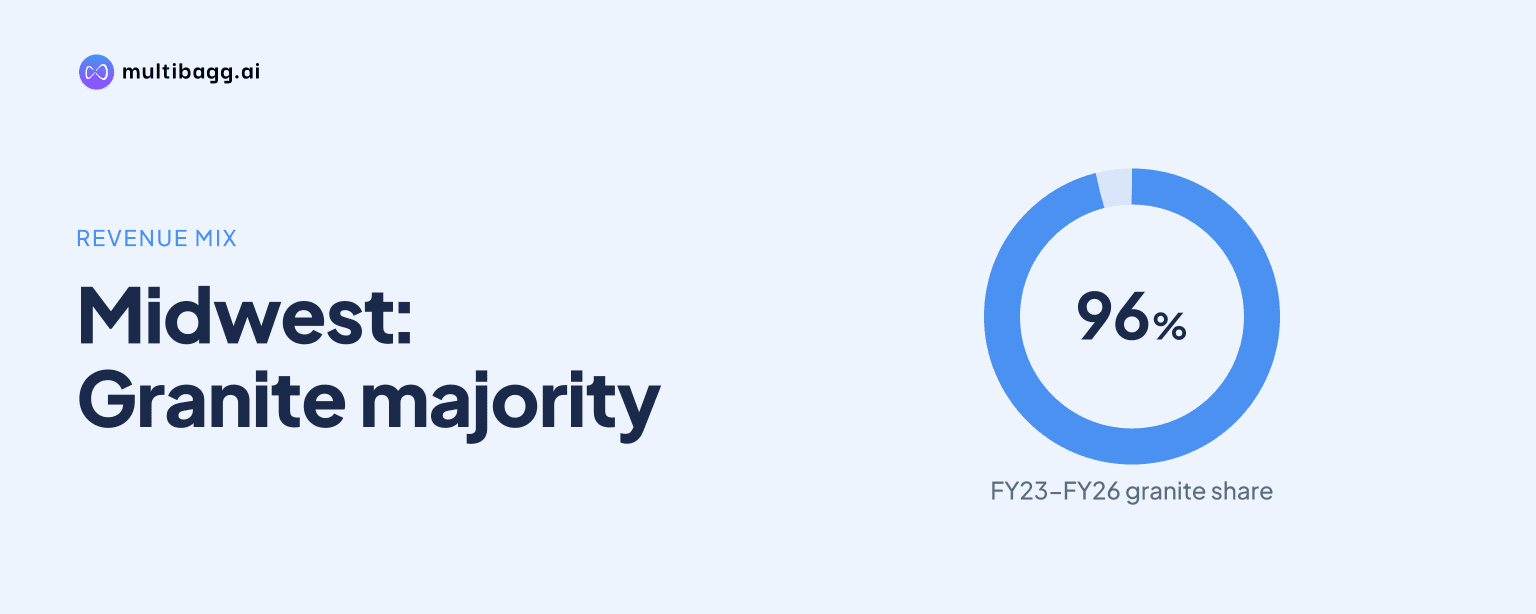
Midwest Limited generated 96% of revenue from granite blocks over FY23-FY26, with Black Galaxy granite and Absolute Black its principal products; diamond wire and other businesses each contributed 2%. The concentration persisted while revenue from operations rose from Rs 502.52 crore in FY23 to Rs 645.62 crore in FY26.
Know Midwest inside out
Results, valuation, peers and who's buying, in one view.
How concentrated was Midwest's revenue between FY23 and FY26?
Midwest's revenue was concentrated in granite blocks, which accounted for 96% over FY23-FY26, while diamond wire and other businesses represented 2% each. The presentation identifies Black Galaxy granite and Absolute Black as the key products in the primary granite-block business, but it does not disclose annual revenue by product or a separate FY26 revenue mix.
Consolidated revenue from operations increased in every reported full year, rising by Rs 143.10 crore from FY23 to FY26. H1FY27 revenue from operations was Rs 374.38 crore, although the presentation does not provide a product or segment split for that six-month period.
Earnings before interest, tax, depreciation and amortisation, or EBITDA, rose from Rs 89.59 crore in FY23 to Rs 174.37 crore in FY26, as the EBITDA margin increased from 17.83% to 27.01%. Midwest does not attribute the margin change to either granite variety, diamond wire, pricing or a specified cost factor.
How did Midwest's granite volumes change?
Black Galaxy was Midwest's expanding granite product, with production rising from 51,672 cubic metres in FY23 to 75,988 cubic metres in FY26 and sales rising from 50,245 cubic metres to 72,789 cubic metres. Production increased in each intervening full year, reaching 57,519 cubic metres in FY24 and 66,548 cubic metres in FY25.
Absolute Black followed a different pattern: production declined from 42,820 cubic metres in FY23 to 39,758 cubic metres in FY26, after reaching 38,120 cubic metres in FY25. Its sales were 41,630 cubic metres in FY23, increased to 42,166 cubic metres in FY25, and then declined to 39,684 cubic metres in FY26.
In H1FY27, Midwest produced 40,073 cubic metres of Black Galaxy and sold 39,563 cubic metres, while it produced 20,397 cubic metres of Absolute Black and sold 20,671 cubic metres. These are partial-period data and do not establish whether FY26 full-year volumes will be exceeded in FY27.
What changed between Black Galaxy and Absolute Black sales?
Black Galaxy sales increased by 22,544 cubic metres between FY23 and FY26, whereas Absolute Black sales decreased by 1,946 cubic metres. The production comparison moved in the same direction: Black Galaxy output increased by 24,316 cubic metres, while Absolute Black output was 3,062 cubic metres lower in FY26 than in FY23.
The difference between Black Galaxy production and sales was 1,427 cubic metres in FY23 and 3,199 cubic metres in FY26, based on Midwest's separate disclosures. The presentation does not provide inventory balances, realised prices, mine capacity or product-level revenue, so the disclosed volume shift cannot establish either granite variety's individual financial contribution.
Both products remain within the granite-block business that produced 96% of Midwest revenue across FY23-FY26. The source provides no explanation for the change in Absolute Black production or sales, and it does not state whether the differing volume trends altered the mix of granite-block revenue.
Got a follow-up? Ask IRIS
Is diamond wire becoming a larger Midwest business?
Diamond wire grew substantially in physical volume, but it remained a 2% revenue segment across FY23-FY26. Production increased from 105,928 metres in FY23 to 263,615 metres in FY26, while sales increased from 104,141 metres to 268,611 metres.
The growth was uneven across the period. Diamond-wire sales fell to 93,015 metres in FY24 from 104,141 metres in FY23, then increased to 166,137 metres in FY25 and 268,611 metres in FY26; production rose from 106,366 metres in FY24 to 157,544 metres in FY25 and 263,615 metres in FY26.
In H1FY27, Midwest produced 103,470 metres of diamond wire and sold 87,969 metres. FY26 sales exceeded production by 4,996 metres, while H1FY27 production exceeded sales by 15,501 metres; the presentation does not disclose diamond-wire pricing, inventory, profitability or annual revenue.
What new businesses does Midwest plan to develop?
Midwest's vision for the next three to four years includes new verticals in Rare Earth Materials and Heavy Mineral Sands, along with High Purity Quartz, or HPQ. The plan also identifies Rs 300 crore of capital expenditure, 2.5 times or more revenue growth and three times or more profitability growth, but the presentation does not state that these verticals generated revenue in FY23-FY26.
The stated vision includes a 35% return on capital employed, or ROCE, and a 15% to 20% reduction in energy consumption to reduce the carbon footprint. Reported ROCE was 16.25% in FY23, 25.00% in FY24, 19.42% in FY25 and 12.64% in FY26, leaving the FY26 result below the 35% vision target.
Cash flow from operations changed from negative Rs 51.946 crore in FY23 to Rs 174.72 crore in FY26, while the working-capital cycle moved from 106 days to 104 days. In H1FY27, cash flow from operations was negative Rs 6.73 crore and the working-capital cycle was 127 days; Midwest attributes FY23-FY26 financial progress to its credit policy and customer payment terms.
Conclusion
Midwest's reported growth through FY26 remained rooted in granite blocks rather than its smaller businesses. Black Galaxy's higher production and sales volumes contrasted with lower Absolute Black volumes, while diamond wire's substantial growth in metres did not change its disclosed 2% share of FY23-FY26 revenue.
The next issue is execution of Midwest's three-to-four-year plan, including Rs 300 crore of capital expenditure, Rare Earth Materials and Heavy Mineral Sands, and HPQ. The presentation leaves unresolved the timing, funding allocation, revenue contribution and profitability of these verticals, as well as whether they will reduce reliance on granite blocks.