










Midwest plans 606,600 MTPA ultra-high-purity quartz capacity
Key highlights
- Midwest commissioned 303,600 MTPA of quartz processing capacity in September 2025.
- Midwest plans to double quartz processing capacity to 606,600 MTPA for Ultra-High-Purity Quartz.
- Solar-glass quartz demand is projected to reach 1,840-2,000 KT by FY30, growing at a 30.7-31.4% CAGR.
- Midwest plans 500,000 tonnes of solar-glass quartz-grit capacity, estimated at 11-13% of FY30 demand.
powered by IRIS
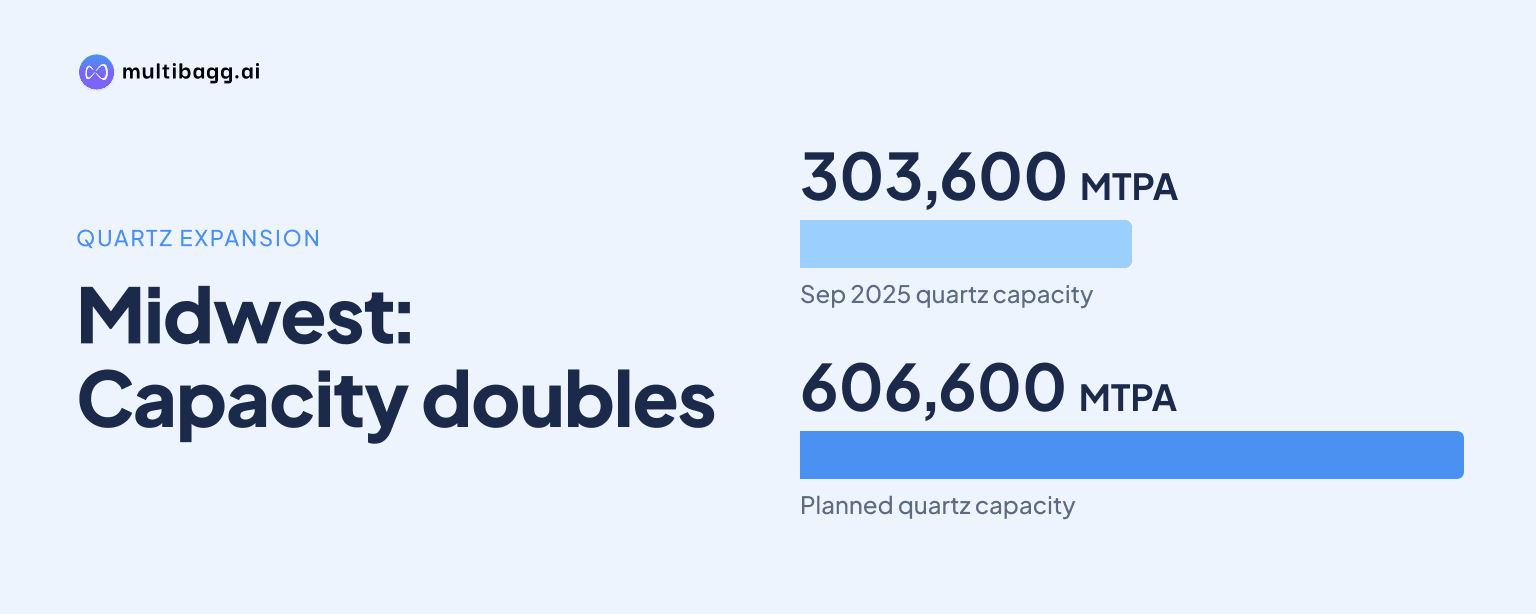
Midwest Limited commissioned a 303,600 metric-tonnes-per-annum (MTPA) quartz processing plant in September 2025 and plans to double capacity to 606,600 MTPA for Ultra-High-Purity Quartz, as solar-glass quartz demand is projected to reach 1,840-2,000 kilo tonnes (KT) by FY30. The expansion places Midwest’s quartz business alongside its established granite operations.
Know Midwest inside out
Results, valuation, peers and who's buying, in one view.
What quartz capacity has Midwest commissioned and planned?
Midwest commissioned Phase I of its 303,600 MTPA quartz processing plant in September 2025 and states that it plans to double capacity to 606,600 MTPA. The plant serves solar-glass and engineered-stone sectors in domestic and export markets, while the planned larger capacity is specified for Ultra-High-Purity Quartz.
The presentation identifies Midwest as India’s largest integrated quartz processor, but it does not state a commissioning date for the additional capacity. It also separately says Midwest plans to add 0.5 million tonnes of quartz-grit capacity for solar glass, equivalent to 500,000 tonnes, and estimates that this would meet 11-13% of FY30 solar-glass quartz demand. The presentation does not explain how that stated grit addition relates to the 606,600 MTPA processing-capacity plan.
The distinction between the current Phase I asset and the proposed capacity matters because Midwest has already moved from a stated plan to an operating facility. September 2025 is the disclosed commissioning event for 303,600 MTPA, whereas 606,600 MTPA remains a capacity objective. No investment amount, construction schedule or phase-by-phase output mix for the quartz expansion is given on the supplied page.
Why is Midwest expanding quartz processing for solar glass?
Midwest is expanding because the presentation expects quartz demand for solar glass to grow at a compound annual growth rate (CAGR) of 30.7-31.4% and reach 1,840-2,000 KT by FY30. Solar glass is therefore the fastest quantified demand driver on the page, compared with total domestic quartz demand growth of 11-12% annually from FY25 to FY30P.
Domestic quartz demand is projected to increase from 3,732 KT in FY25 to 6,166-6,516 KT in FY30P. Within that total, solar’s share is forecast to rise from 16% in FY25 to 30-32% in FY30P, while the share classified as other uses declines from 84% to 68-70%. The figures show that solar is expected to account for a larger part of a substantially bigger domestic market.
India currently imports 65% of its solar-glass requirements, according to the presentation. Midwest cites an expectation that domestic solar-glass supply will rise to 70-80% by FY2030, a shift that provides the stated context for processing quartz grit for the solar-glass supply chain. The presentation gives an average realisation for solar-grade grit of Rs 6,300-6,500 per tonne.
Got a follow-up? Ask IRIS
What do quartz export opportunity figures show for Midwest?
The quartz export opportunity data show a sharp FY24 increase in quartz-lump value followed by a FY25 decline, while quartz-powder value rose in each of the two years. Quartz-lump export opportunity was valued at Rs 585 crore in FY23, Rs 1,941.1 crore in FY24 and Rs 654.1 crore in FY25; powder export opportunity was Rs 247.2 crore, Rs 257.2 crore and Rs 279 crore, respectively.
Export opportunity volumes changed differently across the two product forms. Quartz-lump volumes rose from 691 KT in FY23 to 1,076 KT in FY24 before falling to 573 KT in FY25, while quartz-powder volumes increased from 248 KT to 302 KT and then 344 KT. The presentation derives these figures from total market size and the respective component shares disclosed in its red herring prospectus data.
Engineered stone is the other named market for Midwest’s plant. The presentation shows India’s engineered quartz stone market at USD 3,643 million in FY22 and USD 7,355 million in FY32P. It also notes that global demand for engineered quartz slabs has supported exports, naming China, India and Turkey as the top exporters, but it does not provide Midwest-specific engineered-stone sales or market-share figures.
What products can Midwest make from its quartz processing platform?
Midwest identifies quartz grit and quartz grit powder as products from its quartz platform, with solar glass and engineered stone as the served end markets. For the higher-purity plan, the presentation says ultra-high-purity quartz powder is a precursor used to make crucibles, optical glass and semiconductors.
The 606,600 MTPA target is thus presented as a processing-capacity ambition for Ultra-High-Purity Quartz rather than as a disclosed sales forecast for any one end product. Midwest gives a specific solar-grade-grit realisation range of Rs 6,300-6,500 per tonne, but it does not disclose comparable prices for engineered-stone-grade material, ultra-high-purity powder, crucibles, optical glass or semiconductor uses.
Midwest has established a quartz laboratory at the APIIC Growth Center in Prakasam, Andhra Pradesh. The laboratory can assess quartz samples from mines and identify attributes needed for processing and market specifications, including engineered stone and solar glass; Midwest says this helps it understand raw-material quality, set process parameters and determine yields without relying on third-party facilities.
The processing plan also sits within Midwest’s stated innovation programme. Its dedicated research and development and exploration team has eight members, comprising six geologists, one quality-control specialist and one chemist, with an average 16.10 years of industry experience. The presentation says this work focuses on Black Galaxy Granite, Absolute Black Granite and quartz, including identifying mineral-bearing areas through satellite imagery and geological and geophysical reports.
Conclusion
Midwest’s disclosed quartz strategy combines an operating 303,600 MTPA plant with a plan to reach 606,600 MTPA in Ultra-High-Purity Quartz. The commercial rationale in the presentation is the projected expansion of domestic quartz demand to 6,166-6,516 KT by FY30P, led by solar glass, whose demand is projected at 1,840-2,000 KT and whose share of domestic quartz demand is expected to reach 30-32%.
The next point to watch is execution detail on the second capacity step, including timing, capital allocation and product mix, none of which is specified for the 606,600 MTPA target. Midwest’s wider vision for the next three to four years includes Rs 300 crore of capital expenditure, new High Purity Quartz and rare-earth-material verticals, 2.5-times-plus revenue growth and three-times-plus profitability growth, but the presentation does not allocate that capex among these plans.