










Midwest Ltd Reports 24% H1 Revenue Growth, Cash Flow Turns Negative
Key highlights
- Midwest Ltd’s consolidated H1 FY27 revenue rose 24.4% year-on-year to ₹374.4 crore.
- Midwest Ltd’s H1 FY27 profit after tax increased 17.7% to ₹61.3 crore.
- Q2 FY27 revenue was ₹182.5 crore and net profit was ₹30.2 crore, up 15.0% and 9.0% year-on-year respectively.
- Midwest Ltd expects around ₹90 crore of quartz revenue in FY27 after quartz reached about 16,000 tonnes in Q2.
powered by IRIS
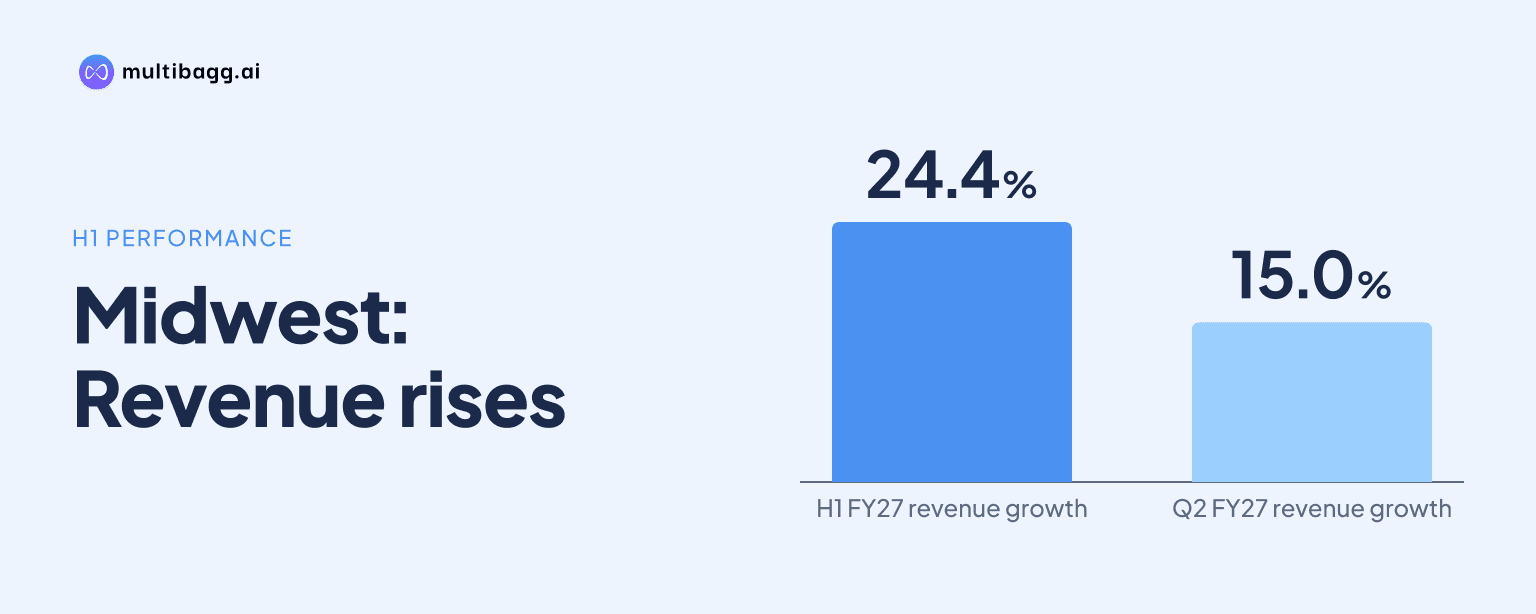
Midwest Ltd reported consolidated H1 FY27 revenue growth of 24.4% to ₹374.4 crore and profit after tax growth of 17.7% to ₹61.3 crore, but operating cash flow turned negative as receivables and inventory increased and some payments were made early.
Know Midwest inside out
Results, valuation, peers and who's buying, in one view.
What did Midwest Ltd report for Q2 and H1 FY27?
Midwest Ltd reported revenue from operations of ₹182.5 crore for Q2 FY27, up 15.0% year-on-year, while net profit rose 9.0% to ₹30.2 crore. The company reported an EBITDA margin of 26.10% for the quarter. Management also indicated that Q2 revenue grew by about 5% sequentially.
For the first half of FY27, Midwest reported consolidated revenue of ₹374.4 crore, a 24.4% increase from the corresponding period a year earlier. Consolidated profit after tax rose 17.7% to ₹61.3 crore. The half-year performance reflects growth across the company’s established granite operations and an increasing contribution from its quartz business.
The Q2 and H1 FY27 earnings call was held on November 11, 2026. The call was attended by promoter and whole-time director and chief executive officer Ram Kollareddy, promoter and whole-time director Uma Kollareddy, and chief financial officer Dilip Kumar.
Why did operating cash flow turn negative in H1 FY27?
Operating cash flow turned negative during H1 FY27 because Midwest increased receivables and built inventory, while also making certain payments early, according to the earnings-call summary. The development came despite the company reporting higher revenue and profit for the half year.
Receivables represent money due from customers, while inventory growth can absorb cash before finished goods are sold and collections are received. These working-capital movements can cause cash flow to differ materially from reported profit in a given period. Midwest’s explanation focused on the timing of these items rather than a decline in reported earnings.
Management’s comments on the issue were described as defensive in the call summary. For investors, the key distinction is that profit growth was accompanied by cash absorption from working capital. The available information does not provide the absolute amount of negative operating cash flow or a detailed receivables ageing profile.
How is Midwest Ltd’s quartz business progressing?
Midwest’s quartz business reached about 16,000 tonnes in Q2 FY27 and remained in the ramp-up stage. Management said quartz had turned EBITDA-positive, and the H1 EBITDA margin for the segment was about 12%, with a Q2 one-off factor also supporting the result.
The company indicated comfort with around ₹90 crore of quartz revenue in FY27. Quartz demand was described as being anchored by one large domestic customer, while export plans were deferred. This means the segment’s near-term demand visibility is tied substantially to domestic business rather than a broad international customer base.
Midwest also referred to export opportunities in Thailand, Vietnam and Europe as part of its approach to potential tariff risks involving India and China in the US market. The company did not provide revenue figures from these destinations or a timetable for the proposed export expansion.
Got a follow-up? Ask IRIS
What are Midwest Ltd’s cost-saving and investment plans?
Midwest expects annual savings of about ₹4 crore to ₹5 crore from electric trucks and renewable-energy initiatives. These measures form part of management’s stated effort to lower operating costs as business volumes expand.
Management also outlined longer-term ambitions connected with around ₹300 crore of capital expenditure. The call summary referred to an objective of 2.5 times revenue, three times profit and 35% return on capital employed over three to four years. These are management targets and not reported financial results.
The company separately referred to a FY27 revenue target of ₹840 crore, which implies growth of roughly 30% from the cited base. Since H1 revenue rose 24.4%, the second half will be relevant in assessing progress towards that target. Management expressed confidence in its broader targets during the call.
What does the update mean for investors and operations?
The results show that Midwest maintained double-digit revenue growth and higher profit in both Q2 and H1 FY27. Granite remained an important earnings contributor, with the H1 margin for that business stated at about 18%, while quartz added a new earnings stream after becoming EBITDA-positive.
However, the negative operating cash flow adds a working-capital issue for investors to track alongside profit growth. Sustained expansion in receivables or inventory can affect liquidity and the funding needs of a growing business, particularly when the company is pursuing capital expenditure plans.
The call summary also noted that a matter involving KMML had stalled during a transition in the Kerala government. The information provided does not specify the financial effect, expected resolution date or operational consequences of that development.
Conclusion
Midwest delivered stronger H1 FY27 revenue and profit, supported by growth in its core operations and progress in quartz. At the same time, the mismatch between reported profit and operating cash flow makes working-capital management an important part of the company’s financial picture.
Investors will watch whether Midwest advances towards its stated FY27 revenue target of ₹840 crore, delivers the expected ₹90 crore of quartz revenue, and converts receivables and inventory into cash. Updates on quartz exports, the planned cost savings and the stalled KMML matter will also provide further context for the company’s execution.