










Millworks H1 loss follows deferred defence revenue timing
Key highlights
- Millworks reported a Rs 1.83 crore loss in H1 FY27, versus a Rs 12.48 crore profit in H1 FY26.
- H1 FY27 total income was Rs 18.11 crore, down from Rs 45.77 crore in H1 FY26.
- Millworks disclosed a Rs 230 crore order book in November 2026, including a Rs 111 crore Israeli defence-sector export order.
- Millworks had installed 27 of 52 new machines by H1 FY27.
powered by IRIS
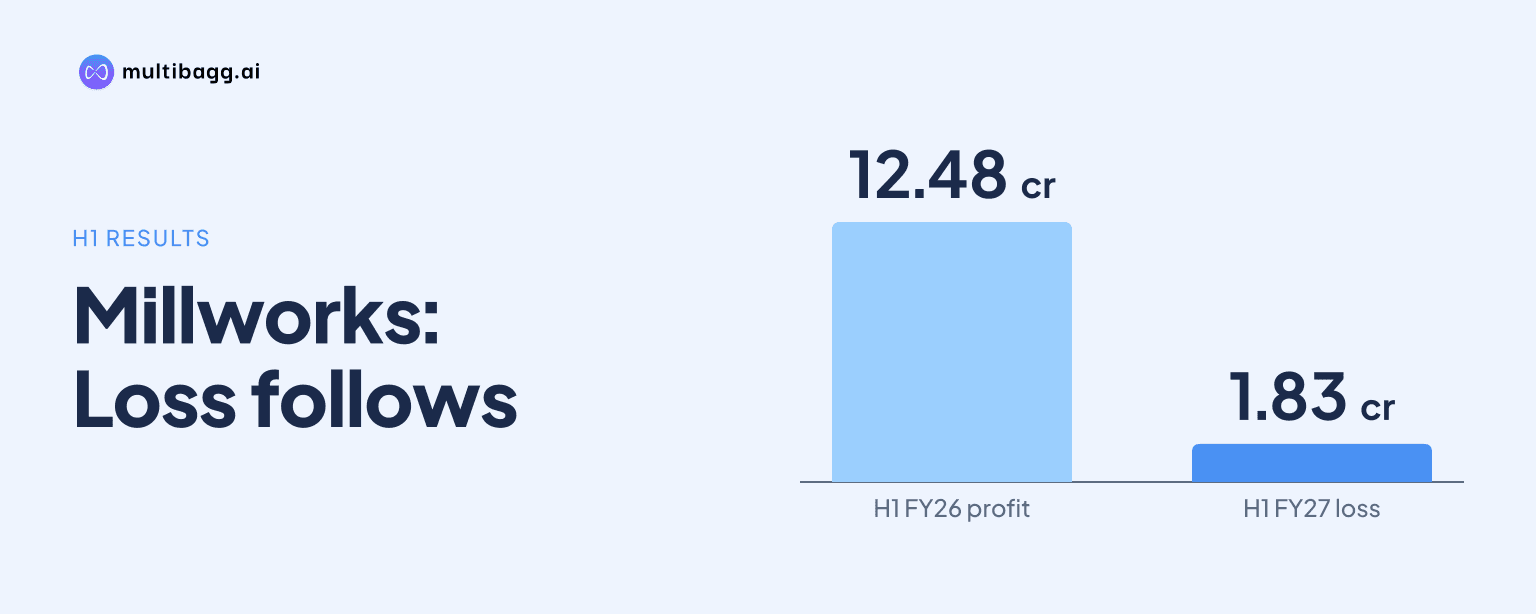
Millworks Technologies Limited reported a Rs 1.83 crore loss in H1 FY27, versus a Rs 12.48 crore profit in H1 FY26, after total income fell to Rs 18.11 crore; management said deferred defence-related revenue recognition, approval delays, higher raw-material prices and pre-capacity manpower costs affected the half.
Know Millworks Technologies inside out
Results, valuation, peers and who's buying, in one view.
Why did Millworks report an H1 FY27 loss?
Millworks reported the H1 FY27 loss because revenue from some executed and deferred orders was not recognised within the half, while raw-material and manpower costs increased. Managing Director Sridhar Acharya said a substantial portion of orders executed in September was recorded as revenue in October, placing it in H2 FY27 rather than H1 FY27.
Management also said certain orders moved into H2 FY27 because customer and regulatory approvals took longer than anticipated. Customer collections depend on the testing and approval process of the customers' defence customer, and management expects these amounts to be received in Q3 FY27 once approvals are in place.
Higher raw-material prices linked by management to the geopolitical environment added to the pressure in H1 FY27. Millworks also increased manpower ahead of new capacity, and management described the additional staffing as part of its growth investment rather than a change in demand conditions.
The reported loss followed FY26 revenue of Rs 148.77 crore, although the annual FY26 result and six-month H1 FY27 result are not directly comparable periods. The presentation characterises the first half as typically weaker for Millworks and says the business is generally weighted toward the second half of the financial year.
How did Millworks' H1 FY27 results compare with H1 FY26?
Millworks' H1 FY27 total income fell by Rs 27.66 crore year on year, while earnings before interest, tax, depreciation and amortisation (EBITDA) fell by Rs 18.84 crore and profit after tax changed from a Rs 12.48 crore profit to a Rs 1.83 crore loss. Earnings per share also moved to a loss of Rs 1.24 from earnings of Rs 10.38 in H1 FY26.
The decline in EBITDA was greater than the decline in total income during the half. Management specifically identified higher input prices and recruitment for new capacity as costs that weighed on H1 FY27 margins.
The H1 FY27 outcome was Millworks' first reporting period after its 21 July 2026 BSE SME listing. The company raised Rs 160.34 crore through a fresh issue at Rs 331 per share, and management said its stronger balance sheet backed capacity expansion at Unit 4.
Got a follow-up? Ask IRIS
What does Millworks' order book say about future revenue?
Millworks reported a Rs 230 crore order book in November 2026, equal to 1.55 times FY26 revenue of Rs 148.77 crore, and management cited it as support for its expectation of a considerably stronger H2 FY27. The order book included a Rs 111 crore export order from the Israeli defence sector announced in November.
The company had earlier announced Rs 53.74 crore of new orders on 20 August, when its confirmed order book stood at Rs 121.88 crore. The subsequent Rs 230 crore figure represents an increase of Rs 108.12 crore from that August disclosed order-book level, although the presentation does not provide a full order-by-order conversion timetable.
Defence is a key component of the pipeline described by management. In October 2026, Millworks received developmental orders from an Indian defence public-sector undertaking and signed a memorandum of understanding with TridenTech covering unmanned aerial vehicle integrated-combustion engines.
The order book does not establish when revenue will be recognised, because the presentation identifies regulatory and customer approval processes as factors that can defer recognition and collection. The September-to-October revenue shift is a disclosed example of how execution timing and revenue recognition can fall in different reporting periods.
What capacity and capability changes is Millworks making?
Millworks had installed 27 of 52 new machines by H1 FY27 and had begun capacity expansion at Unit 4 after the July 2026 listing. Management expects utilisation of this additional capacity, together with recognition of deferred revenue, to support a margin recovery.
The company operated four manufacturing units covering 76,500 square feet as of FY26, with 383,019 installed machine hours including springs capacity. It reported approximately 75% machining utilisation in FY26, while the new-machine programme was under way during H1 FY27.
Millworks also established a Markforged Centre of Excellence in October 2026 with seven machines. The initiative sits alongside its precision-manufacturing chain, which includes computer numerical control machining, sheet-metal work, assembly and inspection, and management said these steps reinforce its aerospace and defence presence.
The company served 74 customers in FY26, including 33 repeat customers, and exports accounted for 27.47% of FY26 revenue. Its order model was approximately 70% build-to-print, where customers provide drawings and specifications, and approximately 30% build-to-spec, where Millworks engineers a solution to a customer-defined function.
Conclusion
Millworks' H1 FY27 loss reflects a sharp change from H1 FY26, with total income falling to Rs 18.11 crore and profit after tax moving to a Rs 1.83 crore loss. Management attributes the reversal primarily to the timing of revenue recognition and approval-driven deferrals, compounded by higher raw-material prices and hiring costs before expanded capacity is utilised.
The next reported indicators are whether September-executed orders recognised in October and other deferred orders lift H2 FY27 revenue, and whether approval-linked customer collections arrive in Q3 FY27 as management expects. Investors can also track conversion of the Rs 230 crore November 2026 order book, installation of the remaining 25 machines and management's expectation that H2 FY27 will be considerably stronger.