










Millworks receivable days hit 185 as cash flow stays negative
Key highlights
- Millworks’ average receivable days rose from 118 in FY25 to 185 in FY26.
- Net cash from operating activities was negative at ₹8.58 crore in FY25 and ₹1.62 crore in FY26.
- Trade receivables increased to ₹138.69 crore in FY26 from ₹12.39 crore in FY25.
- Millworks earmarked ₹81.50 crore of IPO proceeds for working capital.
powered by IRIS
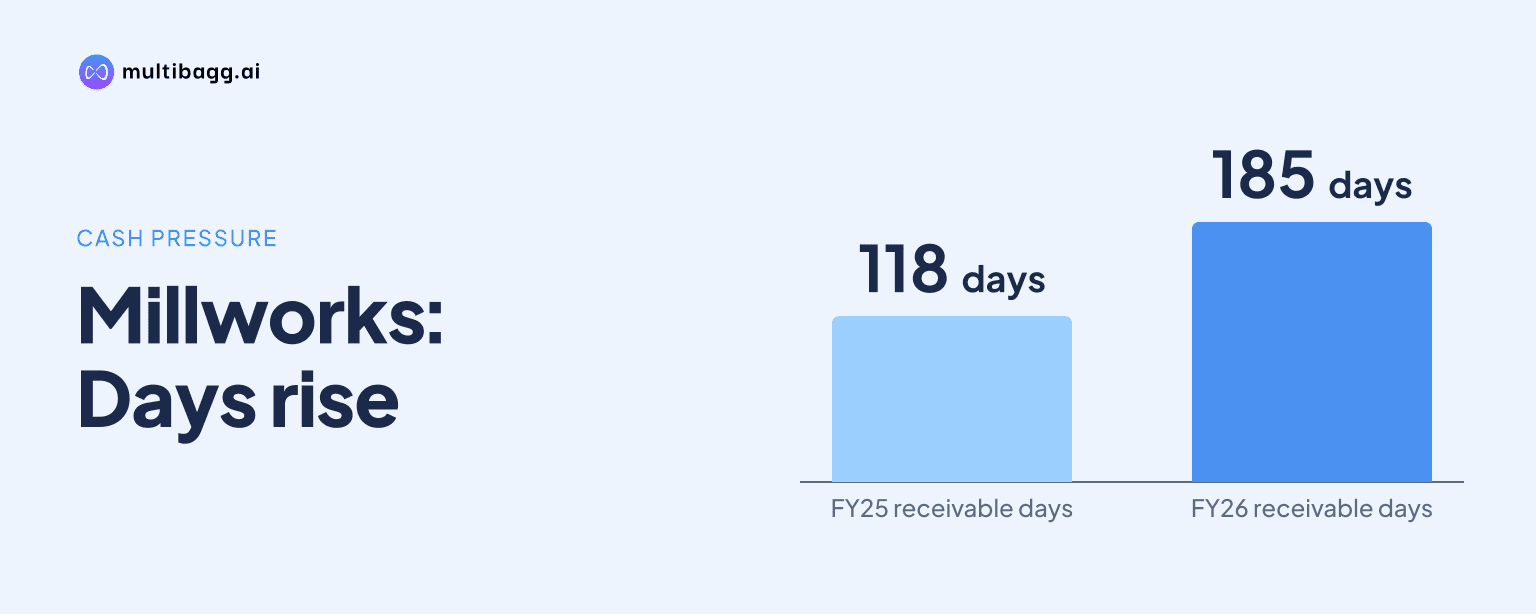
Millworks Technologies Limited reported average receivable days of 185 in FY26, while net cash from operating activities was negative at ₹1.62 crore for a second straight year despite ₹36.38 crore of profit after tax. Trade receivables stood at ₹138.69 crore at the FY26 balance-sheet date after rapid revenue growth.
Know Millworks Technologies inside out
Results, valuation, peers and who's buying, in one view.
Why did Millworks’ operating cash flow remain negative?
Millworks’ operating cash flow remained negative because working-capital absorption outweighed operating profit in FY25 and FY26. Net cash from operating activities moved from an inflow of ₹65 lakh in FY24 to outflows of ₹8.58 crore in FY25 and ₹1.62 crore in FY26, even as operating profit before working-capital changes increased from ₹8.29 crore to ₹52.56 crore between FY25 and FY26.
The FY26 cash result differed from the income statement, where revenue from operations expanded 6.8 times year on year to ₹148.77 crore and profit after tax increased to ₹36.38 crore from ₹5.12 crore in FY25. This shows that higher reported earnings were not matched by operating cash generation during FY26, as the cash-flow statement still recorded an outflow.
How much did Millworks’ collection cycle deteriorate?
Millworks’ average receivable period lengthened from 73 days in FY24 to 118 days in FY25 and 185 days in FY26. The FY26 level was 67 days above FY25 and 112 days above FY24, while the other disclosed working-capital measures moved in the opposite direction or remained broadly unchanged.
Inventory days fell from 85 in FY25 to 22 in FY26, while payable days were 168 versus 170 a year earlier. Millworks calculates receivable and inventory days using revenue, and payable days using cost of materials, with all three measures based on average balances; the disclosed movements therefore point to slower receivable collection rather than inventory accumulation.
How did Millworks’ FY26 cash conversion compare with earnings?
Millworks’ FY26 earnings and cash conversion moved in different directions, with profit after tax rising to ₹36.38 crore while operating cash flow remained an outflow of ₹1.62 crore. Earnings before interest, tax, depreciation and amortisation (EBITDA) reached ₹56.65 crore in FY26 from ₹8.29 crore in FY25, while the EBITDA margin was 36.93%, compared with 37.27% a year earlier.
The divergence was also followed by a weaker reported first half, although the presentation does not disclose a cash-flow statement for H1 FY27. Revenue from operations was ₹17.37 crore and Millworks reported a loss after tax of ₹1.83 crore in H1 FY27, compared with FY26 full-year revenue of ₹148.77 crore and profit after tax of ₹36.38 crore. Finance costs were ₹1.81 crore in H1 FY27, against ₹3.40 crore for all of FY26.
Got a follow-up? Ask IRIS
What balance-sheet changes accompanied Millworks’ longer cash cycle?
Millworks’ trade receivables rose to ₹138.69 crore in FY26 from ₹12.39 crore in FY25 and ₹1.88 crore in FY24. The increase accompanied total assets of ₹198.37 crore in FY26, compared with ₹44.07 crore in FY25, and was substantially larger than the FY26 inventory balance of ₹11.47 crore.
Supplier-credit and funding balances also increased as receivables expanded. Trade payables reached ₹72.23 crore in FY26 from ₹6.67 crore in FY25, while short-term borrowings rose to ₹9.15 crore from ₹3.17 crore. Net cash from financing activities was ₹27.40 crore in FY26 after ₹15.15 crore in FY25, whereas closing cash and cash equivalents were ₹76 lakh at the end of FY26, up from ₹62 lakh at the end of FY25.
The balance sheet separately reported cash and bank balances of ₹1.35 crore in FY26, while total debt before the initial public offering (IPO) was ₹17.02 crore. Millworks said it raised ₹152.24 crore of net IPO proceeds in July 2026, and its capitalisation statement showed debt-to-equity falling from 0.21 times before the issue to 0.07 times after it. These capital-structure figures do not establish the pace at which FY26 receivables will convert into cash.
What is Millworks doing to shorten its cash cycle?
Millworks says it requires a 30% advance payment on all new export orders and moved Israel shipments to air freight to reduce transit time. Israel was its largest FY26 export market at ₹33.31 crore, while total export revenue was ₹40.86 crore, or 27.47% of FY26 revenue.
Management has set a receivable target of 90 to 120 days, against the FY26 average of 185 days. It also states that railway payments are received within about 30 days. The stated target would mean a reduction of 65 to 95 days from the FY26 receivable period, but the presentation provides no later collection-days result against that target.
Millworks earmarked ₹81.50 crore of IPO proceeds for working capital. The allocation exceeds the FY26 inventory balance of ₹11.47 crore and is part of the company’s disclosed plan to fund working-capital needs while collection practices change. The presentation gives no dated deployment schedule for the ₹81.50 crore and no forecast for future operating cash flow.
Conclusion
Millworks’ FY26 disclosures show that rapid reported growth came with a larger cash-conversion requirement. Revenue from operations reached ₹148.77 crore and profit after tax was ₹36.38 crore, but receivable days increased to 185 and trade receivables reached ₹138.69 crore, contributing to a second consecutive year of negative operating cash flow.
The next disclosed measures to watch are management’s 90-to-120-day receivable target, the 30% advance requirement for new export orders and use of ₹81.50 crore of IPO proceeds for working capital. Subsequent disclosures on receivable days, operating cash flow and collection of the FY26 receivable balance will indicate progress against that plan.