










Millworks Technologies Limited targets 75% machine-hour increase
Key highlights
- Millworks plans to increase installed capacity including springs from 383,019 FY26 machine hours to 671,499 hours.
- Rs 61.03 crore of IPO capex is allocated to plant and machinery, covering 52 planned machines.
- Millworks had installed 27 of 52 planned IPO-funded machines at the time of its H1 FY27 presentation.
- FY26 machining utilisation ranged from 72.90% at Unit 2 to 77.16% at Unit 4 machining.
powered by IRIS
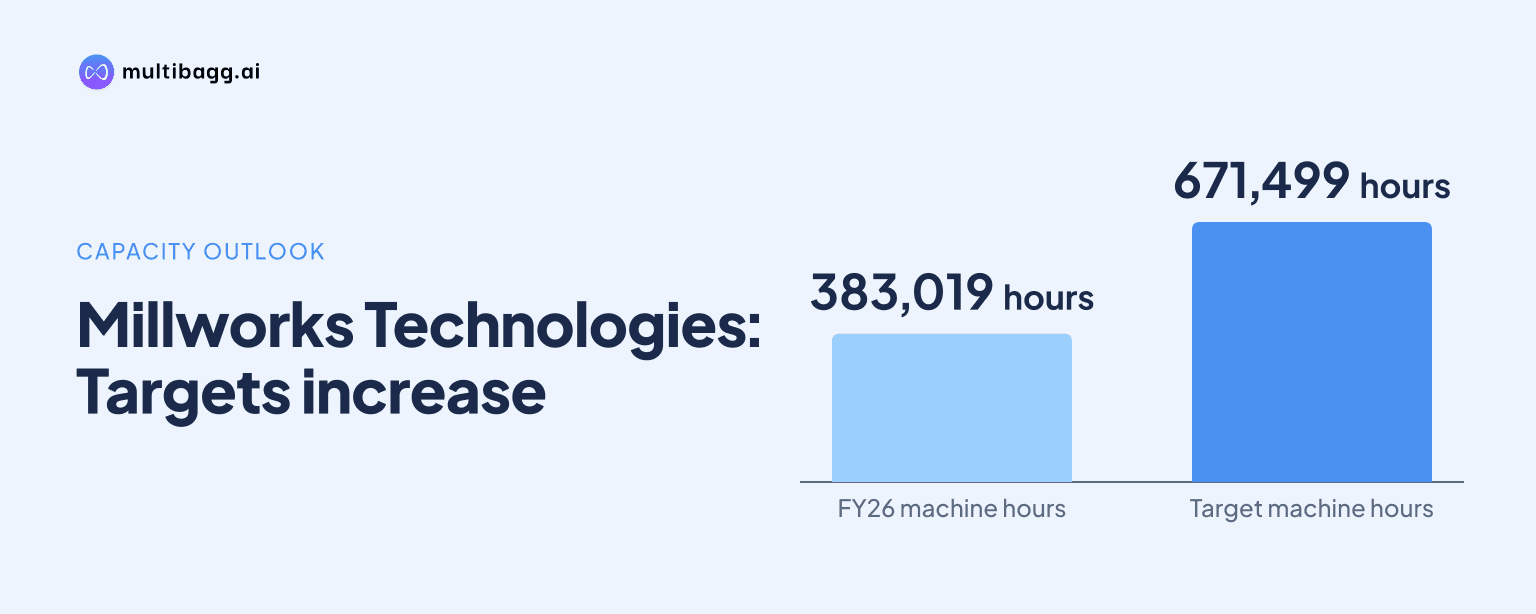
Millworks plans to lift installed capacity including springs from 383,019 machine hours in FY26 to 671,499 after expansion, a 1.75x increase, using Rs 61.03 crore of initial public offering, or IPO, plant-and-machinery capex. The company said 27 of the 52 planned machines had been installed.
Know Millworks Technologies inside out
Results, valuation, peers and who's buying, in one view.
How much machine-hour capacity is Millworks adding?
Millworks is proposing 288,480 additional machine hours, taking FY26 installed capacity including springs from 383,019 hours to 671,499 hours after the expansion. The proposed total is 1.75 times the FY26 base, meaning planned capacity is about 75% higher than the current level disclosed in the H1 FY27 investor presentation.
The presentation also separates the machining-hours trend from the springs business. On that excluding-springs basis, installed capacity rose from 1.64 lakh hours in FY24 to 3.23 lakh hours in FY26, while utilised hours increased from 0.91 lakh to 2.41 lakh. Thus, installed machining capacity was nearly twice the FY24 level before the next IPO-funded leg is completed.
The two capacity measures should not be treated as identical. The FY24-to-FY26 chart excludes springs and shows 3.23 lakh installed hours in FY26, whereas the 383,019-hour headline capacity includes springs. Millworks has 55 spring-division machines at Unit IV, where the springs operation was still in trial run during FY26.
How fully are Millworks' existing units being used?
Millworks reported FY26 machine-hour utilisation above 70% at every operating machining unit, ranging from 72.90% at Unit 2 to 77.16% at Unit 4 machining. Unit 1 reached 74.46% and Unit 3 reached 75.67%, while Unit 4 springs was described as being in trial run rather than assigned a utilisation percentage.
The unit-level data show higher utilisation than in FY24 at the two units with comparable history. Unit 1 rose from 54.79% in FY24 to 70.72% in FY25 and 74.46% in FY26. Unit 2 moved from 57.32% to 71.80% and then 72.90% across those same three years, while Unit 3 was reported at 72.45% in FY25 and 75.67% in FY26.
Millworks' FY26 utilised machining hours of 2.41 lakh were 0.83 lakh hours above FY25 utilisation of 1.58 lakh hours. Installed hours excluding springs increased by 1.02 lakh over the same period, from 2.21 lakh to 3.23 lakh, so both capacity and production use expanded during FY26.
Which machines are being installed with Millworks' IPO capex?
Millworks has allocated Rs 61.03 crore of IPO capex to plant and machinery for 52 planned machines, of which 27 had been installed at the time of the presentation. The company specifically identifies 16 installed computer numerical control, or CNC, lathes and two installed slitting and laser-cutting machines, without listing the remaining installed equipment categories on this page.
The existing equipment base covers machining, sheet metal and springs across four Bengaluru units. It includes 41 vertical machining centres, or VMCs, including five-axis equipment; one horizontal machining centre, or HMC; 26 CNC lathes; and 55 spring machines. Unit 3 adds one laser-cutting machine, one CNC press brake and four welding sets and presses.
The planned investment is directed at an established manufacturing configuration rather than a single process. Milling equipment is located across Units 1, 2 and 4, while Unit 3 handles sheet-metal operations and Unit 4 includes the spring division. Millworks also reports positional tolerance of 10 to 15 microns on most CNC machines and inspection tools including coordinate measuring machines, video measuring, surface-finish and hardness testers.
Got a follow-up? Ask IRIS
Where will Millworks place its expanded capacity?
Millworks is locating its IPO-funded expansion at Unit IV in Nelamangala, its largest site at 43,000 square feet, or 56% of its 76,500-square-foot leased manufacturing footprint. Unit IV performs multi-axis CNC machining and assembly, houses the springs section and is expressly identified as the expansion site.
The other three units are smaller and have more specialised roles. Unit I in Peenya Phase IV has 18,000 square feet, or 24% of the footprint, for core precision machining, tooling, prototypes and metrology. Unit III, also in Peenya Phase IV, has 11,000 square feet for laser cutting, bending, forming, welding and integration, while Unit II has 4,500 square feet and is dedicated to high-volume railway machining and sub-assembly.
All four Millworks units hold AS9100D and ISO 9001:2015 certification on a multi-site basis. Alongside physical expansion, the company said it has 12 research and development engineers and plans to expand that team to about 20. Its Centre of Excellence has seven Markforged 3D printers for composite and resin prototypes, fixtures and tooling, with metal 3D printing planned for complex parts.
What could the additional capacity support at Millworks?
Millworks' added machinery is being positioned alongside capabilities used for railway, aerospace, semiconductor and other precision-manufacturing work. Unit II is focused on railway machining and sub-assembly, while Unit IV combines multi-axis machining with assembly and springs. The company reported FY26 railway revenue of Rs 35.17 crore, compared with Rs 15.04 crore in FY25.
For aerospace, Millworks said a new facility is under construction mainly for aerospace customers and a Class 1000 clean room is due in December 2026 as a prerequisite for Boeing and Airbus supplier audits. Aerospace revenue was Rs 1.47 crore in FY26, versus Rs 1.06 crore in FY25. Semiconductor revenue rose from Rs 4.45 crore in FY25 to Rs 8.84 crore in FY26.
The presentation does not give a completion date for all 52 planned IPO-funded machines or forecast revenue from the additional 671,499 machine-hour capacity. It does identify a planned dedicated facility being discussed with an international rail customer, while semiconductor and aerospace engagements with global original equipment manufacturers remain under qualification. Those developments are distinct from installed-machine counts and capacity figures.
Conclusion
Millworks has linked Rs 61.03 crore of IPO machinery capex to a proposed rise from 383,019 to 671,499 installed machine hours, while FY26 utilisation exceeded 70% at its four reported machining operations. The underlying machining base, excluding springs, had already expanded from 1.64 lakh installed hours in FY24 to 3.23 lakh in FY26.
The next items to watch are installation progress beyond 27 of 52 planned machines, the transition of Unit IV springs from trial run, and the timing of the proposed capacity reaching 671,499 hours. Management also plans to grow its research and development team from 12 to about 20 engineers, while the aerospace clean room is due in December 2026.