










Mold-Tek H1 PAT rises 375% as EBITDA margin reaches 23.7%
Key highlights
- Mold-Tek's H1 FY27 PAT rose 375.1% to Rs 18.62 crore.
- Mold-Tek's H1 FY27 EBITDA margin increased to 23.7% from 11.4% in H1 FY26.
- Mold-Tek's revenue from operations grew 63.7% to Rs 120.35 crore while total expenses rose 38.2% to Rs 94.83 crore.
- Mold-Tek's Q2 FY27 EBITDA margin was 24.0%, compared with 23.4% in Q1 FY27.
powered by IRIS
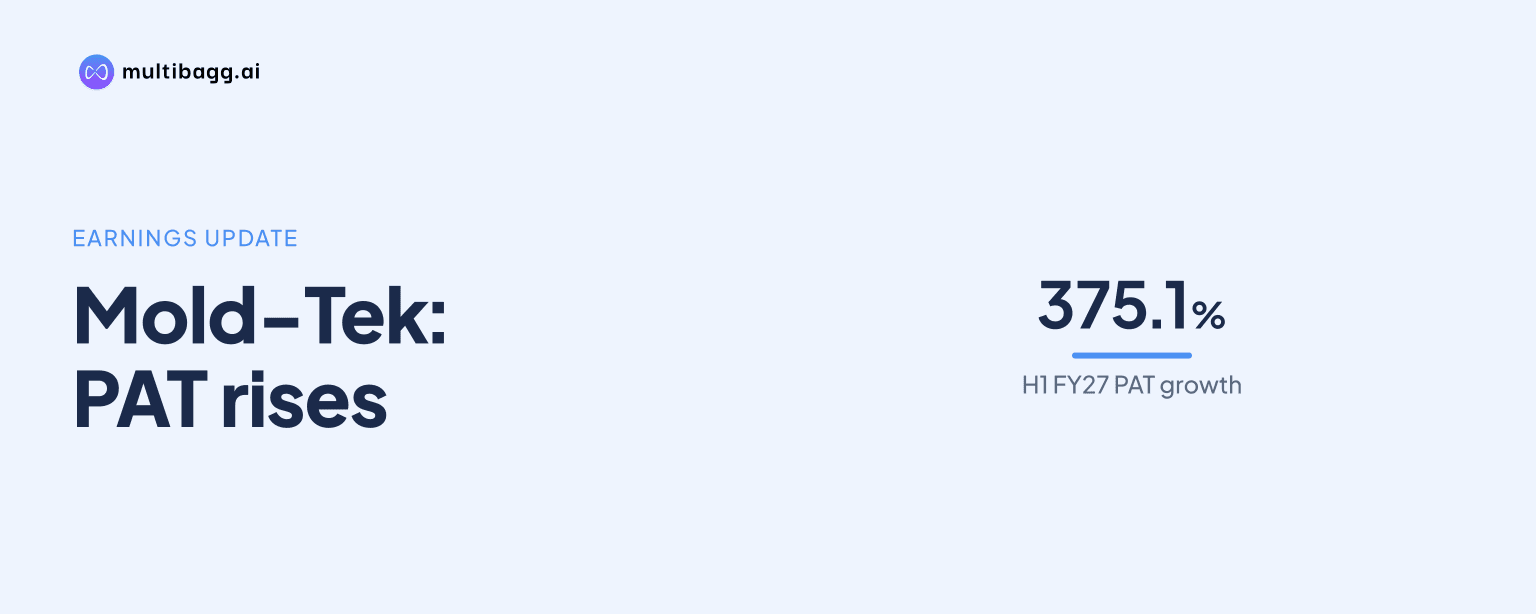
Mold-Tek reported profit after tax of Rs 18.62 crore in H1 FY27, up 375.1% year on year, as earnings before interest, tax, depreciation and amortisation (EBITDA) margin increased to 23.7% from 11.4%. Revenue from operations rose 63.7% to Rs 120.35 crore, while total expenses grew 38.2% to Rs 94.83 crore.
Know Mold-Tek Technologies inside out
Results, valuation, peers and who's buying, in one view.
How did Mold-Tek's H1 FY27 profit change?
Mold-Tek's profit after tax (PAT) rose to Rs 18.62 crore in H1 FY27 from Rs 3.92 crore in H1 FY26, while PAT margin increased to 15.5% from 5.3%. Profit before tax rose 397.0% to Rs 25.59 crore from Rs 5.15 crore, exceeding the growth in revenue from operations.
Revenue from operations increased by Rs 46.83 crore to Rs 120.35 crore, while total income rose 60.1% to Rs 123.32 crore. Other income moved in the opposite direction, declining 15.3% to Rs 2.97 crore from Rs 3.50 crore, meaning the reported income growth was led by operations.
Earnings per share after the bonus issue rose to Rs 3.24 in H1 FY27 from Rs 0.68 in H1 FY26. Before the bonus issue, earnings per share were Rs 6.47 against Rs 1.36, a reported increase of 375.7%.
What drove Mold-Tek's EBITDA margin expansion?
Mold-Tek's EBITDA margin rose by 12.3 percentage points to 23.7% in H1 FY27 because total expenses grew more slowly than revenue from operations. EBITDA increased 239.1% to Rs 28.49 crore from Rs 8.40 crore, compared with the 63.7% rise in operating revenue.
Employee benefits expense rose 41.2% to Rs 76.10 crore, below the revenue growth rate, while other expenses increased 27.3% to Rs 18.73 crore. Together, total expenses increased 38.2% to Rs 94.83 crore from Rs 68.62 crore, compared with the Rs 46.83 crore increase in revenue from operations.
Employee benefits remained Mold-Tek's largest reported expense in both periods, rising by Rs 22.19 crore from Rs 53.90 crore. Finance costs declined 22.0% to Rs 19.11 lakh and depreciation and amortisation declined 10.0% to Rs 2.71 crore, while tax expense rose 467.1% to Rs 6.97 crore as profit before tax increased.
Did Mold-Tek sustain the improvement in Q2 FY27?
Mold-Tek sustained the margin improvement in Q2 FY27, reporting an EBITDA margin of 24.0%, compared with 14.8% in Q2 FY26 and 23.4% in Q1 FY27. Quarterly revenue from operations increased 51.2% year on year to Rs 60.81 crore and 2.1% sequentially from Rs 59.54 crore.
Q2 FY27 EBITDA rose 144.5% year on year to Rs 14.58 crore and 4.8% from Rs 13.91 crore in Q1 FY27. PAT reached Rs 9.62 crore, up 197.3% from Rs 3.24 crore a year earlier and 6.8% from Rs 9.00 crore in the preceding quarter.
The quarterly cost pattern was also below income growth on a year-on-year basis. Employee benefits expense rose 36.0% to Rs 37.93 crore and other expenses increased 16.5% to Rs 9.22 crore, while total expenses rose 31.7% to Rs 47.15 crore and total income increased 47.8% to Rs 61.73 crore.
Got a follow-up? Ask IRIS
What growth actions does Mold-Tek disclose?
Mold-Tek expanded its US engineering offering through Beryl, which brought more than 14 years of residential engineering experience in Florida and about 40 US employees at acquisition. Beryl's disclosed services include residential engineering, building inspection, permit engineering, government and regulatory services, and plan review.
Beryl's entry into Forsyth County, Georgia extends Mold-Tek's operating footprint beyond Florida, according to the presentation. Mold-Tek says the acquisition expands its offering beyond traditional structural detailing, although its H1 FY27 financial tables do not separately disclose Beryl revenue or profit.
Mold-Tek is also repositioning its Mechanical Engineering Services business away from EV-only programmes by rationalising underutilised automotive manpower and high-cost automotive software. It has reallocated engineering talent toward poles and towers, substation design, electrical distribution, plant engineering and general engineering.
For US electrical engineering, Mold-Tek cites an annual addressable opportunity of about US$5 million to US$10 million. It has initiated a new client engagement with an initial team of 10 engineers, which management expects to scale towards about 20 engineers through training in American electrical design standards and additional teams for large US distribution companies.
How did Mold-Tek's financial position change by H1 FY27?
Mold-Tek reported net worth of Rs 150.11 crore at H1 FY27, up from Rs 128.10 crore at FY26, as reserves rose to Rs 144.35 crore from Rs 122.34 crore. Total assets increased to Rs 177.52 crore from Rs 171.96 crore over the same comparison.
Non-current assets rose to Rs 97.49 crore from Rs 81.64 crore, led by investments of Rs 43.88 crore compared with Rs 27.47 crore. Current assets declined to Rs 80.03 crore from Rs 90.32 crore, including cash, bank balances and other equivalents of Rs 22.04 crore against Rs 25.47 crore at FY26.
Current liabilities decreased to Rs 24.17 crore at H1 FY27 from Rs 41.34 crore at FY26. Trade payables fell to Rs 3.94 crore from Rs 10.76 crore, while other financial liabilities reduced to Rs 13.08 crore from Rs 17.46 crore; non-current liabilities increased to Rs 3.24 crore from Rs 2.52 crore.
Conclusion
Mold-Tek's H1 FY27 performance combined 63.7% operating-revenue growth with a 38.2% increase in total expenses. That gap lifted EBITDA to Rs 28.49 crore and margin to 23.7%, while PAT rose to Rs 18.62 crore and PAT margin reached 15.5%.
The next disclosed execution points are the planned expansion of the US electrical engineering team from 10 engineers towards about 20 and the development of Beryl's footprint beyond Florida, including Forsyth County, Georgia. Management also identifies a US$5 million to US$10 million annual electrical-engineering opportunity, but the presentation does not provide a timetable or separate revenue target for that activity.