










MPS says AJE repaid Rs 70 crore purchase price in 2-2.5 years
Key highlights
- MPS said AJE’s roughly Rs 70 crore February 2024 purchase price paid back in 2 to 2.5 years.
- MPS said AJE generates more than Rs 35 crore of EBITDA each year after rationalisation.
- MPS said group ROCE is about 35% despite multiple acquisitions.
- AJE launched pre-submission peer review in April, with more author solutions planned before FY’27 ends.
powered by IRIS
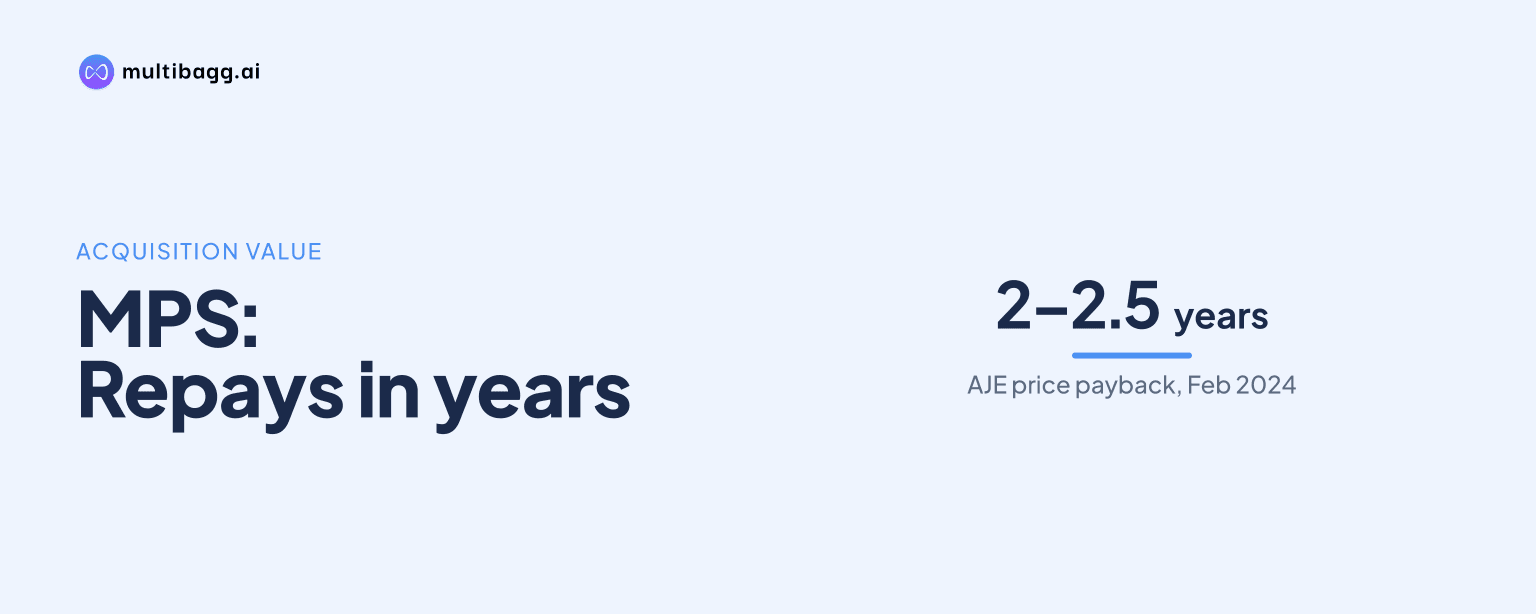
MPS Limited said AJE repaid its roughly Rs 70 crore February 2024 purchase price in two to two-and-a-half years, based on annual earnings before interest, tax, depreciation and amortisation (EBITDA) of more than half that amount. Management said AJE also expanded MPS’s work in research integrity and quality.
Know MPS inside out
Results, valuation, peers and who's buying, in one view.
How quickly did MPS recoup AJE's purchase price?
MPS said AJE’s net payback period was about two to two-and-a-half years following its February 2024 acquisition for around Rs 70 crore. Management said the business had completed FY’25 and FY’26 after the transaction and was in its third full year, placing the reported payback within MPS’s acquisition standards.
The assessment includes earnings after tax rather than relying only on the acquisition consideration. Management said AJE earns more than half of the Rs 70 crore purchase value in EBITDA each year and that payback would remain in the two-to-two-and-a-half-year range even at the net level after taxes. MPS did not disclose annual cash flow, tax expense or an exact EBITDA figure for AJE.
More than Rs 35 crore of annual EBITDA represents over half of the original Rs 70 crore outlay in one year. However, the transcript does not provide AJE’s annual revenue, precise EBITDA, working-capital movement or year-by-year post-tax cash generation. The two-to-two-and-a-half-year figure is therefore management’s stated payback assessment rather than a calculation that can be reconstructed from the disclosed figures.
What has AJE contributed financially to MPS?
MPS said AJE has consistently made profit above 30% since the business was rationalised and has generated more than Rs 35 crore of EBITDA each year. Management called AJE one of its most successful acquisitions financially, while also saying the group’s return on capital employed, or ROCE, is about 35% despite multiple acquisitions.
That financial description contrasts with the concern raised by an analyst about AJE’s standalone growth after a rightsizing exercise in the prior year. MPS did not report AJE’s revenue growth rate, current revenue or a comparison with pre-acquisition sales. Management instead separated the growth question from the stated financial return, citing the business’s post-rationalisation profit and payback period.
MPS also linked AJE to research growth outside the acquired business. Rahul Arora said research outside AJE would not, in his view, have grown 22% in the quarter without AJE because the acquisition changed MPS’s position with its largest customers. This was management’s view on the acquisition’s wider effect, not a disclosed allocation of the 22% growth to AJE.
The group-level ROCE figure does not establish AJE’s individual capital efficiency. MPS said acquisitions such as AJE support the roughly 35% group ROCE, but it did not disclose AJE’s invested capital, standalone ROCE or integration expenditure. Those missing figures limit direct comparison between AJE’s reported profit performance and MPS’s overall return metric.
Got a follow-up? Ask IRIS
How has AJE changed MPS's research business?
MPS said AJE gives it an artificial-intelligence language-editing engine and an entry point into research-quality work at large research companies. Management said the shift reflects authors’ growing need for research integrity and quality as artificial intelligence takes a larger role in language editing.
The strategic effect, according to MPS, is broader customer engagement. Management said AJE opened a second door at some large accounts, with customers that had once bought one line of work now buying three or four lines from MPS. It said this expanded position was visible in research-business growth outside AJE as well as in the acquired operation.
AJE launched pre-submission peer review in April, and MPS said orders had arrived steadily each month after the launch. Management also said a new research-integrity mandate starts this month. The transcript did not identify the customer, give the mandate’s value or duration, or say how much revenue either initiative is expected to add.
MPS described the underlying research issue as a sharp increase in paper volumes and quality-control demands, including concerns around paper mills and fake papers enabled by artificial intelligence. It said throughput, rather than the availability of papers, is the key issue for customers. Research contracts typically run for three to five years, according to management, although it gave no AJE-specific contract duration.
What is MPS planning for AJE through FY’27?
MPS plans to launch more author solutions centred on research integrity and quality before the end of FY’27. The planned products follow AJE’s April pre-submission peer-review launch and the research-integrity mandate that management said would begin this month.
Management characterised the opportunity as a structural shift rather than a response to macroeconomic conditions. As artificial intelligence assists with language editing, MPS said authors increasingly need services related to scientific quality and integrity. Whether this produces standalone AJE growth remains unresolved because MPS did not disclose a booking target, revenue target or margin target for AJE through FY’27.
Capacity is relevant to the plan because MPS said research customers need systems tailored to maximise throughput. The company also said it is investing in product development, technology, sales headcount and marketing while its EBITDA margin expands through artificial-intelligence operating leverage. It did not disclose how much of those investments applies specifically to AJE.
Customer adoption across multiple service lines is another disclosed measure to watch. MPS said some large research customers have moved from one service line to three or four, but it did not provide the number of these customers, their share of AJE sales or renewal data. The next indication of execution will be any update on orders from the April service, the new mandate and planned FY’27 launches.
Conclusion
MPS presented AJE as both a financially productive acquisition and a strategic addition to its research business. Management’s reported two-to-two-and-a-half-year payback, supported by annual EBITDA above Rs 35 crore against an acquisition price of around Rs 70 crore, sits alongside its claim that AJE has widened relationships with major customers from one service line to three or four.
The next milestones are the research-integrity mandate starting this month and additional author solutions due before the end of FY’27. MPS is also scheduled to speak with investors after the third quarter, when it may provide further detail on AJE’s orders, growth and customer adoption.