










MPS raises FY27 EBITDA floor after record first half
Key highlights
- MPS raised its FY27 EBITDA floor to at least Rs 310 crore after H1 FY27 EBITDA rose 39% to Rs 154 crore.
- H1 FY27 revenue increased 17.8% to Rs 448.5 crore and EBITDA margin was 34.3%.
- Research Solutions reported a 48.2% Q2 FY27 margin, while Education Solutions reached 30.6% of group revenue.
- MPS had zero debt and Rs 163 crore of cash on 30 September 2026, with DSO down to 38 days from 45 days.
powered by IRIS
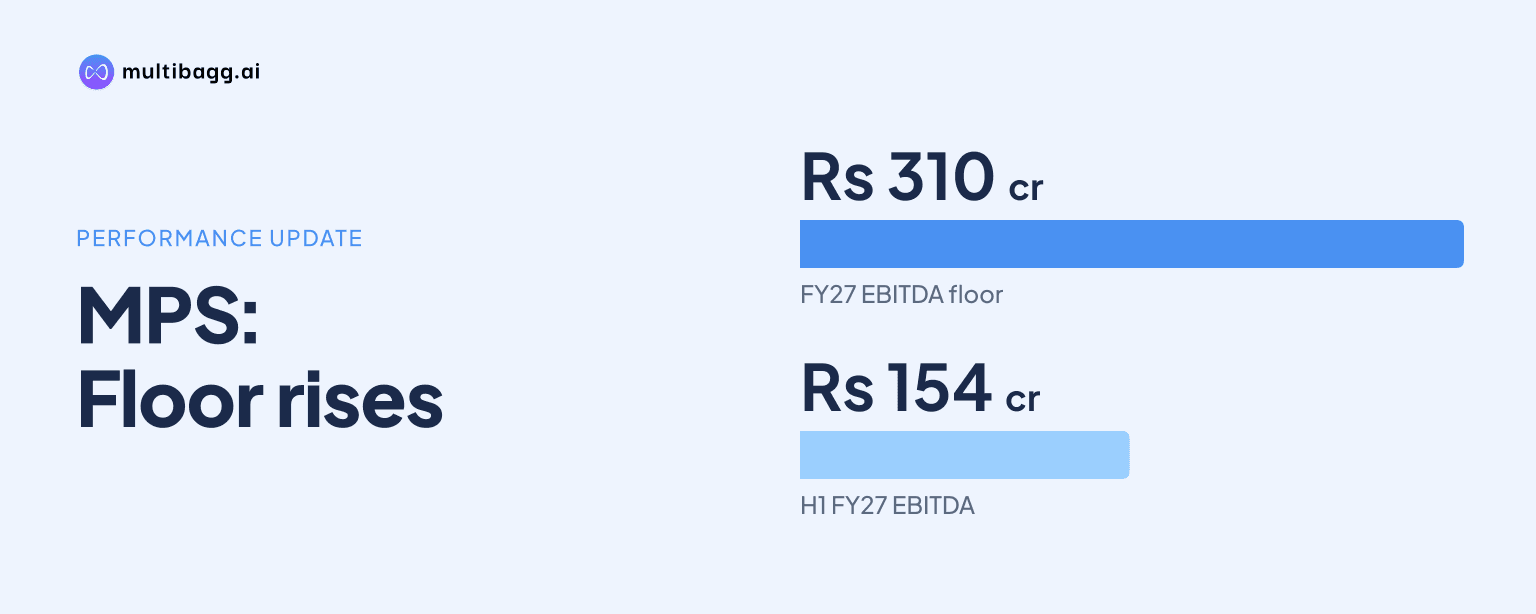
MPS Limited raised its FY27 EBITDA floor to at least Rs 310 crore after H1 FY27 EBITDA rose 39% to Rs 154 crore on revenue of Rs 448.5 crore, its most profitable half-year. Management said the new floor does not depend on a favourable exchange rate and expects mandates won in the first half to support a fourth-quarter weighted second half.
Know MPS inside out
Results, valuation, peers and who's buying, in one view.
Why did MPS raise its FY27 EBITDA floor?
MPS raised its FY27 EBITDA floor because H1 FY27 EBITDA of Rs 154 crore puts the business near Rs 308 crore on a simple annualised basis, before its historically stronger second half. Chief Financial Officer Prarthana Agarwal said MPS had begun FY27 expecting to comfortably cross Rs 300 crore of EBITDA, but now expects at least Rs 310 crore.
Management expects H2 FY27 to lean towards the fourth quarter because mandates won in the first half will bill for a full three months then. Agarwal also said MPS plans its business at an exchange rate well below the current rate, meaning the Rs 310 crore floor is not dependent on currency support.
Over the past six quarters, MPS said revenue grew about 20% while EBITDA grew about 53%. Management attributed the difference to operating leverage, as additional revenue moves through platforms and teams that have already been built. EBITDA per employee rose about 15% in Q2 FY27 even as MPS hired ahead of incoming work.
How did MPS perform in H1 FY27?
MPS reported its most profitable half-year in H1 FY27, with revenue up 17.8% to Rs 448.5 crore and EBITDA up 39% to Rs 154 crore. The EBITDA margin was 34.3%, while Q2 FY27 also delivered a 34.3% margin, making it the second consecutive quarter above 34%, according to management.
The comparison with prior-period profit includes an exceptional item. Q2 of the preceding year contained a one-time gain of about Rs 12.8 crore from the Liberate write-back. Excluding that gain, management said profit before tax rose 23.1% in the quarter and 33.9% in the half year.
MPS also reported a broader customer base and lower concentration among its largest accounts. It billed 839 clients in Q2 FY27, compared with 422 a year earlier, while the top five clients accounted for 46% of revenue, down from 51%. The changes represent 417 additional billed clients and a 5-percentage-point decline in top-five revenue concentration.
Which segments are supporting MPS profitability?
Research Solutions is supporting profitability with a Q2 FY27 margin of 48.2%, more than 6 percentage points above a year earlier. MPS said Research revenue excluding AJE grew about 22% in the quarter, at a margin close to 50%, with no acquisition contribution included in that growth figure.
Management linked Research demand to research-quality and integrity work, including production and peer-review workflows for existing customers. One of MPS's largest customers awarded a new production mandate and a research-integrity mandate that begins billing from November. Separately, one of the five largest companies in MPS's market is moving more than 110,000 submissions a year onto its peer-review platform.
MPS is hiring ahead of those Research mandates and said its H2 FY27 priority is to bring them to a steady state while maintaining margins as work scales. Management's explanation is that customers pay for outcomes, such as a submission reviewed or a paper made ready, allowing higher volumes to run through existing platforms and workflows.
Education Solutions became a larger component of the group, accounting for 30.6% of revenue in H1 FY27 versus 27.2% a year earlier. Segment revenue grew 36% in the half, while EBITDA grew 14.5%. Quarterly bookings included work for Florida's upcoming mathematics adoption, and management said California follows in the adoption cycle.
Got a follow-up? Ask IRIS
What did Unbound Medicine and Corporate Learning contribute?
Unbound Medicine contributed Rs 41.6 crore in H1 FY27 through its subscription business. MPS said the royalty-based model has a lower margin than its solutions work, but provides Education Solutions with a recurring revenue base from medical schools, nursing programmes, hospital systems and medical societies.
Management said the next market for Unbound is hospitals and health systems, where clinical answers need to be accurate at the point of care. It also said Unbound's clinical knowledge and platform were combined with Liberate's learning-design capability in a four-year programme won from a large US university during the year.
Corporate Learning improved its H1 FY27 EBITDA margin to 25% from about 16% a year earlier. EBITDA grew 77% despite 19% fewer employees, and Q2 FY27 revenue rose 17%. Management said the segment is adding new logos in Asia-Pacific and selling more AI- and technology-led work.
How does MPS's cash position support its plans?
MPS had zero debt and cash of Rs 163 crore as of 30 September 2026, after fully repaying in August the borrowing taken for the Unbound Medicine acquisition. Days sales outstanding, or DSO, fell to 38 days from 45 days at the end of June, which management cited as evidence of improved cash conversion.
The balance-sheet position is relevant to MPS's stated acquisition plan, but the Rs 310 crore EBITDA floor does not assume a new transaction. Chairman and Chief Executive Officer Rahul Arora said growth, including acquisitions, is MPS's first capital-allocation goal for the year and that the company has made 11 acquisitions in 13 years.
Management said it has examined several potential targets since acquiring Unbound Medicine and walked away when prices exceeded what it considered appropriate. Arora said MPS expects its next acquisition to close during the current financial year, after which it would provide a tighter view of its FY28 revenue target of Rs 1,500 crore, which has always combined organic growth and acquisitions.
MPS also said it returned more than Rs 650 crore to shareholders between FY19 and FY25. Arora described the company's capital-allocation principle as requiring capital to earn its return within 12 months or be returned to shareholders, while noting that distributions resume after capital needed for growth has been deployed.
Conclusion
The higher FY27 floor reflects a combination of Rs 154 crore of H1 EBITDA, a 34.3% margin, faster EBITDA growth than revenue and management's expectation that new mandates will contribute more fully in Q4 FY27. Research Solutions supplied the highest disclosed segment margin at 48.2%, while Education Solutions increased its share of group revenue to 30.6% and added Rs 41.6 crore from Unbound Medicine.
The next disclosed milestones are the November start of billing for a new research-integrity mandate, the planned Q4 FY27 weighting as first-half mandates complete a full three months of billing, and management's expectation of an acquisition closing during FY27. MPS also needs to bring new Research hiring to a steady state while holding margins, according to management.