










MPS expects FY27 deal; FY28 Rs 1,500 crore still needs M&A
Key highlights
- MPS expects its next acquisition to close in FY27, but has not named a target or disclosed a value.
- Management said the Rs 1,500 crore FY28 revenue ambition has always required organic growth plus acquisitions.
- MPS held Rs 163 crore of cash and zero debt at 30 September after repaying Unbound-related borrowing in August.
- Research excluding AJE grew about 22% in the quarter, and MPS raised its FY27 EBITDA floor to at least Rs 310 crore.
powered by IRIS
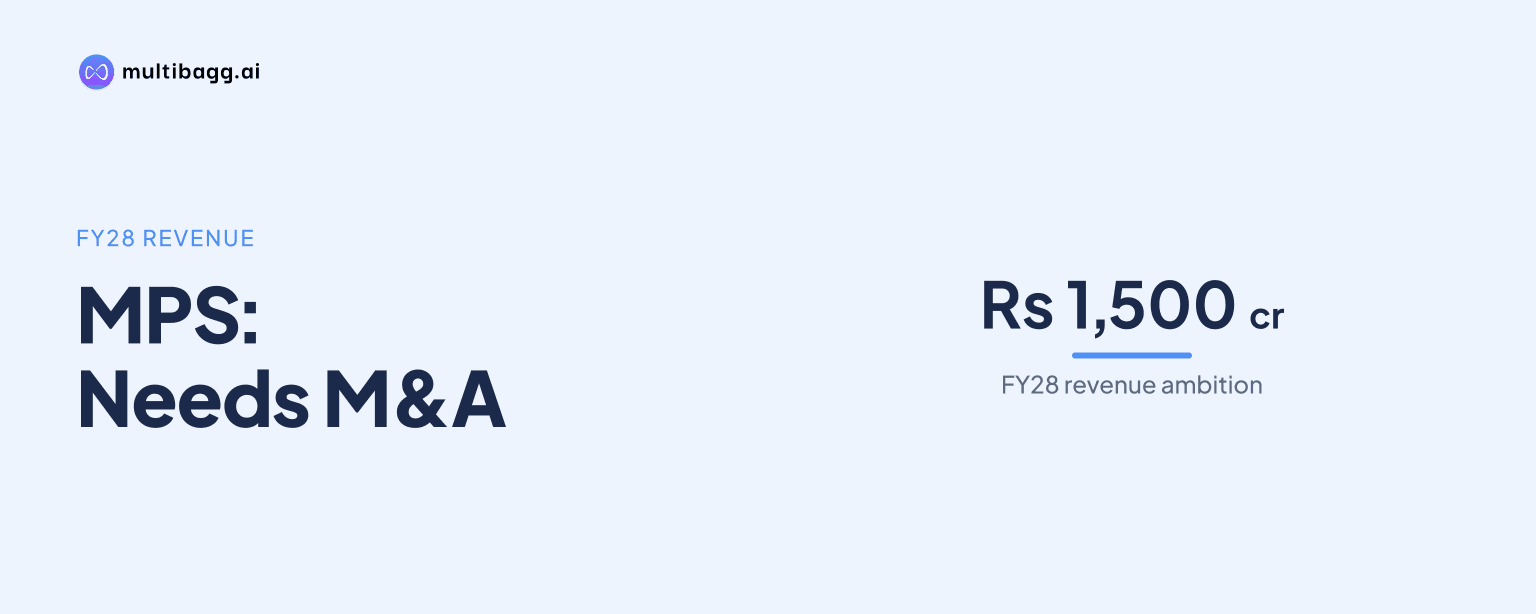
MPS expects its next acquisition to close in FY27, but management said its Rs 1,500 crore FY28 revenue target has always depended on both organic growth and acquisitions. MPS had Rs 163 crore of cash and zero debt at 30 September, yet it will provide a tighter FY28 view only after a deal closes.
Know MPS inside out
Results, valuation, peers and who's buying, in one view.
When does MPS expect its next acquisition to close?
MPS expects the next acquisition to close during FY27, according to Rahul Arora, but management did not give an exact closing date, identify a target or disclose a potential transaction value. The expectation followed an analyst question over the rising difficulty of reaching the Rs 1,500 crore FY28 revenue ambition without a new deal.
MPS said it has reviewed several businesses since acquiring Unbound Medicine and has walked away where the price exceeded the value management placed on the asset for shareholders. Arora said the deal pipeline remains active and that MPS would rather miss a transaction than overpay, meaning the FY27 expectation is not evidence of a signed agreement.
MPS has financial capacity while it continues its search. It repaid in August the borrowing raised for Unbound Medicine, leaving zero debt, and held Rs 163 crore of cash at 30 September. Management also raised its FY27 earnings before interest, tax, depreciation and amortisation, or EBITDA, floor from Rs 300 crore to at least Rs 310 crore.
Why does MPS need an acquisition for its FY28 target?
MPS needs an acquisition for the Rs 1,500 crore FY28 revenue target because management explicitly said the target has always combined organic growth with acquisitions. MPS did not quantify the revenue that the existing portfolio could deliver by FY28, and said it would offer a tighter view only once the next acquisition closes.
The organic business is nevertheless growing across several operations. Management said first-half revenue increased about 18% and EBITDA rose about 39%, while Research excluding AJE grew about 22% in the quarter without an acquisition. Research margins reached 48.2%, up by more than 6 percentage points from a year earlier, with the excluding-AJE business operating at a margin close to 50%.
The second half is expected to have a different billing pattern from the first half. New Research production and research-integrity mandates begin billing in November and December, while the fourth quarter is expected to receive three full months of contribution from those mandates. Management said the second half is usually stronger than the first, with the fourth quarter normally stronger than the third.
Education also provides a larger component of the group than a year earlier. Education represented 30.6% of group revenue, compared with 27.2% a year earlier, and Unbound contributed Rs 41.6 crore in the first half. Management said Unbound’s royalty-based model has a lower margin than solutions work, but adds recurring subscription revenue that renews annually.
Got a follow-up? Ask IRIS
What acquisition characteristics is MPS looking for?
MPS is seeking assets with artificial-intelligence tailwinds, science or other high-stakes content, low customer concentration, recurring revenue, a defensible niche and a clear route into MPS’s current operations. Arora described these features as the template established by Unbound, rather than as details of a specific acquisition under negotiation.
The high-stakes-content criterion reflects the markets served by Unbound. Unbound turns clinical content into answers for medical schools, nursing programmes, hospital systems and medical societies, where management said the answer needs to be right the first time. MPS is expanding Unbound towards hospitals and health systems, while its first combined Unbound and Liberate sale was a four-year programme with a large US university.
Recurring revenue is a central part of the stated strategy. MPS said Unbound subscriptions renew year after year and that it is steering towards subscriptions and contracted mandates. In Research, management said customer contracts typically run for three to five years, while one of the five largest companies in its market is moving more than 110,000 annual submissions onto MPS’s peer-review platform.
The integration requirement draws on MPS’s experience with AJE. MPS paid about Rs 70 crore for AJE, which management said now earns back more than half of that purchase amount every year. AJE also added an artificial-intelligence language engine subsequently rebuilt as Rubriq, and management said customers now buy three or four lines of work where they previously bought one.
How much capacity does MPS have to fund a transaction?
MPS said its Rs 163 crore cash balance and zero-debt position leave it ready to fund the right deal, but management did not disclose a maximum acquisition budget or say whether it would use additional borrowing. The company linked its funding capacity to the revised FY27 EBITDA floor of at least Rs 310 crore and to its stated intention to deploy capital for growth.
Management said acquisitions take priority over distributions while capital is being deployed. Its principle since FY19 is that capital must earn its return within 12 months or be returned to shareholders. MPS said it returned more than Rs 650 crore between FY19 and FY25, although this framework does not specify a future payout amount or a deadline for the next transaction.
MPS has completed 11 acquisitions in 13 years, according to management, and views Unbound as its newer template. Unbound generated Rs 41.6 crore in first-half revenue and its margin has risen from 12%-13% at acquisition to about 18%. Management said the next climb into the 20% range and beyond is expected to come from revenue growth rather than further cost cutting.
The group’s other operating measures show why management can continue pursuing a transaction while waiting for a suitable price. MPS billed 839 clients in the quarter, compared with 422 a year earlier, while its top five clients represented 46% of revenue versus 51%. Those figures show a broader customer base, but management has not stated how much this diversification changes the valuation or financing of a future deal.
Conclusion
MPS has maintained its FY27 acquisition expectation while making clear that the Rs 1,500 crore FY28 revenue ambition is not an organic-only goal. Its stated screen favours recurring revenue, low concentration, defensible niches, AI tailwinds, high-stakes content and integration potential, with Unbound and AJE providing management’s operating examples.
The next event to watch is an FY27 deal announcement, after which management has said it will give a tighter FY28 outlook. Before then, investors can watch November and December billing from new Research mandates, the expected fourth-quarter weighting, and progress against the revised FY27 EBITDA floor of at least Rs 310 crore.