










NCL Industries Q2 FY27 Revenue Rises 12%, EBITDA Margin Falls
Key highlights
- NCL Industries' Q2 FY27 revenue rose 12% year on year to ₹385.9 crore.
- Q2 FY27 EBITDA declined 26.3% to ₹37.2 crore, and EBITDA margin fell to 9.64% from 14.66%.
- Cement volume increased 16% in Q2 FY27, while profit after tax remained flat at ₹20 crore.
- H1 FY27 revenue was ₹729.5 crore and profit after tax declined 7.2% to ₹37.3 crore.
powered by IRIS
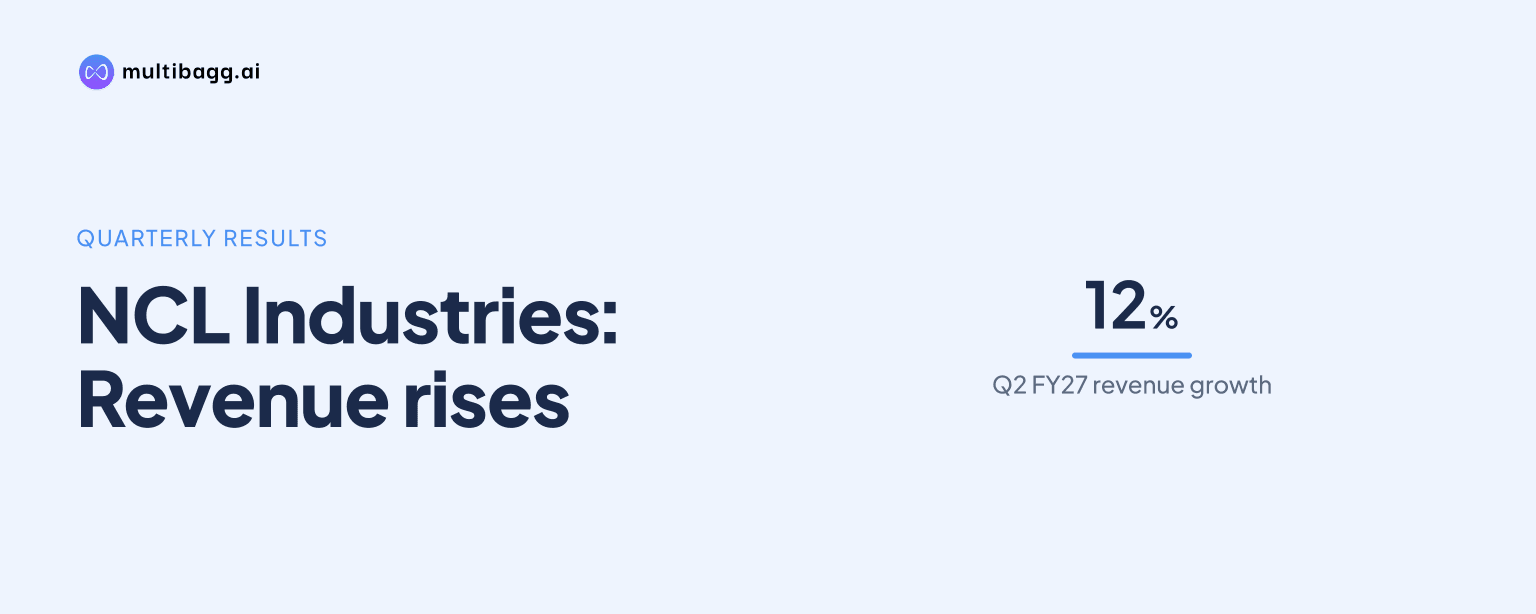
NCL Industries Limited reported 12% year-on-year revenue growth to ₹385.9 crore in Q2 FY27, but EBITDA declined 26.3% to ₹37.2 crore and margin narrowed to 9.64% from 14.66%, reflecting weaker cement realisations and higher power and fuel costs.
Know NCL Industries inside out
Results, valuation, peers and who's buying, in one view.
What did NCL Industries report for Q2 FY27?
NCL Industries reported revenue of ₹385.9 crore for the quarter ended September 30, 2026, compared with the corresponding quarter a year earlier. The company’s operating performance did not rise in line with revenue, with EBITDA falling to ₹37.2 crore and the EBITDA margin declining by 5.02 percentage points to 9.64%.
Profit after tax was broadly unchanged at ₹20 crore, while earnings per share stood at ₹4.41. Cement volume increased 16% during the quarter, according to the earnings-call summary, indicating that sales volumes improved even as the pricing and cost environment put pressure on profitability.
Why did NCL Industries' EBITDA margin decline?
NCL Industries attributed the weaker operating margin to lower cement realisations and higher power and fuel costs. These factors limited the benefit of higher cement volumes and revenue growth during the September quarter.
The movement shows the sensitivity of cement producers to selling prices and energy inputs. Cement manufacturing is power-intensive, and fuel expenses can affect profitability when price realisations do not adequately offset cost increases. The company’s Q2 figures illustrate this relationship: revenue rose, but EBITDA declined because the cost and pricing mix weakened.
The available call summary also referred to a management-reported Q2 EBITDA figure of about ₹37 crore. A separate platform note referred to a ₹42.05 crore filed EBITDA measure that excludes other income, while stating that management did not provide a bridge between the measures. Investors should therefore compare operating metrics only after checking the definitions used in the company’s results and presentation.
What were the key developments in the Q2 FY27 earnings call?
NCL Industries held its Q2 and H1 FY27 earnings conference call on November 13, 2026, at 4:00 pm IST, with Valorem Advisors as the host. The call followed the release of unaudited standalone and consolidated results for the quarter and half year ended September 30, 2026.
The interaction lasted about an hour and included 11 questions from nine analysts, according to the call listing. The company subsequently informed exchanges that it had uploaded the audio recording of the call to its website. The filing made the recording available for investors to review management’s comments on the quarterly and half-year performance.
The audio-upload announcement did not contain new financial guidance or targets. Its significance is mainly disclosure-related, as it gives shareholders access to the discussion around revenue growth, cement volumes, margin pressure and the company’s operating outlook as discussed during the call.
Got a follow-up? Ask IRIS
How did NCL Industries perform in the first half of FY27?
NCL Industries reported H1 FY27 revenue of ₹729.5 crore and profit after tax of ₹37.3 crore. Half-year profit declined 7.2% year on year, extending the pressure seen in the second-quarter operating margin.
The investor presentation described cement as contributing about 84% of the business mix. It also highlighted the company’s backward integration through limestone and power assets. Such integration can support supply reliability and cost management, although Q2 results show that external realisation and energy-cost conditions remained important determinants of earnings.
The presentation also referred to a planned 130 MW solar-wind project in Tuticorin, with commissioning targeted by FY28, and a renewable project outlay of ₹987 crore. The company also cited a floating MCLR-linked borrowing cost of about 8.5%. These disclosures are relevant because energy sourcing and funding costs can influence the economics of expansion projects.
How did the update affect investors and the cement sector view?
The earnings update presented mixed signals for investors. Revenue and cement volumes grew, showing continued sales activity, but the fall in EBITDA and the lower margin highlighted the effect of subdued realisations and higher energy expenses. For a cement company, volume growth alone may not translate into higher earnings when selling prices and input costs move unfavourably.
A market update associated with the investor-presentation alert showed the NCL Industries share price moving 4.28% lower from ₹168.10 to ₹160.90. The source identifies this as movement since the alert, rather than a confirmed full-day trading performance. The data nevertheless reflected investor attention on the margin contraction despite reported revenue growth.
The wider sector relevance is also clear. Cement producers depend on construction demand, regional pricing, fuel costs and logistics efficiency. NCL Industries' quarter demonstrates how increased dispatches can coexist with weaker operating profitability when cost pressure and pricing conditions do not support margins.
Conclusion
NCL Industries delivered double-digit Q2 FY27 revenue growth and higher cement volumes, but lower realisations and increased power and fuel costs reduced EBITDA by 26.3% and cut the operating margin to 9.64%. The flat quarterly profit and lower H1 profit underline that revenue growth did not fully convert into earnings growth.
The next points to watch are management commentary available in the call recording, the development of cement realisations and input costs, and progress on the planned 130 MW Tuticorin solar-wind project targeted for commissioning by FY28. Investors may also monitor whether future disclosures reconcile the EBITDA measures cited across the earnings-related materials.