










NCL Industries Limited Targets 130 MW Power Addition by FY28
Key highlights
- NCL Industries plans to commission a 130 MW solar-wind project in Tuticorin by FY28.
- The 130 MW project has stated capital expenditure of Rs 987 crore and 410 acres of acquired land.
- NCL Industries’ existing hydro, solar and waste-heat-recovery portfolio totals 42.05 MW.
- Revenue on NCL Industries’ Green Energy page rose from Rs 1.5 crore in FY24 to Rs 7.4 crore in FY26.
powered by IRIS
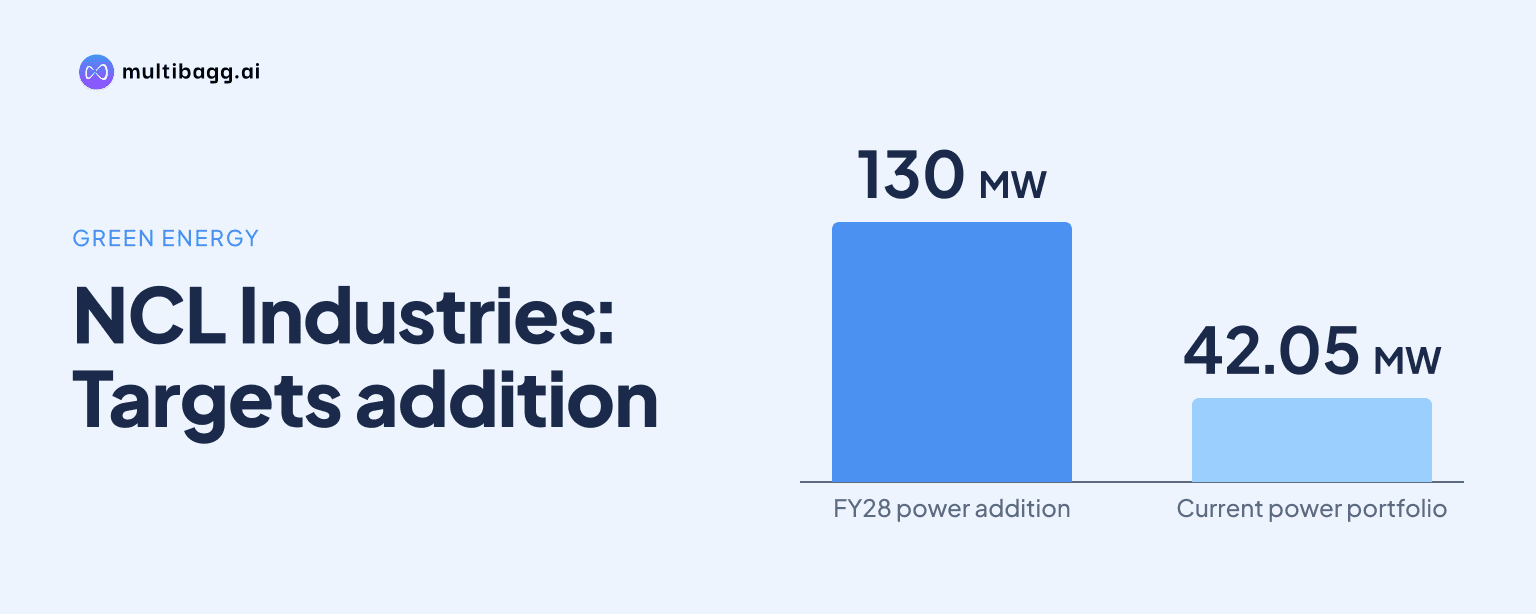
NCL Industries plans to commission a 130 MW solar-wind project in Tuticorin, Tamil Nadu, by FY28, adding capacity more than three times its existing 42.05 MW hydro, solar and waste-heat-recovery platform. The project has disclosed capital expenditure of Rs 987 crore and is planned on 410 acres of acquired land.
Know NCL Industries inside out
Results, valuation, peers and who's buying, in one view.
What power assets does NCL Industries operate today?
NCL Industries operates an existing 42.05 MW power portfolio comprising hydro, solar and waste heat recovery system assets. The portfolio includes 15.75 MW of mini-hydro capacity, 18.30 MWp of solar capacity and 8 MW of waste heat recovery capacity. MWp, or megawatt-peak, is the solar capacity measure used in the presentation, while MW means megawatts.
The 15.75 MW hydro portfolio is split between two mini-hydel projects: a 7.5 MW plant at Srisailam in Andhra Pradesh and an 8.25 MW plant at Tungabhadra Dam. NCL Industries says its mini-hydro facilities generate more than 50 million units of green power annually. The company presents the hydro, solar and waste-heat-recovery assets as support for its overall energy requirements.
The planned 130 MW addition would be 87.95 MW larger than the current 42.05 MW platform. Unlike the existing portfolio, which combines three types of assets, the proposed project is a solar-wind hybrid facility. NCL Industries describes the expansion as part of a larger renewable-led power platform intended to support its core cement business.
How large is NCL Industries’ planned solar-wind project?
NCL Industries plans a 130 MW solar-wind hybrid project at Tuticorin, Tamil Nadu, targeted for commissioning by FY28. The capacity is more than three times the company’s current 42.05 MW power portfolio. The presentation identifies solar and wind as the project technologies but does not disclose the generation-capacity split between them.
The project has a stated total capital expenditure of Rs 987 crore, and NCL Industries says it has acquired 410 acres of land. Management plans to implement the project in phases, describing this approach as calibrated capital deployment. The presentation does not give phase-wise capacities, an annual spending schedule, project contractors or intermediate commissioning dates before FY28.
Tuticorin is the specific project location cited in the strategic power-expansion plan, while the company’s existing hydro facilities are at Srisailam and Tungabhadra Dam. This means the planned 130 MW facility would add a new Tamil Nadu location to a portfolio that also includes 18.30 MWp of solar and 8 MW of waste heat recovery capacity. No expected annual generation figure is disclosed for the Tuticorin project.
How will NCL Industries use the electricity it generates?
NCL Industries says around 75% to 80% of power generation from its portfolio is used for captive consumption. Captive consumption means electricity generated for the company’s own operations, and the presentation links the renewable expansion to the long-term power requirements of its cement business. The stated purpose is to reduce dependence on external power sources.
NCL Industries says surplus generation is sold under power purchase agreements, or PPAs, providing an additional revenue stream from the power portfolio. A PPA is an agreement for electricity sales to an offtaker under agreed terms. The company’s backward-integration presentation also identifies exchanges as a channel through which surplus power can be monetised.
The presentation does not disclose the share of generation sold through PPAs or exchanges, realised electricity prices, contracted counterparties or the duration of agreements. It also does not specify whether the 130 MW Tuticorin project will have dedicated offtake arrangements. As a result, the disclosed 75% to 80% captive-use range describes the current portfolio approach rather than a stated allocation for the FY28 project.
Got a follow-up? Ask IRIS
What does the 130 MW plan mean for NCL Industries’ cement operations?
NCL Industries says the 130 MW project is intended to provide greater access to renewable electricity for its core cement business and reduce reliance on grid power. Management presents this as a long-term energy-cost optimisation measure, with the existing 15.75 MW hydro, 18.30 MWp solar and 8 MW waste-heat-recovery assets complementing the proposed project. The presentation provides no forecast for power cost per tonne of cement.
The power strategy is part of a broader backward-integration plan covering energy and limestone, which the company identifies as its two biggest cost drivers. NCL Industries has acquired Vishwamber Cements Ltd., which holds a 322-acre limestone mining lease, and has disclosed a planned merger intended to create a captive limestone source. Management says the combination is designed to reduce external sourcing, freight and supply risks alongside grid-power dependence.
The presentation describes lower energy and raw-material costs, higher margins and surplus-power revenue as intended outcomes of the strategy. Those are management objectives rather than quantified forecasts: no targeted savings, cement-margin effect or expected revenue from the 130 MW project is disclosed. The identified mechanisms are captive power consumption, surplus sales through PPAs and exchanges, and the planned captive limestone source.
How has NCL Industries’ green-energy revenue changed?
NCL Industries reported revenue on its Green Energy page of Rs 7.4 crore in FY26, up from Rs 6.6 crore in FY25 and Rs 1.5 crore in FY24. Revenue therefore increased by Rs 5.1 crore between FY24 and FY25, followed by a further Rs 0.8 crore increase in FY26. The figures below convert the presentation’s Indian rupee million amounts into crore.
NCL Industries reported Rs 1.8 crore of revenue in H1-FY27. This is a half-year figure, while FY24, FY25 and FY26 are full financial years, so it is not directly comparable without a corresponding first-half figure for earlier periods. The presentation does not break revenue down by hydro, solar, waste heat recovery, PPAs or exchange sales.
The revenue trend from FY24 to FY26 predates the proposed 130 MW project, which is targeted for commissioning by FY28. Accordingly, the reported FY24 to FY26 increase cannot be attributed in the presentation to the planned Tuticorin facility. Future revenue from surplus electricity will depend on generation, captive use and sales arrangements, none of which are quantified for the project.
Conclusion
NCL Industries is planning a substantial expansion of its renewable-led power platform, with 130 MW of solar and wind capacity proposed alongside its existing 42.05 MW of hydro, solar and waste-heat-recovery assets. The Rs 987 crore project is positioned primarily to support captive consumption for cement operations, while PPAs and exchanges are identified as monetisation routes for surplus generation.
The next disclosed milestone is commissioning by FY28, with implementation planned in phases on 410 acres in Tuticorin. Items to watch are the timing and capacity of each phase, capital deployment against the Rs 987 crore plan, the solar-wind capacity mix, and any later disclosure on offtake arrangements, surplus-power revenue or operating-cost effects.