










NCL Industries Q2 volumes rise, but EBITDA falls 26%
Key highlights
- NCL Industries' Q2 FY 2027 revenue increased 12% year on year to Rs 386 crore.
- NCL Industries' Q2 FY 2027 EBITDA fell 26% year on year to Rs 37 crore, with margin at 9.64%.
- NCL Industries sold 14.59 lakh tonnes of cement in H1 FY 2027, compared with 12.63 lakh tonnes a year earlier.
- NCL Industries targets March 2028 commissioning for its Rs 987 crore, 130-megawatt renewable project.
powered by IRIS
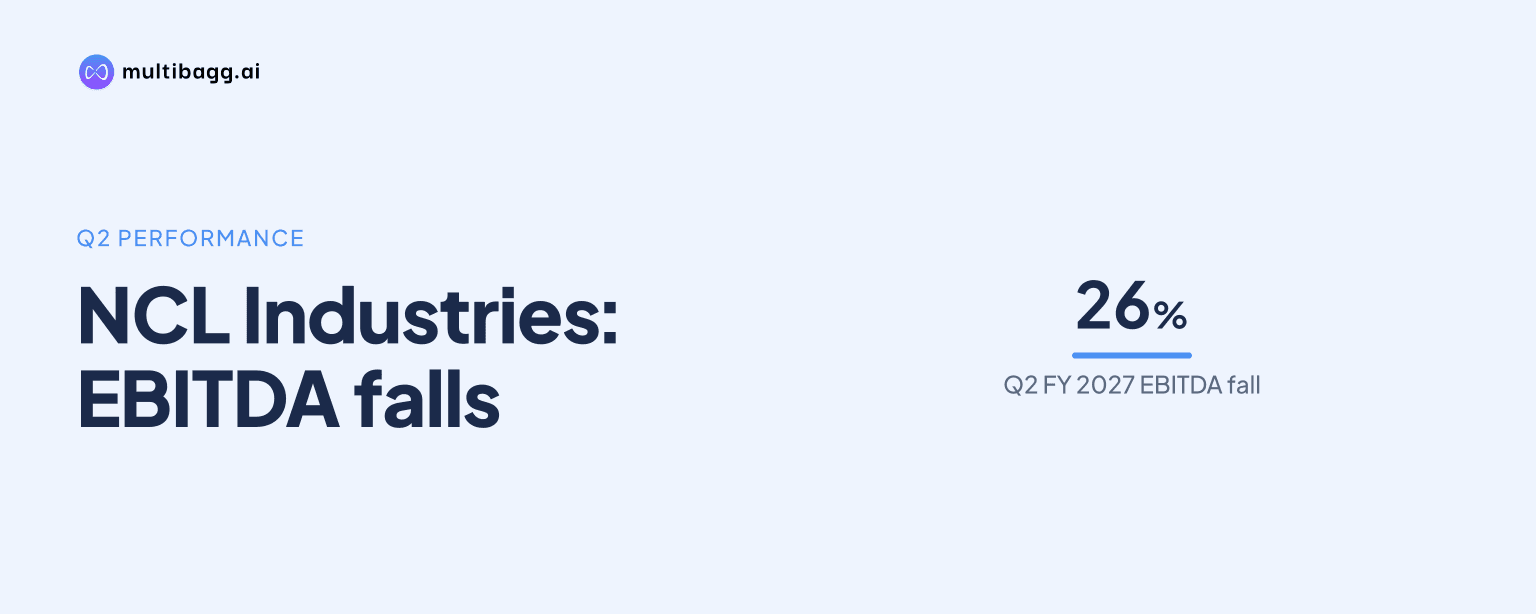
NCL Industries Limited increased cement sales volumes by 16% in Q2 FY 2027, yet consolidated EBITDA fell 26% year on year to Rs 37 crore because lower selling prices and higher raw-material and fuel costs compressed margins. Revenue rose 12% to Rs 386 crore, showing that volume growth did not offset cost and pricing pressure.
Know NCL Industries inside out
Results, valuation, peers and who's buying, in one view.
Why did NCL Industries' EBITDA fall despite higher volumes?
NCL Industries' EBITDA declined because lower cement prices and higher raw-material costs outweighed the contribution from higher sales volumes in Q2 FY 2027. Consolidated EBITDA was Rs 37 crore, down 26% year on year and 6% quarter on quarter, while the EBITDA margin contracted 502 basis points year on year to 9.64%.
Revenue from operations increased 12% both year on year and sequentially to Rs 386 crore in Q2, supported by housing and infrastructure demand during the July-to-September monsoon period. Management said cement prices remained subdued, while coal and fuel costs rose, indicating that the revenue increase was driven primarily by volume rather than higher realisations.
Fuel was a specific cost pressure. An analyst cited kiln fuel cost of Rs 144 per tonne in Q2, 22% above the year-earlier level, and management said NCL Industries was then using almost entirely Indian coal rather than pet coke. Management also said its facilities can alter the coal and pet-coke mix quickly if relative fuel economics change.
How did NCL Industries' cement division perform in Q2?
NCL Industries' cement division recorded 16% volume growth in Q2 FY 2027 and operated at 79% capacity utilisation, despite the monsoon being a seasonally softer period for cement demand. Cement revenue rose 12% quarter on quarter and 11% year on year, while division EBITDA was Rs 38 crore.
For H1 FY 2027, cement sales rose to 14.59 lakh tonnes from 12.63 lakh tonnes in the corresponding prior-year period. Half-year capacity utilisation was 74% on expanded capacity, compared with the 79% Q2 rate, and the division operates 4 million tonnes per annum of cement capacity and 2.6 million tonnes per annum of clinker capacity.
Unit profitability did not follow volume growth. Cement EBITDA was Rs 480 per tonne in Q2 and Rs 475 per tonne in H1 FY 2027, while H1 segment EBITDA was Rs 74 crore. Cement accounted for about 84% of H1 revenue, leaving consolidated profitability particularly exposed to cement prices, coal costs and plant utilisation.
The Visakhapatnam grinding unit, commissioned in FY 2025, was operating at 77% utilisation, according to management. It makes ordinary Portland cement, Portland pozzolana cement, slag cement marketed as SteelKrete, and ground-granulated blast-furnace slag for concrete applications, with sales extending into Odisha for about one year.
Which non-cement segments contributed to NCL Industries' results?
NCL Industries' cement bonded particle board division was its largest non-cement contributor, representing about 10% of H1 revenue and reporting a 14% EBITDA margin in both Q2 and H1. Bison Panel volumes increased 6% in each period, while EBITDA was Rs 5 crore in Q2 and close to Rs 10 crore in H1.
Bison Panel reduced selling prices by about 17% to 20% to improve affordability and market penetration, while starting advertising across television and social media to counter duplicate products sold under its name. The division was operating near 60% utilisation against 90,000 tonnes per annum of installed capacity; management said output could rise to 75% or 100% if orders increase.
Ready-mix concrete, or RMC, showed a different trend. Q2 RMC volumes rose 9% quarter on quarter, but H1 volumes fell 18% because of market conditions, manpower constraints and competition from unorganised suppliers. RMC EBITDA was Rs 1 crore in Q2 and Rs 1.47 crore in H1, and the segment generated about 7% of H1 revenue.
The energy division generated 9.22 million units in Q2 after its two canal-based hydropower plants produced no electricity in Q1 because water was unavailable. Of Q2 output, 1.81 million units were used captively and the balance was sold under power purchase agreements, while H1 energy EBITDA was Rs 0.63 crore.
Got a follow-up? Ask IRIS
What does NCL Industries expect for second-half margins?
NCL Industries management expects cement EBITDA per tonne to improve by around Rs 50 to Rs 60 in H2 FY 2027 from the first-half level of about Rs 470 per tonne. Management nevertheless said full-year cement EBITDA per tonne is not expected to exceed about Rs 550, which would leave the expected recovery limited relative to the first-half pricing and cost pressure.
At the company level, H1 revenue rose 7% year on year to Rs 730 crore, while EBITDA fell 25% to Rs 77 crore. The H1 EBITDA margin was 10.53%, down 453 basis points from the prior-year period, and profit after tax declined 7.2% to Rs 37 crore, with the profit-after-tax margin down 80 basis points to 5.11%.
Management expects Bison Panel's 14% EBITDA margin to improve as volumes grow, with demand described as broadly linear across all four quarters. The division's current utilisation of about 60% means the outlook depends on whether price cuts, advertising and broader market reach translate into additional orders.
How could NCL Industries' renewable project change energy costs?
NCL Industries has approved a 130-megawatt solar and wind project at Tuticorin, Tamil Nadu, with aggregate investment of about Rs 987 crore and a March 2028 commissioning target. Management described the project as 170 megawatts of solar direct-current capacity and about 31 megawatts of wind capacity, producing 130 megawatts of alternating-current capacity.
Management said Rs 675 crore, or 70% of the project cost, has been sanctioned by ICICI Bank and HDFC Bank, with internal accruals to fund the balance. The floating-rate debt costs about 8.5%, has a three-year moratorium and a nine-year repayment period, and is expected to lift the debt-to-equity ratio from 0.26 to about 0.9.
About 40% of the project's generation is intended for captive consumption, with the rest proposed for bulk consumers or the Indian Energy Exchange. Management estimated captive savings of about Rs 3 per unit, based on a purchase cost of about Rs 7 per unit and generation cost of about Rs 4 per unit, and cited potential annual savings of around Rs 70 crore.
No power purchase agreement for surplus electricity had been signed at the time of the call. Battery energy storage is not included in the approved project, although management said it was evaluating the option, while its proposed Odisha cement plant remained preliminary and subject to further evaluation and approvals.
Conclusion
NCL Industries' Q2 FY 2027 performance shows that cement demand and utilisation did not translate into operating-profit growth. Cement volumes rose 16% and revenue rose 12% to Rs 386 crore, but lower selling prices and higher raw-material and fuel costs reduced EBITDA by 26% to Rs 37 crore and compressed the margin to 9.64%.
The next measures to watch are management's planned Rs 50 to Rs 60 per-tonne H2 improvement in cement EBITDA, Bison Panel's response to its 17% to 20% price reduction, and construction progress on the Rs 987 crore renewable project ahead of March 2028. Surplus-power sales remain unresolved because no power purchase agreement had been signed.