










NHPC H1 profit rises 27% as higher output lifts revenue
Key highlights
- NHPC’s H1 FY’27 PAT rose 27% to Rs 2,645 crore from Rs 2,086 crore.
- H1 FY’27 generation increased 14% to 23,741 MUs and revenue from operations rose 26% to Rs 8,291 crore.
- Total H1 FY’27 incentives fell 47% to Rs 103 crore from Rs 265 crore.
- H1 FY’27 finance cost rose Rs 623 crore to Rs 1,162 crore, mainly due to Subansiri Lower’s part commissioning.
powered by IRIS
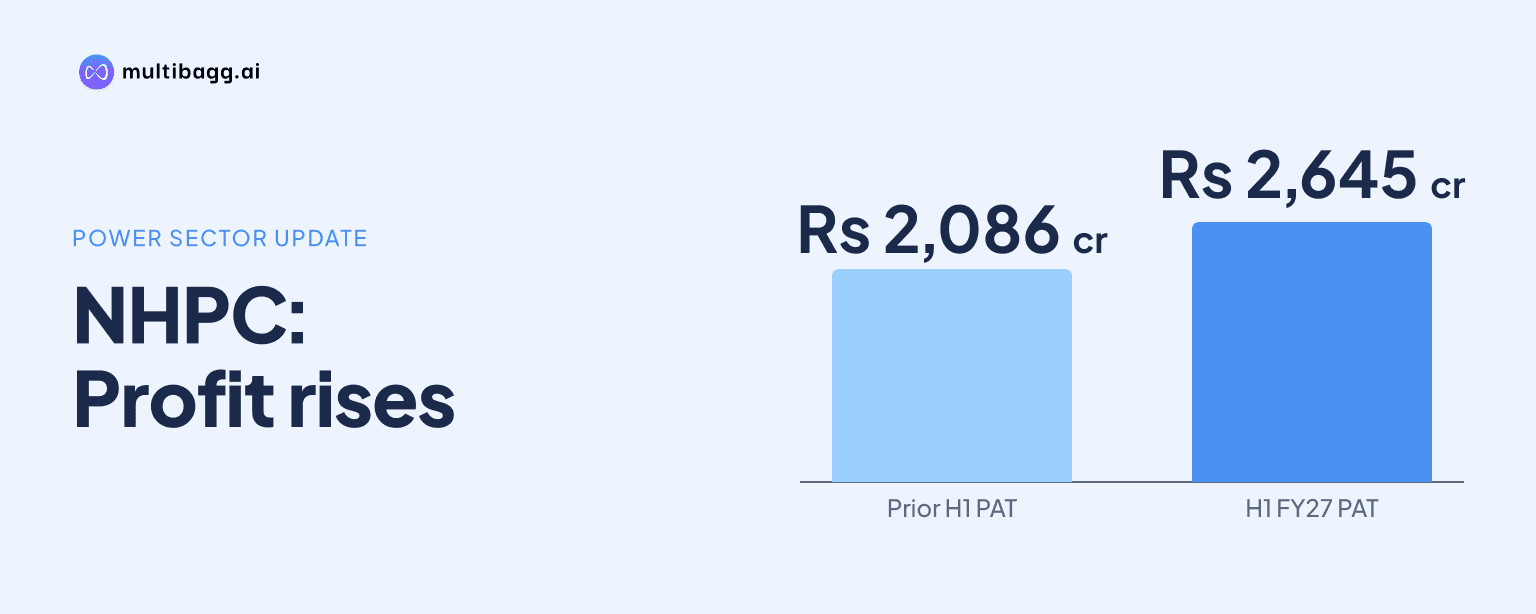
NHPC reported profit after tax of Rs 2,645 crore in H1 FY’27, up 27% from Rs 2,086 crore a year earlier, as generation rose 14% to 23,741 million units and revenue from operations increased 26% to Rs 8,291 crore. The result came despite total incentives falling 47% to Rs 103 crore and higher Subansiri-related costs.
Know NHPC inside out
Results, valuation, peers and who's buying, in one view.
Why did NHPC’s H1 FY’27 profit increase?
NHPC’s H1 FY’27 profit increased because higher electricity generation and revenue more than offset lower other income, reduced incentives and higher operating, finance and depreciation costs. Profit after tax, or PAT, rose by Rs 559 crore to Rs 2,645 crore from Rs 2,086 crore in the corresponding previous period, a gain of about 27%.
Revenue from operations increased by Rs 1,712 crore, or 26%, to Rs 8,291 crore in H1 FY’27 from Rs 6,579 crore a year earlier. Management attributed the increase to part commissioning of the Subansiri Lower Project, increased generation at Parbati-II Power Station and the resumption of commercial operations at Teesta-V Power Station.
Generation reached 23,741 million units, or MUs, in H1 FY’27, compared with 20,866 MUs in the corresponding prior-year period. That was an increase of 2,875 MUs, or about 14%. Plant availability factor, or PAF, improved to 86.67% from 81.10%, which management described as about 6% higher.
The quarterly comparison showed a sharper rise. Q2 FY’27 generation increased 17% to 13,935 MUs from 11,870 MUs, while revenue from operations rose 33% to Rs 4,482 crore from Rs 3,365 crore. Q2 PAT rose 52% to Rs 1,549 crore from Rs 1,021 crore, a Rs 528 crore increase.
How far did lower incentives affect NHPC’s earnings?
NHPC’s H1 FY’27 incentives fell by Rs 162 crore, or 47%, to Rs 103 crore from Rs 265 crore in the corresponding previous period. The decline reduced a source of earnings even as revenue rose on higher generation from commissioned and restored power capacity.
Secondary-energy incentive fell by Rs 174 crore, a 75% decrease, while PAF-based incentives declined by Rs 10 crore, which management put at 77%. Deviation charges moved in the other direction, increasing Rs 22 crore, or 105%, but that rise did not offset the decline in the other incentive categories.
The Q2 comparison was more pronounced. Total incentives were Rs 59 crore in Q2 FY’27 against Rs 253 crore in the corresponding previous-year quarter. Secondary-energy incentive declined by Rs 204 crore, or 89%, and PAF-based incentive fell by Rs 10 crore, or 77%, while deviation charges increased by Rs 20 crore, or 167%.
Other income also declined, limiting non-operating support to earnings. H1 FY’27 other income was Rs 338 crore, down Rs 156 crore, or 31%, from Rs 494 crore in the year-earlier period. Management said the comparison reflected insurance-claim income recorded in the corresponding previous period; Q2 other income similarly declined 29% to Rs 187 crore.
Got a follow-up? Ask IRIS
Which costs rose after Subansiri Lower was partly commissioned?
NHPC’s finance cost, depreciation, employee benefits and other expenses rose in H1 FY’27, mainly because costs related to the partly commissioned Subansiri Lower Project began being charged to the profit and loss account. Finance cost increased by Rs 623 crore to Rs 1,162 crore, the largest reported cost increase among these line items.
Depreciation and amortization expense rose Rs 333 crore to Rs 1,210 crore, also due mainly to the project’s part commissioning. Employee-benefit expense increased Rs 43 crore to Rs 793 crore, with management linking the rise to Subansiri-related expenses shifting into the profit and loss account after part commissioning.
Other expenses rose Rs 308 crore to Rs 1,717 crore. Management cited a Rs 207 crore increase in Subansiri Lower Project expenses and a Rs 231 crore provision related to Teesta-IV, partly offset by a Rs 92 crore decline in insurance premiums at other power stations.
Generation expenses moved lower despite the increased output. They declined Rs 40 crore to Rs 552 crore in H1 FY’27 from Rs 592 crore in the earlier period, which management attributed to lower water cess in power stations in the Union Territory of Jammu and Kashmir and no water cess in Uttarakhand following an Uttarakhand High Court verdict in NHPC’s favour.
What do generation and receivables figures show for NHPC?
NHPC’s generation improvement was supported by part commissioning at Subansiri Lower, increased Parbati-II generation and Teesta-V returning to commercial operations from July 2026. These operational changes drove the Rs 1,712 crore H1 revenue increase, while PAF rose 5.57 percentage points from 81.10% to 86.67%.
Tax expense was broadly stable despite the higher profit. H1 FY’27 tax expense was Rs 912 crore, compared with Rs 923 crore in the corresponding previous period, a decrease of Rs 11 crore. In Q2 FY’27, tax expense was Rs 536 crore, which management said was on a similar line to the previous-year quarter.
Cash collection from beneficiaries increased, but reported trade receivables also rose at the September period-end. NHPC received Rs 5,126 crore against energy sales during H1 FY’27, compared with Rs 4,764 crore in the corresponding prior-year period. Reported trade receivables stood at Rs 4,283 crore on September 30, 2026, up from Rs 2,630 crore on March 31, 2026.
The reported receivable balance included Rs 1,573 crore of unbilled debtors, down from Rs 1,887 crore at March 31, 2026. After deducting unbilled debtors and Rs 817 crore of billed receivables converted into instalments under Central Electricity Regulatory Commission tariff orders and other orders, management put the net amount due at Rs 1,893 crore, including Rs 290 crore outstanding for more than 45 days.
Conclusion
NHPC’s H1 FY’27 result reflects a rise in generation and operating revenue that exceeded a Rs 162 crore fall in incentives, lower other income and materially higher expenses associated with Subansiri Lower’s part commissioning. Revenue rose 26% and PAT rose 27%, while the mix of expenses changed as finance cost increased Rs 623 crore and depreciation rose Rs 333 crore.
The next disclosed developments are tariff decisions and further Subansiri commissioning. Management said the Parbati-II tariff matter was scheduled for a hearing on November 11 and that the interim tariff order for Subansiri was reserved, while the last Subansiri unit was expected to spill into the next financial year and its full financial impact was expected largely in FY’28 and thereafter.