










NHPC avoids uncontracted builds after 14,120 MW PPA gap
Key highlights
- NHPC signed PPAs for 9,000 MW out of 23,120 MW of renewable capacity tendered.
- NHPC said around 5,000 MW of tendered renewable capacity may not be tied up.
- NHPC has 1,190 MW of renewable capacity under construction and expects completion next year.
- NHPC awarded 73 renewable projects through its tendering process.
powered by IRIS
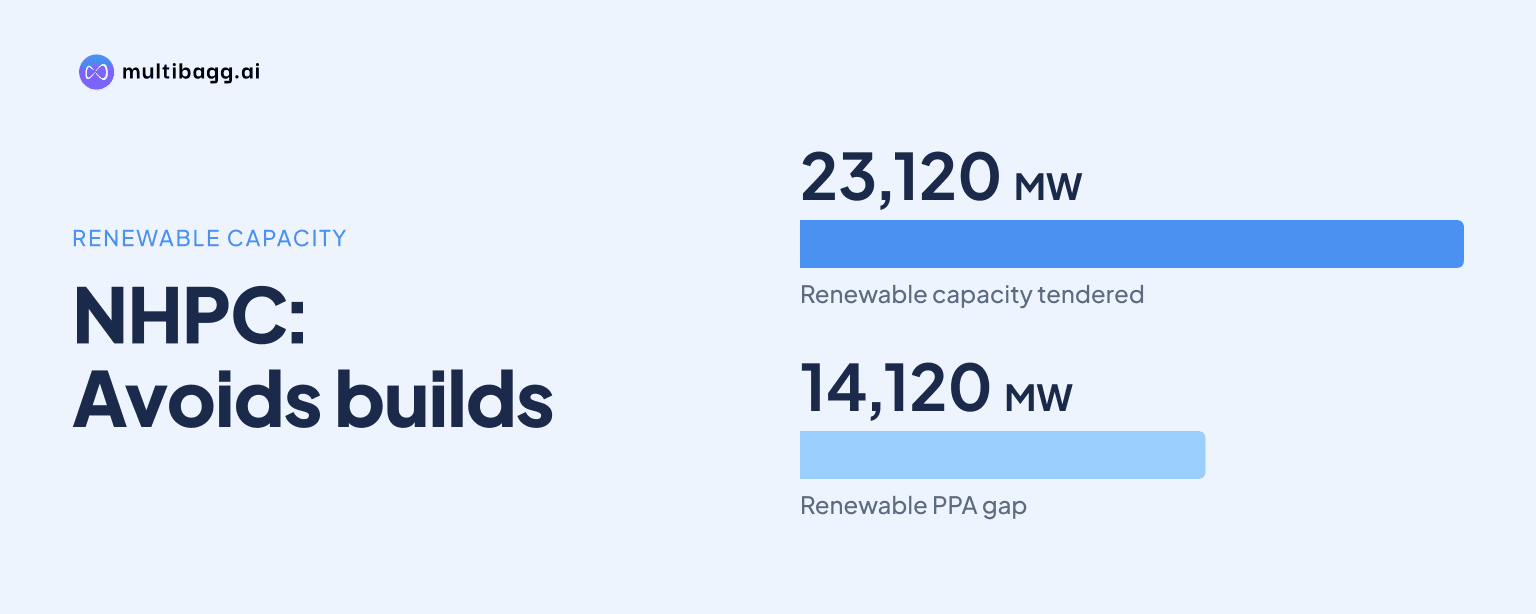
NHPC said it will not construct renewable projects without power-purchase agreements (PPAs), after signing PPAs for 9,000 megawatts (MW) of the 23,120 MW it has tendered. Management said changing state demand, daytime solar surplus and peak-hour shortages are driving a shift toward solar-storage, wind and state-specific project configurations.
Know NHPC inside out
Results, valuation, peers and who's buying, in one view.
Why is NHPC changing its renewable project strategy?
NHPC is changing its strategy because daytime solar supply, transmission constraints and altered state demand patterns have made plain-vanilla solar harder to contract for 25 years. Management said there is excess power during daytime, particularly in summer, while shortages are emerging during morning and evening peak hours. That mismatch means a project designed only to produce daytime solar output may not match the capacity or delivery profile that state buyers now require.
The company said resource-adequacy plans at states have become less settled over the past year as energy requirements and consumption patterns changed sharply. States are weighing solar, solar-wind combinations and other configurations rather than committing to a single power type for 25 years. NHPC said it is reviewing which renewable configurations can be sold on a long-term basis, rather than treating the 23,120 MW tendered pipeline as an automatic construction programme.
Management framed the contracting requirement as a financial discipline. It said NHPC does not want to build a project and then lack a PPA because that would create an unnecessary dent on finances. The policy applies as the company works as a Renewable Energy Implementing Agency (REIA), through which it has already awarded 73 renewable projects from the tenders it issued.
How large is NHPC’s contracted renewable capacity gap?
NHPC has signed PPAs for 9,000 MW out of 23,120 MW tendered, leaving 14,120 MW without signed PPAs at the point disclosed. Management said it expects a further 5,000 MW to 7,070 MW could be contracted and that total PPA-backed capacity could reach around 15,000 MW. It also said around 5,000 MW may ultimately remain untied.
The disclosed figures distinguish between project awards and contracted power sales, rather than showing a simple construction backlog. NHPC said it is discussing revised configurations for projects awarded through its REIA process, which could allow them to fit demand for different forms of power. The company did not disclose a project-by-project list of the 73 awards, their commissioning dates or the capacity that may be reconfigured.
The tendering position also explains why management did not provide a fixed aggregate solar target in response to an analyst’s question. It instead described the market as an energy-transition period in which developers, states and other stakeholders are reassessing the mix needed for long-term electricity supply. The 9,000 MW of signed PPAs is therefore the contracted base, while the remaining tendered capacity remains subject to negotiations and revised configurations.
Got a follow-up? Ask IRIS
What renewable configurations does NHPC plan to pursue?
NHPC plans to pursue solar plus battery energy storage systems (BESS), floating solar, wind and state-specific projects alongside conventional solar. Management said several states are discussing joint ventures with NHPC to develop projects inside their own borders. Those discussions cover floating solar, solar, solar-plus-BESS and wind, rather than only standalone solar plants.
State-level interest is linked to interstate transmission charges, according to management. It said states are less interested in renewable projects located in other states because of those charges and are approaching NHPC about local joint ventures instead. This approach could pair a state buyer with generation located in that state, although the company did not disclose a number of prospective joint ventures, MW allocations or expected agreement dates.
Storage is particularly relevant to the supply-demand pattern management described. Solar generation is available primarily in daytime, while NHPC identified morning and evening periods as hours of shortfall. A solar-plus-BESS configuration can be designed around a different delivery profile from plain solar, but NHPC did not provide storage capacity, duration, tariff or project-cost figures for the configurations under discussion.
NHPC also said it remains bullish on the renewable energy sector and is not considering any action on its renewable business until commissioning. When asked whether solar projects under NHPC Green Energy would be hived off, management said it would decide what to do after commissioning. That leaves the corporate structure unresolved, while the immediate focus is on projects with viable connectivity and contracted output.
What renewable capacity is already under construction?
NHPC has 1,190 MW of renewable capacity under construction and said it expects to complete all of it next year. Management attributed delayed commissioning to the availability of grid connectivity, saying the projects would have been completed faster otherwise. This makes transmission connectivity a separate execution issue from the PPA gap in tendered capacity.
The company is also working on allocations under PM Surya Ghar, involving certain states and some Central Government ministry buildings. Management said work has picked up and that it will try to complete the allocated capacity within its target timeline. It did not disclose the MW allocation, the states involved, the number of buildings or the target completion date during the call.
The contrast between the 1,190 MW under construction and the 23,120 MW tendered is central to the strategy. The construction portfolio has an identified completion objective for next year, whereas the much larger tendered pipeline is being assessed through PPA availability and customer preferences. NHPC’s stated position is that future builds should follow sale arrangements, not precede them.
Conclusion
NHPC’s renewable strategy is moving from volume tendering toward contracted and dispatch-oriented capacity. Of 23,120 MW tendered, only 9,000 MW had signed PPAs, while management cited changing state demand, daytime solar surplus, morning and evening shortages, and interstate transmission charges as reasons to favour solar-storage, wind and in-state configurations.
The next points to watch are whether the additional 5,000 MW to 7,070 MW of PPAs materialise, how much of the roughly 5,000 MW that management said may remain untied can be reconfigured, and whether the 1,190 MW under construction is completed next year. Management also plans to decide the future structure of its renewable business after commissioning, while state joint-venture discussions remain ongoing.