










Stock Market Today: Nifty gains 1.14%, Sensex rises 990 points
Key highlights
- Nifty 50 rose 286.35 points, or 1.14%, to close at 25,514.30.
- BSE Sensex gained 989.94 points, or 1.21%, to finish at 83,021.75.
- Nifty Bank rose 1,024 points to a record closing level of 63,063.
- Nifty Auto gained 4.07%, while Nifty IT fell 1.23%.
powered by IRIS
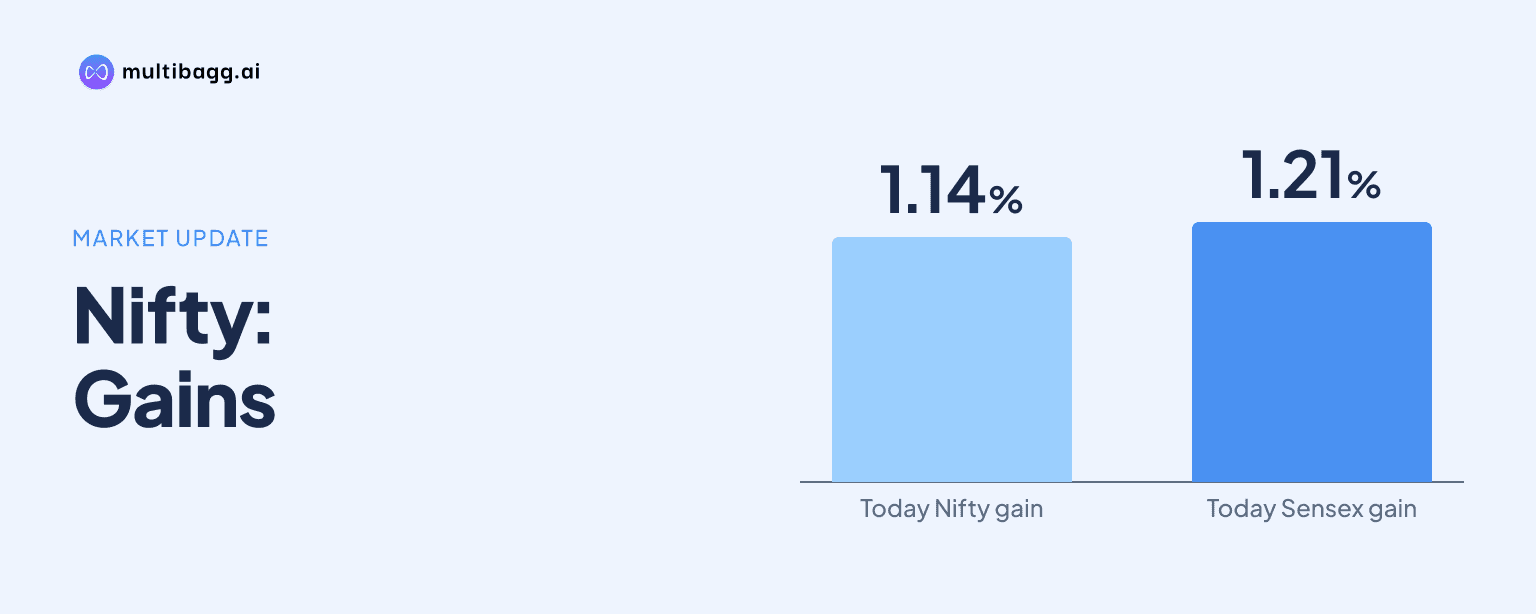
The Indian stock market rebounded sharply on November 19, 2026, with the Nifty 50 gaining 286.35 points, or 1.14%, to close at 25,514.30 and the BSE Sensex rising 989.94 points, or 1.21%, to 83,021.75. Buying in banks, autos and FMCG shares, aided by easing commodity costs and continued foreign inflows, drove the recovery.
Why did Nifty today rebound so sharply?
Nifty today erased the previous session's loss as investors returned to cyclical and domestic-demand themes after Wednesday's profit-taking. The immediate trigger was a sharp rise in automobile shares, where lower commodity prices improved expectations for manufacturers' input costs and margins. Mahindra & Mahindra, Eicher Motors and Maruti Suzuki gained between 4% and 7%, according to market reports.
FMCG stocks also attracted buying on the prospect of lower raw-material costs. Hindustan Unilever gained 4%, helping lift the defensive consumption pack. The move showed that the rally was not confined to a handful of index heavyweights: consumer-facing companies and banks joined the advance, producing a more constructive breadth picture than the preceding session.
The rebound followed a 0.63% decline in Nifty on November 18, when investors booked profits after a rapid run-up. Thursday's close above 25,500 therefore restored momentum, but it does not remove the case for caution after a strong month-to-date advance.
Which sectors led the Sensex today?
Banking, automobiles and FMCG led Sensex today, while information technology was among the few weak pockets. Nifty Bank gained 1,024 points, crossed 63,000 for the first time and ended at a record 63,063. All 12 of its constituents advanced, with State Bank of India and HDFC Bank among the largest contributors.
The auto index rose more than 3.5%, supported by easing commodity prices. Consumer durables also benefited from lower copper prices, which improve the cost outlook for air-conditioner makers. Blue Star, Voltas and PG Electroplast reportedly rose by as much as 9% during the session.
The broader sectoral scorecard underlined the rotation. Nifty Auto was up 4.07%, while Nifty Bank rose 1.48%. FMCG gained 1.76%, capital goods rose 1.59%, and the public-sector enterprise index added 1.31%. Nifty IT, however, declined 1.23%, reflecting continued caution around overseas technology demand, elevated US interest-rate expectations and uneven global sentiment toward AI-linked shares.
How did global signals affect Indian equities?
Global signals were mixed, but lower oil prices and resilient domestic flows gave Indian shares a stronger footing than many overseas markets. Federal Reserve minutes indicated that most policymakers still expected further rate increases, while comments from Governor Christopher Waller revived discussion of a larger 50-basis-point increase in December.
That stance pushed the US Dollar Index close to a 19-month high near 103.8 and remained a risk for emerging-market assets. A stronger dollar and higher US rates can raise the relative appeal of US assets, pressure emerging-market currencies and make foreign money less dependable. Those risks were visible in the continued weakness of Indian IT stocks.
Yet crude's pullback helped offset the pressure for India, a major oil importer. Brent was around $92.4 a barrel in the market commentary, while other reports placed it below $90 and more than 20% under the prior month's high. Softer crude can ease concerns over imported inflation, the current account and corporate input costs.
Asian trading was uneven. Japan's Nikkei closed higher, while Hong Kong equities weakened. Wall Street had recently been unsettled by AI valuation concerns and rate expectations, leaving global risk appetite vulnerable to changes in US yields, technology earnings and geopolitical developments.
Got a follow-up? Ask IRIS
What company developments should investors note?
Three corporate announcements stood out for investors tracking event-driven opportunities and order visibility. NLC India said its wholly owned subsidiary, NLC India Renewables, filed a draft red herring prospectus for a proposed initial public offering. The proposed issue includes a fresh issue of up to ₹3,300 crore and an offer for sale of up to 10 crore shares. The filing begins the regulatory process and could provide a clearer market valuation for the renewable-energy business.
Ashoka Buildcon disclosed that Diriyah Company cancelled a Saudi Arabia hotel construction contract valued at SAR 351.37 million for internal reasons. The cancellation matters because overseas orders can influence revenue visibility and execution plans. Investors will look for management commentary on whether the lost project is replaced by other awards or affects the order book outlook.
Tips Films received an initial public announcement from its promoters for a voluntary delisting proposal. The promoters propose to acquire 10.82 lakh shares held by public shareholders and seek delisting from the BSE and National Stock Exchange. The eventual outcome depends on the regulatory process, price discovery and public shareholder response.
What should investors watch after this rally?
Investors should distinguish between the day's strong price action and the broader liquidity backdrop. Foreign institutional investors have put nearly ₹1 trillion into Indian equities this month, according to market commentary, which has supported large-cap valuations and helped the market withstand a firmer dollar. Such flows can be powerful but may reverse quickly when global rate expectations shift.
Near-term attention will remain on the Federal Reserve's December decision, US inflation signals, Treasury yields and crude oil. Any evidence that policy tightening will be more aggressive than markets expect could pressure the rupee and rate-sensitive equity valuations. Conversely, a sustained easing in oil and continued foreign buying would remain supportive for domestic cyclicals.
For stock selection, the session reinforced the appeal of companies with exposure to lower input costs, domestic consumption and credit growth. It also highlighted why investors should avoid treating all sectors alike: IT remains more sensitive to global growth and US-rate expectations, while autos and FMCG currently have a clearer cost tailwind.
Conclusion
The November 19 recovery put the stock market today back on a firm footing: Nifty closed above 25,500, Sensex reclaimed 83,000 and Nifty Bank set a record. The rally was driven chiefly by bank, auto and FMCG buying, with lower commodity costs and strong foreign inflows outweighing the immediate drag from hawkish Federal Reserve signals.
Next, investors should track the Federal Reserve's December policy meeting, movement in Brent crude, US dollar strength and the durability of foreign portfolio flows. At the company level, NLC India Renewables' IPO review, Ashoka Buildcon's order-book response and the Tips Films delisting process are the disclosed developments that merit follow-through.