










RHI Magnesita India Reports ₹1,030 Crore Q2 FY27 Revenue
Key highlights
- RHI Magnesita India reported Q2 FY27 revenue of ₹1,030 crore, above ₹1,000 crore for the second straight quarter.
- Q2 FY27 EBITDA was ₹144 crore and the EBITDA margin was 14%, up 332 basis points year-on-year.
- Q2 FY27 profit after tax rose 62% year-on-year to ₹62 crore.
- H1 FY27 EBITDA rose 36% to ₹291 crore, while profit after tax increased 72% to ₹127 crore.
powered by IRIS
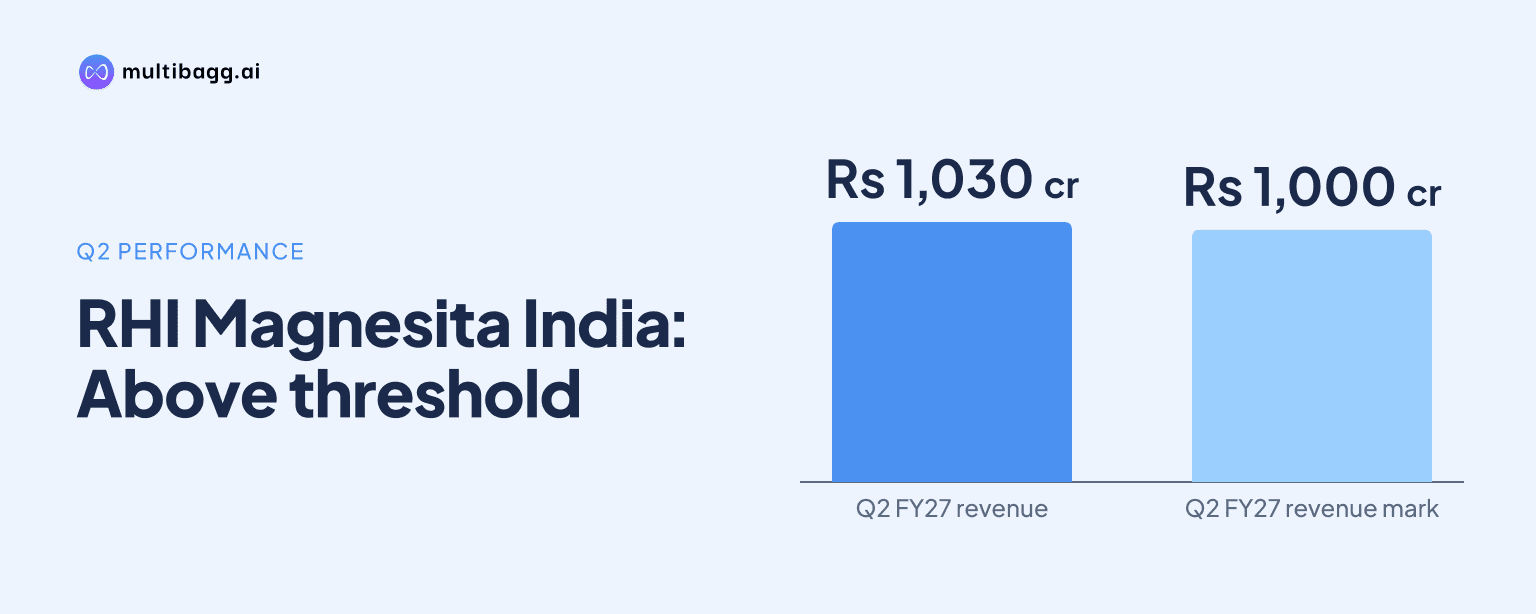
RHI Magnesita India Limited reported Q2 FY27 revenue of ₹1,030 crore, its second consecutive quarter above ₹1,000 crore, while EBITDA margin reached 14%. The company said disciplined commercial execution, product mix and cost competitiveness supported profitability despite a challenging operating environment.
Know RHI Magnesita India inside out
Results, valuation, peers and who's buying, in one view.
Why did RHI Magnesita India’s Q2 FY27 result matter?
RHI Magnesita India delivered broadly stable revenue sequentially in Q2 FY27 and retained revenue above the ₹1,000 crore threshold for a second quarter. For a refractory supplier operating in an environment marked by demand, cost and capacity pressures, the result showed that it maintained its sales level while improving operating profitability.
The main financial improvement was in margin. EBITDA stood at ₹144 crore and the EBITDA margin rose 332 basis points year-on-year to 14%, which management said was above its guidance. Profit after tax increased 62% year-on-year to ₹62 crore, indicating that the operational improvement also translated into higher net earnings.
How did RHI Magnesita India perform in the first half?
RHI Magnesita India reported H1 FY27 revenue of ₹2,044 crore, up 2% year-on-year. The half-year performance reflected stronger realisations and disciplined costs, according to the management summary shared with investors.
H1 EBITDA increased 36% year-on-year to ₹291 crore, with the EBITDA margin at 14.2%, up 353 basis points from a year earlier. H1 profit after tax rose 72% to ₹127 crore. The first-half figures indicate that the Q2 margin improvement was part of a stronger six-month profitability performance rather than an isolated quarterly movement.
What supported RHI Magnesita India’s margins?
RHI Magnesita India attributed the Q2 outcome to its commercial approach, product mix, cost competitiveness and operational execution. Management said it prioritised value-generating orders rather than volume alone, while an improved flow-control mix supported realisations.
These measures were implemented despite higher material, energy, freight and logistics costs. The company described the operating environment as challenging, making the 14% EBITDA margin significant because it was achieved alongside those cost pressures rather than after their removal.
Management also referred to 4PRO solutions as part of its profitable-growth strategy. The company did not provide volume or revenue guidance during the call. Its stated approach therefore remained centred on order quality, pricing and mix, rather than on setting a near-term sales-volume target.
Got a follow-up? Ask IRIS
What does the update mean for RHI Magnesita India’s operations?
RHI Magnesita India said it had started a quartzite mine and had a large silica order book. Management indicated that the CoCo silica order would keep production lines filled for about 18 months, giving the company an identified order base for execution.
The update also placed the results in the context of steel-sector activity. The call summary cited H1 steel demand growth of about 7.2% and crude-steel growth of about 2.8%, while management said Q3 steel orders were strong. Since refractory products are used in high-temperature industrial processes, steel demand and customer order patterns are relevant to operating activity.
For investors, the key reported facts are stable quarterly revenue, a higher margin and faster growth in profit after tax. At the same time, the company identified refractory overcapacity and elevated input, energy and logistics costs as continuing challenges. The available information does not establish how these factors will affect later quarters.
How should investors assess the Q2 FY27 earnings update?
RHI Magnesita India’s result shows a clear gap between modest revenue growth and stronger profit growth. H1 revenue increased 2% year-on-year, while EBITDA and profit after tax rose 36% and 72%, respectively. This means margin management, realisations and cost discipline were more important to the reported improvement than top-line expansion.
The second consecutive quarter above ₹1,000 crore in revenue provides a useful operating benchmark, but the company said Q2 revenue was broadly stable versus the preceding quarter. Investors assessing the update may therefore focus on whether the value-focused order strategy can preserve margins amid higher costs and industry capacity pressure.
Conclusion
RHI Magnesita India reported ₹1,030 crore of Q2 FY27 revenue, ₹144 crore of EBITDA and ₹62 crore of profit after tax. The result was defined by a 14% EBITDA margin, up 332 basis points year-on-year, supported by product mix, order selection and cost competitiveness despite a difficult operating environment.
The next operating indicators disclosed by the company include execution of the silica order book, which management said could fill lines for about 18 months, the contribution from the quartzite mine, and demand conditions in the steel sector. Input, energy, freight and logistics costs, along with refractory overcapacity, remain unresolved factors identified during the call.