










RHI Magnesita flow-control mix masks rising input inflation
Key highlights
- RHI Magnesita reported H1 FY27 revenue of Rs 2,044 crore, up 2% year on year.
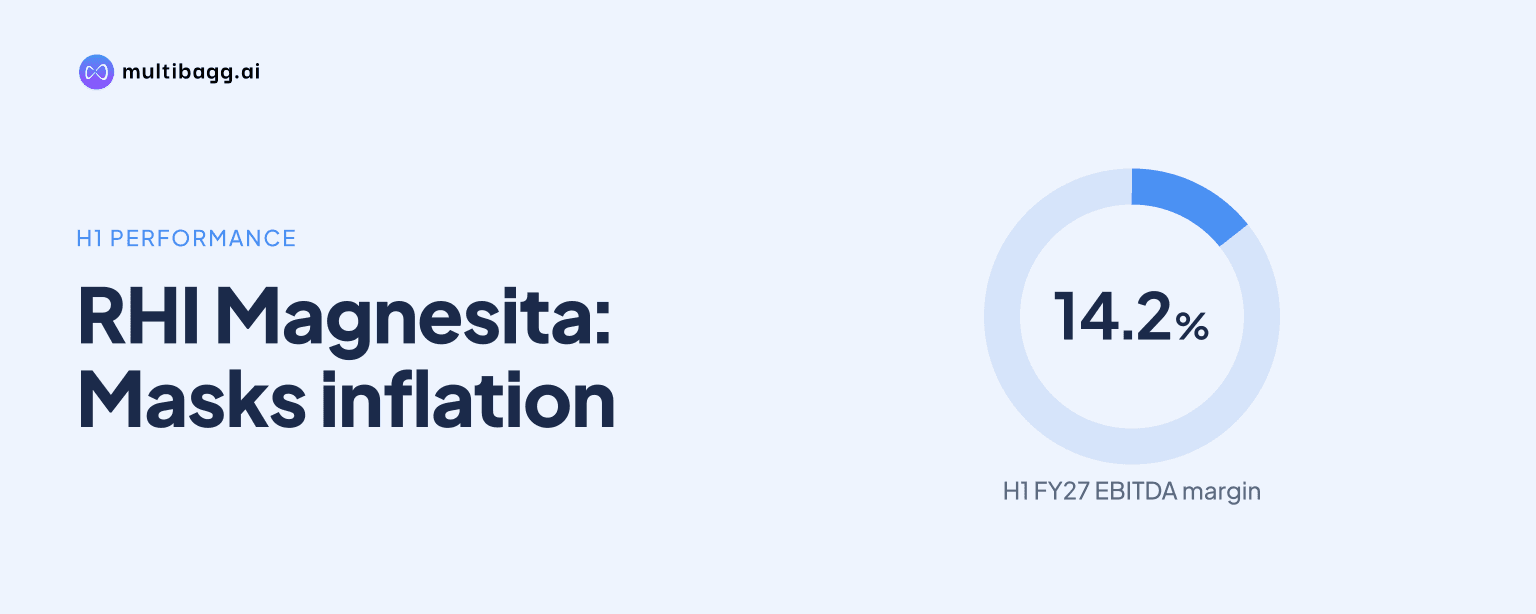
- RHI Magnesita's H1 FY27 EBITDA rose 36% to Rs 291 crore and margin increased 353 basis points to 14.2%.
- RHI Magnesita's H1 FY27 working-capital intensity reached 38%, while operating cash flow was Rs 99 crore.
- RHI Magnesita expects captive quartzite sourcing by the next financial year and estimates a 3% to 3.5% full-year EBITDA improvement.
powered by IRIS
RHI Magnesita said its flow-control product mix raised realization and partly masked rising raw-material costs in Q2 FY27, while H1 FY27 working-capital intensity rose to 38% as it built inventory for supply resilience and large silica orders. Management identified bauxite, fused magnesia and DBM as inputs with particularly sharp price increases.
Know RHI Magnesita India inside out
Results, valuation, peers and who's buying, in one view.
Why did flow control mask RHI Magnesita's input-cost increase?
Flow control masked some input-cost pressure because RHI Magnesita measures those products in pieces rather than tonnes, allowing higher-value sales to lift realization without a comparable rise in reported volume. Management said flow-control revenue increased both quarter on quarter and year on year, and that the resulting product mix obscured higher material costs in the profit and loss account.
Management attributed the mix change partly to higher flow-control market share, including at public-sector steel customers that commonly use six-month or 12-month tender cycles. It also said the quarter was atypical because RHI Magnesita deliberately stepped away from some low-margin orders due to external market conditions. That decision changed the relation between shipment tonnage, revenue and realization.
An analyst asked whether the Rs 87,000-per-tonne realization cited for the quarter could continue through H2 and into FY28 and FY29. RHI Magnesita gave no realization guidance, saying steel order cycles, cement sales and hard-to-forecast industrial orders all affect the figure. Management described the quarter as a slight anomaly but called flow control a future growth pillar.
Which costs and orders increased RHI Magnesita's inventory?
RHI Magnesita identified four reasons for the H1 FY27 inventory build: higher raw-material prices, preparation for large silica orders, other industrial project orders, and selective stockholding for supply resilience. Management ranked raw-material inflation as the most severe factor, noting that inventory value can increase quarter on quarter even when physical tonnage is unchanged.
Bauxite, fused magnesia and DBM recorded the sharpest increases, according to management. It said DBM and fused-magnesia prices rose sharply from the preceding month, while bauxite had risen about two months earlier. Resins and other alumina-based products started rising during the Middle East war crisis, while energy costs and ocean freight further lifted landed costs.
The silica-order preparation involved buying moulds and starting production ahead of delivery, RHI Magnesita said. Its Rajgangpur silica line was fully booked for more than one year because of large coke-oven orders, which management said would take more than a year to execute. The inventory build therefore reflected both costlier inputs and production commitments.
How did inventory affect RHI Magnesita's H1 FY27 cash conversion?
Inventory raised working-capital intensity to 38% in H1 FY27, but RHI Magnesita still generated Rs 99 crore of operating cash flow during the six months. Management said it is focusing on cash conversion, inventory optimisation and receivables management, but did not disclose a target level or date for reducing working-capital intensity.
Reported earnings improved despite the inventory burden. Revenue from operations rose 2% year on year to Rs 2,044 crore in H1 FY27, while earnings before interest, tax, depreciation and amortisation, or EBITDA, rose 36% to Rs 291 crore. EBITDA margin expanded 353 basis points to 14.2%, and profit after tax increased 72% to Rs 127 crore.
Management linked the earnings improvement to product mix, realization and cost management, while separately explaining that the flow-control mix made material-cost inflation less visible. The comparison matters because margin expansion and a 38% working-capital intensity occurred in the same H1 FY27 period, rather than representing evidence that input costs had eased.
Got a follow-up? Ask IRIS
How is RHI Magnesita responding to raw-material supply risk?
RHI Magnesita plans to shift some imported raw materials to domestic suppliers, a structural move management said would improve supply-chain resilience. The plan follows increases in base material prices, energy costs and ocean freight, but management did not quantify the expected saving from domestic sourcing. Recycling, operational optimisation and digital offerings are additional planned changes.
The quartzite-mining initiative is a separate supply action supporting silica production. Management said running its own mines could create a 3% to 3.5% improvement in full-year EBITDA, and expects quartzite consumption to become fully captive by the next financial year. It connected the initiative to the Rajgangpur silica line, which is booked for more than one year.
RHI Magnesita is also seeking a balance between volume and value after dropping selected low-margin, low-net-sales-realisation steel products. Management said volumes would improve in subsequent quarters but provided neither a numerical forecast nor capacity-utilisation guidance. Its stated approach is therefore to prioritise an appropriate product mix alongside higher throughput.
What targets and order developments has RHI Magnesita disclosed?
For FY28, RHI Magnesita reaffirmed management's expectation of around 7% volume growth, or volume growth above the market, together with a 13% EBITDA margin. Management gave no revenue guidance, realization target or raw-material-price outlook. The FY28 expectation was maintained despite the inflationary pressures discussed in the call.
Management said Q3 had a very strong order book across steel and coke-oven orders. It expects some project orders to start in the second half, and said coke-oven orders should improve Rajgangpur capacity utilisation over an execution period exceeding one year. It did not provide margin guidance for project orders.
Beyond steel, management outlined coal gasifiers, glass, aluminium and product technology transfers as areas of focus. It said an MGG bricks technology transfer from the Dalian plant to Rajgangpur was ramping up, but stressed that product transfers remain at an early stage. Management declined to provide a 15% to 18% revenue-growth forecast for FY28.
Conclusion
RHI Magnesita's H1 FY27 results show that higher-value flow-control sales and selective order choices supported a 14.2% EBITDA margin even as bauxite, fused magnesia, DBM, freight and energy costs increased. The associated inventory response raised working-capital intensity to 38%, while Rs 99 crore of operating cash flow showed that the company remained cash-generative during the build.
Next, management's plan to achieve fully captive quartzite sourcing by the next financial year and execute coke-oven orders over more than one year will be important. The disclosed FY28 expectation of around 7% volume growth and a 13% EBITDA margin, alongside the unresolved timing of inventory optimisation and domestic sourcing, provides the key measures to watch.