










RHI Magnesita sees a 3%-3.5% EBITDA lift from quartzite
Key highlights
- RHI Magnesita management expects captive quartzite mining to improve overall EBITDA by 3%-3.5%.
- One RHI Magnesita quartzite mine began operating towards the close of Q2 FY27.
- RHI Magnesita reported H1 FY27 EBITDA of Rs 291 crore, up 36% year on year.
- RHI Magnesita’s Rajgangpur silica line is booked for more than one year after coke-oven orders.
powered by IRIS
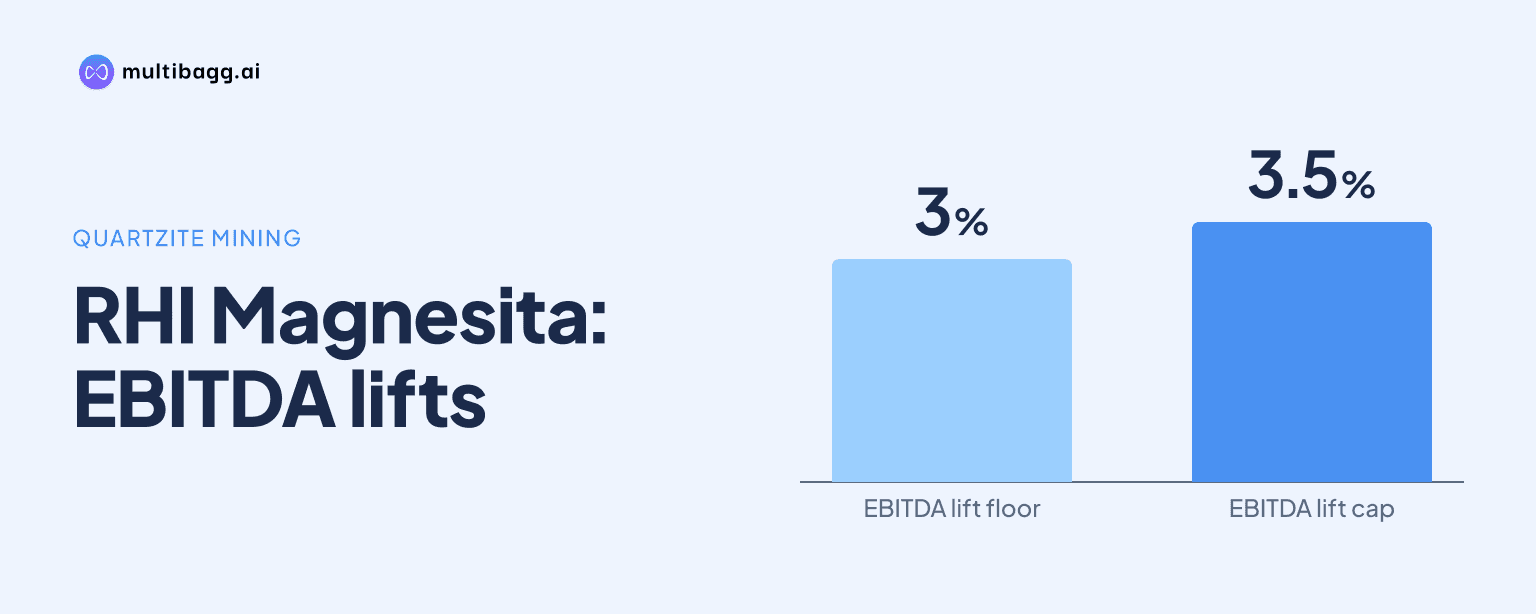
In Q2 FY27, RHI Magnesita India Limited said operating its own quartzite mines could improve overall earnings before interest, tax, depreciation and amortisation (EBITDA) by 3%-3.5% for the full year, and management plans to be fully captive in quartzite by the next financial year. One mine started operating near the quarter’s close.
Know RHI Magnesita India inside out
Results, valuation, peers and who's buying, in one view.
How much could quartzite mining improve RHI Magnesita’s EBITDA?
RHI Magnesita expects captive quartzite mining to create a 3%-3.5% improvement in overall EBITDA. Managing Director and Chief Executive Officer Pankaj Malhan made the estimate during the Q2 and H1 FY27 call, clarifying that the benefit applied to overall EBITDA rather than only to raw-material costs.
The 3%-3.5% figure is management’s forward-looking estimate, not a reported FY27 result. RHI Magnesita did not disclose the capacity, output, reserves or operating cost of the mine, nor did it provide a rupee value for the projected benefit or state the share of quartzite that is currently bought from outside suppliers.
The estimate comes against Q2 FY27 EBITDA of Rs 144 crore and an EBITDA margin of 14%. That margin was 332 basis points higher year on year, while revenue from operations was Rs 1,030 crore. A basis point is one-hundredth of a percentage point.
When will RHI Magnesita become fully captive in quartzite?
RHI Magnesita plans to become fully captive in quartzite by the next financial year. Mr Malhan said the transition would be gradual and that management was working towards being fully on its own resources by that period.
The initial operating milestone occurred towards the close of Q2 FY27, when RHI Magnesita began operations at one quartzite mine. Management said this should improve cost competitiveness and make the supply chain more resilient, but it did not identify the mine or specify how many additional operating steps are required for full captive sourcing.
Quartzite is relevant to RHI Magnesita’s silica production. Management said large coke-oven orders had booked the silica line at its Rajgangpur plant for more than one year, and that the orders would take more than a year to execute. The company did not disclose the orders’ commercial value or volume.
How does the mine plan compare with RHI Magnesita’s current results?
RHI Magnesita’s H1 FY27 EBITDA rose 36% year on year to Rs 291 crore, while revenue increased 2% to Rs 2,044 crore. The difference between EBITDA and revenue growth coincided with improved product mix, higher realisations and commercial decisions, which management cited as drivers before the full mining benefit is expected.
RHI Magnesita reported Q2 FY27 revenue of Rs 1,030 crore, broadly stable from the preceding quarter and above Rs 1,000 crore for a second consecutive quarter. Q2 profit after tax was Rs 62 crore, up 62% year on year, and management attributed profitability to pricing discipline, operational execution and a higher-value product mix.
The quartzite initiative is not management’s stated explanation for the H1 margin expansion. The company said it chose value-generating orders in a difficult market and also reported increased flow-control business, whose products are measured in pieces rather than tonnes. This affected reported volume comparisons while improving realisation rates.
Got a follow-up? Ask IRIS
Why is quartzite supply important for RHI Magnesita now?
Quartzite supply matters because RHI Magnesita is supporting silica production for coke-oven orders while input, freight and energy costs have increased. Management said the Rajgangpur silica line was completely booked for more than a year, and described mining operations as a major driver for future silica production.
RHI Magnesita cited rising prices for bauxite, fused magnesia and dead-burned magnesia, or DBM, alongside higher ocean freight and energy costs. Its H1 FY27 working-capital intensity increased to 38%, primarily from inventory built for raw-material availability, silica orders and supply-chain resilience.
Operating cash flow nonetheless remained positive at Rs 99 crore in H1 FY27, while cash and cash equivalents stood at Rs 456 crore at the end of September 2026. The inventory build-up also included mould purchases and production in anticipation of fulfilling large silica orders, according to management.
What else could affect RHI Magnesita’s mine-related benefit?
RHI Magnesita’s realised benefit will depend on production, product mix and the progression to full captive supply by the next financial year. Management did not provide EBITDA-margin guidance, noting that steel order cycles, cement activity and industrial orders can influence the revenue mix and realisation rates.
The company is also pursuing domestic sourcing of some imported raw materials, a structural initiative separate from captive quartzite mining. Management said this change could improve supply-chain resilience after six months of elevated logistics, energy and raw-material costs, but it gave no timeline or quantified savings target for broader domestic sourcing.
RHI Magnesita is simultaneously pursuing new applications and product transfers, including thin-slab caster trials with a large Indian account and MGG brick technology transfer from Dalian to Rajgangpur. Management also identified recycling, coal gasifiers, glass and aluminium as areas of focus, which may change the business mix alongside the mine transition.
Conclusion
RHI Magnesita has attached a specific profitability estimate to quartzite backward integration: management expects its mines to improve overall EBITDA by 3%-3.5% once captive sourcing is established. The first mine was operating near the end of Q2 FY27, while the company’s reported H1 EBITDA growth reflected product mix, realisations and commercial discipline rather than a disclosed full mining contribution.
The next item to watch is progress against management’s plan to become fully captive in quartzite by the next financial year. Investors can also track silica-line utilisation at Rajgangpur, where coke-oven orders are booked for more than a year, and subsequent disclosures on inventory, input costs and EBITDA as mine operations scale.