










RHI Magnesita says refractory overhang will prolong pressure
Key highlights
- RHI Magnesita says Indian refractory capacity is already scaled for 300 million tonnes of steel-production capability.
- Indian steel demand grew 7.2% in H1, while crude-steel production rose 2.8%.
- RHI Magnesita added 2 new steel-sector customers during the quarter.
- The Chiraipani mine has commenced operations with annual capacity of 40,000 tonnes.
powered by IRIS
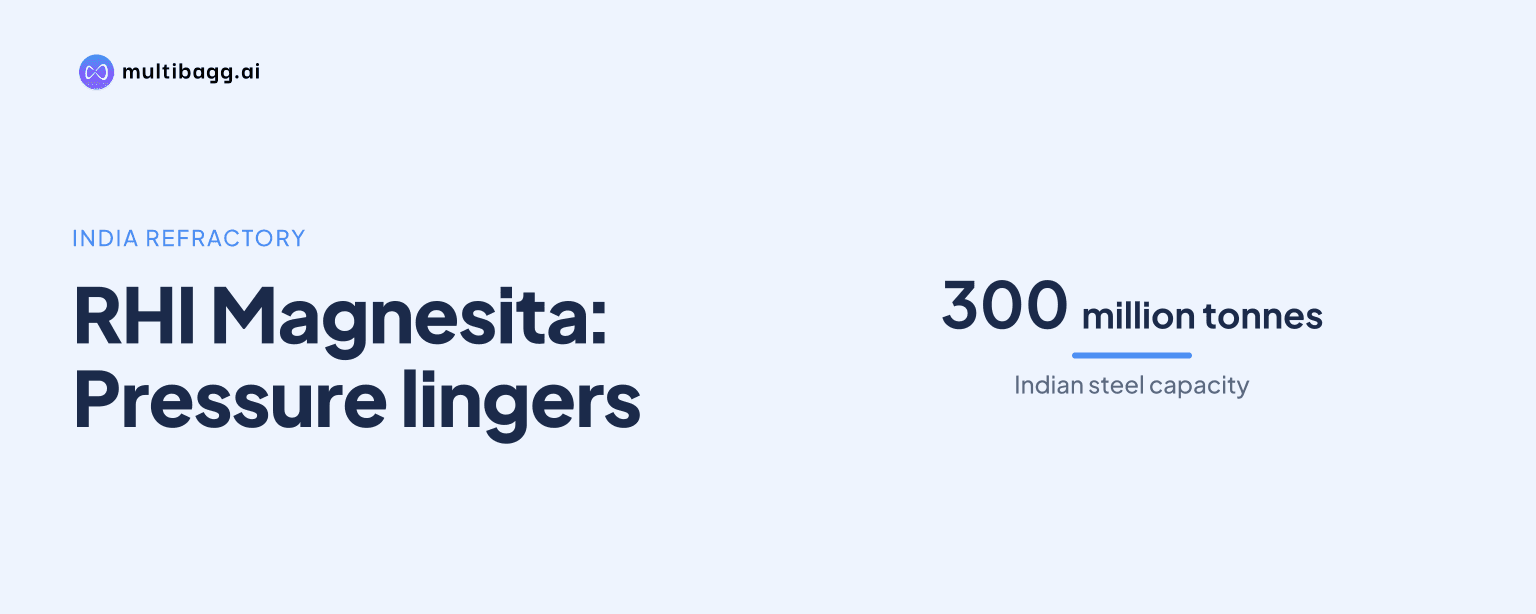
RHI Magnesita India Limited said in H1 that India’s refractory industry had already scaled capacity to the National Steel Policy 2017 benchmark of 300 million tonnes of steel-production capability, leaving a capacity overhang despite 2.8% crude-steel production growth. Management said competitive intensity would therefore continue for some time.
Know RHI Magnesita India inside out
Results, valuation, peers and who's buying, in one view.
Why does RHI Magnesita expect refractory overcapacity to persist?
RHI Magnesita expects the overhang to persist because refractory capacity has been built for 300 million tonnes of domestic steel-production capability before steel output has absorbed that supply. Management linked this assessment to the National Steel Policy 2017 and said the refractory industry had already scaled itself to that level.
India remains a growth market for steel and other industrial sectors, according to management, but that growth also creates opportunities for more refractory suppliers. RHI Magnesita’s conclusion was that customer-industry expansion does not by itself remove supply pressure when refractory capacity has been installed ahead of realised steel production.
The 4.4-percentage-point difference between H1 steel-demand growth and crude-steel production growth is central to management’s view. RHI Magnesita said refractory-industry growth tracked the 2.8% increase in crude-steel production more closely than the 7.2% rise in steel demand, indicating that demand growth had not yet translated into equivalent refractory consumption.
How is RHI Magnesita managing volume and pricing pressure?
RHI Magnesita has made a selective trade-off between volume and value by dropping some low-margin, low-net-sales-realisation, or NSR, steel products. Management said this was a deliberate short-term recalibration while it restructures parts of its steel-sector strategy, rather than a result of flow-control products being lighter than other refractory products.
The company said it gained market share in flow control, a portfolio sold in pieces rather than tonnes and described by management as higher-margin. It did not quantify the market-share gain, give a bricks-and-monolithics volume split, or disclose the proportion of shipments manufactured internally versus sourced through trade.
Management said its objective is to improve volumes in subsequent quarters, but it declined to give forward guidance. It said the earlier 7%-9% volume-growth endeavour remained the team’s aspiration, while the immediate focus was on achieving profitable and sustainable growth rather than taking every available steel order.
Where could RHI Magnesita’s volumes recover?
RHI Magnesita identified project orders, iron making, direct reduced iron, or DRI, and pellet applications as potential contributors to volumes in upcoming quarters. Management said its project-order pipeline was healthy and that some project orders should begin to take effect in the second half.
For coke ovens, management said one order could arise during the current quarter, while it did not identify other near-term orders at that point. Iron making is another growth area, where RHI Magnesita cited improved market share and expected top-line support from coke-oven orders.
In DRI and pellet applications, the company said it had converted orders that should flow through the profit and loss account in upcoming quarters, though not necessarily in the next quarter. Management described the work as capable of delivering sustainable revenue and profitability, but gave no order value or revenue timing.
Cement shows why that approach may constrain short-term volume. RHI Magnesita said the second quarter is normally important for cement orders, but it did not participate in certain opportunities because it did not consider them value-accretive, contributing to a significant year-on-year and half-year gap.
Got a follow-up? Ask IRIS
How is RHI Magnesita pursuing higher-value customer work?
RHI Magnesita is seeking longer-term contracts and solution-based customer relationships in response to price competition. Management said it is focused on becoming more than a product supplier, including through customer solutions that support kiln performance and energy conservation in cement.
The company is discussing its 4PRO solution with the world’s three largest cement players, according to management. RHI Magnesita said it wants to replicate this model to gain cement market share through work it considers value-creating, but it did not provide revenue, order-book or market-share targets for 4PRO.
Competition remains relevant in coke ovens as well. Management said there are two major manufacturers in India for this application and described RHI Magnesita as the largest, while noting continued competition from Chinese suppliers. India is expected to add about 30 million tonnes of coke-oven capacity over the next six to eight years, management said.
RHI Magnesita is working to improve coke-oven production capability through internal checks and measures without additional capital expenditure for that programme. This focus on internal improvement fits management’s wider position that pricing and delivered value must be balanced in an industry facing continued capacity pressure.
What is RHI Magnesita doing beyond core steel markets?
RHI Magnesita plans to broaden its industrial portfolio through coal gasifiers, glass, aluminium and technology transfers from its global parent. Management said it is building teams and parent-company synergies around a coal-gasifier product, while describing glass as a high-margin business where it wants a stronger presence.
In aluminium, RHI Magnesita said its current foothold is weak but that it sees headroom to expand. It is also developing a glass centre of competency in India, although management said product transfers are at an early stage and did not offer numerical targets for industrial revenue or mix.
One named technology transfer is MGG bricks from the Dalian plant to the Rajgangpur plant. Management said transferring products and technology to India is a cornerstone of its strategy, aimed at improving competitiveness in both project business and maintenance applications.
Raw-material integration is another operational initiative. The Chiraipani mine, with annual capacity of 40,000 tonnes, has commenced operations, while the Bhikampali mine in Odisha was on track to start in the following quarter, according to management. Capital spending is directed at equipment reliability, product technology transfers and compliance.
Conclusion
RHI Magnesita’s assessment is that steel-market growth will not quickly eliminate the refractory industry’s supply imbalance. Capacity already scaled to 300 million tonnes of steel-production capability, alongside H1 crude-steel production growth of 2.8%, supports management’s expectation of continued competition. Its response is to avoid selected low-NSR volumes, build flow-control share and pursue project-led demand in iron making, DRI, pellets and selected industrial markets.
The next evidence will be whether the project-order pipeline begins converting into revenue in the second half and upcoming quarters, and whether Bhikampali starts operations in the following quarter as management expects. Management also said it hoped to have a stronger industrial-segment story by the first quarter of the next year as technology transfers, glass, aluminium and coal-gasifier initiatives progress.