










RHI Magnesita targets projects after selective cement exit
Key highlights
- RHI Magnesita reaffirmed around 7% FY28 volume growth and a 13% EBITDA margin target.
- RHI Magnesita said no project orders contributed in the quarter discussed, but some should begin in the second half.
- India's H1 steel demand grew 7.2%, compared with 2.8% crude-steel production growth, according to management.
- RHI Magnesita started its 40,000-tonne annual-capacity Chiraipani mine and expects Bhikampali to start next quarter.
powered by IRIS
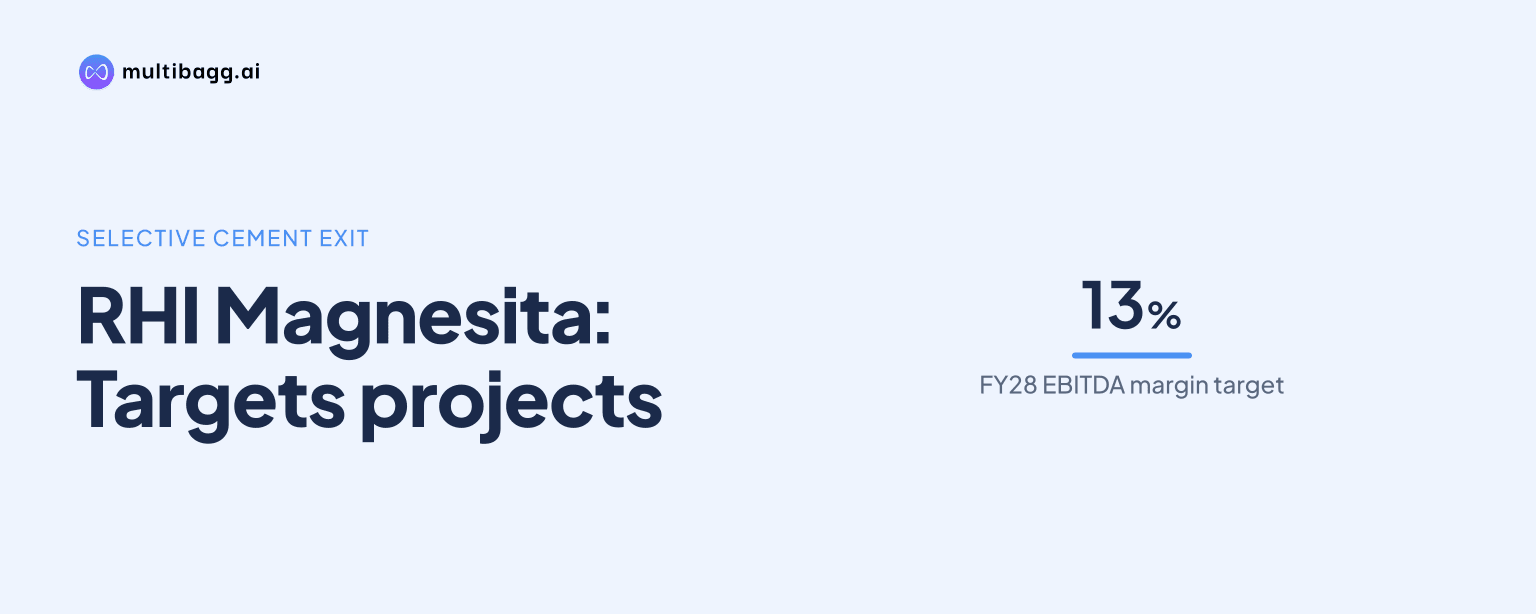
For FY28, RHI Magnesita is targeting growth from coke-oven, direct reduced iron (DRI) and pellet projects after selectively declining cement work it judged not value-accretive, while maintaining around 7% volume growth and a 13% earnings before interest, tax, depreciation and amortisation (EBITDA) margin target.
Know RHI Magnesita India inside out
Results, valuation, peers and who's buying, in one view.
How will RHI Magnesita restart growth?
RHI Magnesita plans to restart growth through a balance of volume and value, with project orders, flow control and selected customer contracts taking priority over lower-value business. Management said it deliberately dropped some low-margin, low-net-sales-realisation products in steel while gaining market share in flow control, a portfolio measured in pieces rather than tonnes. This product mix means shipment tonnage does not capture all flow-control growth, while the higher-value product mix supports reported realisations.
An analyst said RHI Magnesita's turnover had remained around Rs 1,000 crore for several quarters despite industry growth. Management accepted the observation that a strategy recalibration had occurred, but said it was reinforcing long-term customer contracts and building a solutions-based model rather than acting only as a product supplier. The company said volumes should improve in subsequent quarters, although management did not provide revenue guidance or a numerical quarterly volume forecast.
India's H1 steel demand grew about 7.2%, while crude-steel production rose 2.8%, according to management. RHI Magnesita said refractory-industry growth was broadly similar to crude-steel production growth, but that flow control helped it outperform that market during H1. The comparison indicates why management is seeking growth from applications beyond conventional steel refractory volumes, including iron making and industrial project work.
Which project orders could drive RHI Magnesita growth?
Coke ovens, DRI and pellet applications are the project areas RHI Magnesita identified for future growth. Management said no project orders contributed in the quarter discussed on the call. As of the call, however, it said one coke-oven order could proceed in the current quarter and that some project orders should begin contributing during the second half. It described the wider project-order pipeline as healthy without disclosing its value, customers or expected margins.
RHI Magnesita said iron making is a clear growth area, with coke-oven orders expected to add revenue as its position improves. In DRI and pellet applications, management said it has a strong profile, has completed the required work and has converted orders. The company expects these orders to generate revenue in upcoming quarters, not the next quarter, because recognition depends on the relevant contract cycle and the timing of orders moving through the profit and loss account.
Management did not provide a project-business margin forecast when asked whether such orders generally carry higher margins than steel or cement work. That distinction is material because RHI Magnesita is not presenting project orders as immediate revenue. Instead, management said contract timing will determine when the converted DRI and pellet work appears in financial results, while the potential coke-oven order is the nearer-term item in the pipeline.
Why did RHI Magnesita reject some cement opportunities?
RHI Magnesita rejected some cement opportunities because management did not consider them value-accretive under prevailing market conditions. Management said this decision created a large year-on-year and half-year gap in cement performance, particularly because the second quarter is normally a stronger period for the cement order book. It described the decision as a choice about external market conditions and contract value, rather than an inability to participate in cement projects.
RHI Magnesita said it nevertheless secured some of the largest cement project orders and maintenance orders from cement customers. Its plan is to offer kiln-performance improvements, energy-conservation measures and its 4PRO solution to larger customers. Management said it is discussing that solutions-led model with the world's three largest cement players, aiming to build longer-term contracts instead of competing solely on refractory products.
The cement approach mirrors the company's decision to exit selected lower-margin steel business, but the commercial mechanisms differ. In steel, flow-control products and customer tender cycles are contributing to market-share gains. In cement, management is trying to improve the value of contracts by linking refractory supply to kiln performance, energy savings and maintenance work. It did not disclose any awards, revenue target or timetable from the discussions with the three cement groups.
Got a follow-up? Ask IRIS
Can industrial products reduce RHI Magnesita's reliance on steel?
RHI Magnesita sees industrial businesses as a long-term way to balance its steel exposure, although management said product transfers remain at an early stage. Its priorities include coal gasifiers, glass and aluminium, alongside technology transfers from its global parent to Indian plants. Management said it is building teams and global synergies for coal-gasifier applications, where it has a relevant product, while seeking to build a stronger position in aluminium.
Glass is another focus because management said capacity has entered the Indian market and the segment has attractive economics. RHI Magnesita is establishing a glass centre of competency in India and wants to compete in both project and maintenance business. The company is also transferring MGG brick technology from the Dalian plant to the Rajgangpur plant, with management identifying domestic technology and product shifts as a cornerstone of strategy in coming quarters.
Management did not endorse an analyst's suggestion that industrials could rise from 13% of revenue to 20% or 25%. Nor did it provide the requested 15% to 18% revenue-growth outlook from FY28. Instead, it said the immediate task is to establish competitive offerings in India before quantifying the market opportunity, particularly in technically demanding industrial and maintenance applications.
What is RHI Magnesita's FY28 operating target?
RHI Magnesita said it remains committed to around 7% volume growth, or growth above the market, and a 13% EBITDA margin in FY28. Management did not provide revenue guidance and declined to forecast realisations because the mix depends on steel tenders, cement activity and unpredictable industrial orders. It called the current quarter somewhat anomalous because it withdrew from selected low-margin orders.
The target is being pursued amid higher input and logistics costs. Management identified bauxite, fused magnesia and dead-burned magnesia as materials with sharp price increases, while also citing higher energy costs and ocean freight. Inventory increased because of the higher raw-material cost base, large silica orders requiring mould purchases and production, industrial project work, and additional inventory held to support order fulfilment.
RHI Magnesita also said it had started operations at the Chiraipani mine, which has annual capacity of 40,000 tonnes. Management said the Bhikampali mine in Odisha remained on track for start-up in the next quarter. The company's capital expenditure priorities include equipment reliability, product technology transfers and compliance, rather than a disclosed expansion target tied to a specific revenue or volume outcome.
Conclusion
RHI Magnesita's plan combines selective order-taking with a broader project pipeline. The company has accepted a near-term cement revenue gap in exchange for rejecting contracts it judged insufficiently value-accretive, while looking to coke ovens, DRI, pellets, flow control and industrial technology transfers to support its around 7% FY28 volume-growth commitment and 13% EBITDA-margin target.
The next evidence will be whether a coke-oven order and other second-half projects begin contributing, and whether converted DRI and pellet orders enter the profit and loss account in their contract cycles. Management's planned next-quarter start-up for the Bhikampali mine, following the 40,000-tonne annual-capacity Chiraipani start, is another disclosed operational milestone to watch.