










Olive Ecopak H1 EBITDA Hits ₹11.33 Crore, Yet Posts Loss
Key highlights
- Olive Ecopak reported ₹38.36 crore of revenue from operations in H1 FY27, up 93.15% year on year.
- Olive Ecopak reported ₹11.33 crore of H1 FY27 EBITDA, versus a ₹1.80 crore EBITDA loss in H1 FY26.
- Olive Ecopak's ₹3.10 crore exceptional flood loss contributed to a ₹3.13 crore H1 FY27 loss after tax.
- Olive Ecopak produced 971 MT of coating and 887 MT of finished goods in Q2 FY27.
powered by IRIS
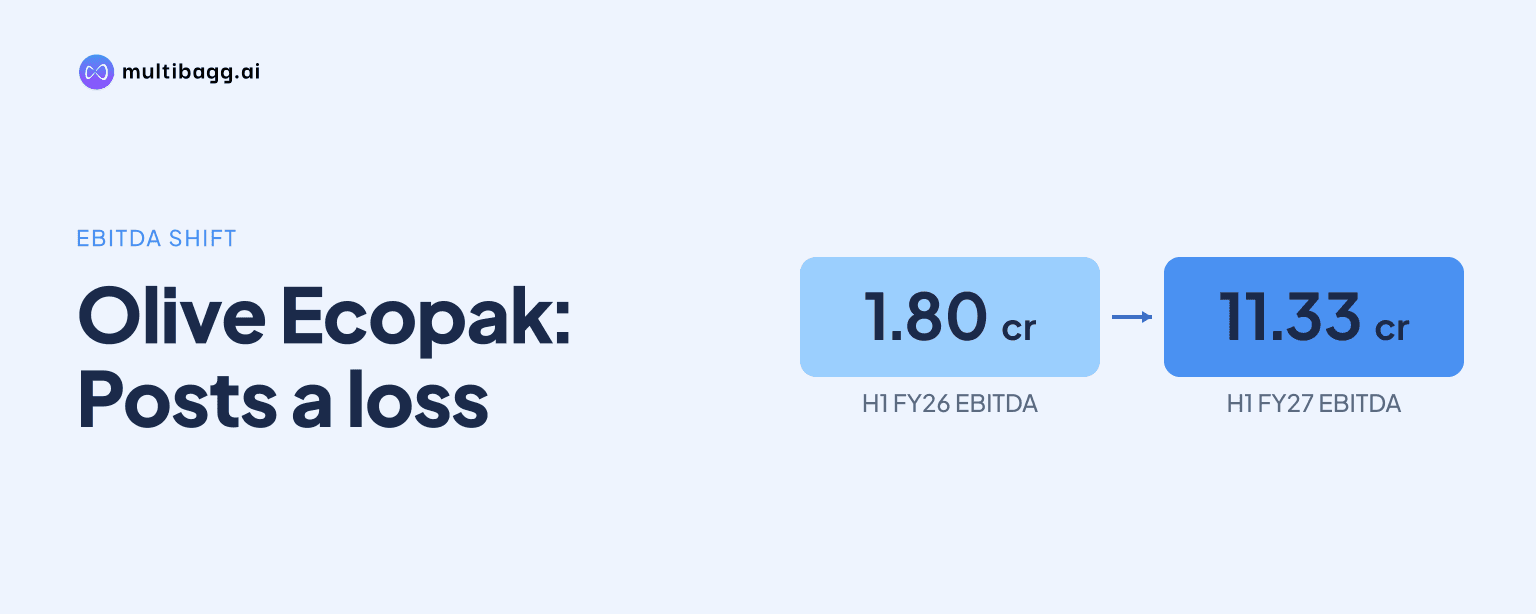
Olive Ecopak Private Limited reported ₹11.33 crore of earnings before interest, tax, depreciation and amortisation (EBITDA) in H1 FY27, compared with an EBITDA loss of ₹1.80 crore a year earlier, but a ₹3.10 crore exceptional flood loss contributed to a ₹3.13 crore loss after tax for the half year.
Know Rajshree Polypack inside out
Results, valuation, peers and who's buying, in one view.
What drove Olive Ecopak's H1 FY27 turnaround?
Olive Ecopak's operating turnaround was driven by revenue from operations rising 93.15% year on year to ₹38.36 crore in H1 FY27 from ₹19.86 crore in H1 FY26. EBITDA changed from a ₹1.80 crore loss to a ₹11.33 crore profit, and the EBITDA margin moved to 29.53% from negative 8.48%.
Operating EBITDA was ₹11.25 crore in H1 FY27, compared with an operating EBITDA loss of ₹1.95 crore in H1 FY26. The operating EBITDA margin was 29.33%, against negative 9.82% in the prior-year half, while the difference between operating EBITDA and reported EBITDA was ₹0.08 crore in H1 FY27.
Olive Ecopak is a joint venture between Rajshree Polypack and Mr. Rajesh Gandhi of Oracle Polyplast. The presentation says the business had commercially launched more than 150 stock-keeping units, or SKUs, covering paper-based tableware and packaging solutions.
How did Olive Ecopak's Q2 FY27 compare with Q1?
Olive Ecopak's Q2 FY27 revenue from operations was ₹21.15 crore, up 22.89% from ₹17.22 crore in Q1 FY27 and 75.52% from ₹12.05 crore in Q2 FY26. The second quarter accounted for more than half of the ₹38.36 crore reported for H1 FY27.
Q2 FY27 EBITDA increased 45.99% sequentially to ₹6.72 crore from ₹4.61 crore in Q1 FY27. The EBITDA margin rose to 31.82% from 26.79%, while operating EBITDA increased 46.93% to ₹6.69 crore from ₹4.57 crore.
Olive Ecopak's loss after tax narrowed to ₹1.39 crore in Q2 FY27 from ₹1.74 crore in Q1 FY27. The loss-after-tax margin improved to negative 6.58% from negative 10.11%; in Q2 FY26, the business had reported a ₹4.88 crore loss after tax and a negative 40.52% margin.
Why did Olive Ecopak remain loss-making despite positive EBITDA?
Olive Ecopak remained loss-making because the presentation records a ₹3.10 crore exceptional loss due to floods. Management says the related insurance claim is under process, while the company reported a ₹3.13 crore loss after tax for H1 FY27.
The H1 FY27 loss after tax was lower than the ₹11.37 crore loss reported in H1 FY26. Its loss-after-tax margin improved to negative 8.15% from negative 57.27%, alongside the shift to ₹11.33 crore of EBITDA from a ₹1.80 crore EBITDA loss.
The presentation does not disclose the value, timing or outcome of the insurance claim. It also does not provide a full reconciliation between EBITDA, the ₹3.10 crore exceptional loss and loss after tax, so any eventual insurance proceeds cannot be treated as recognised income from the disclosed information.
Got a follow-up? Ask IRIS
What do Olive Ecopak's production volumes show?
Olive Ecopak's coating output reached 971 metric tonnes, or MT, in Q2 FY27, up from 578 MT in Q1 FY27 and 840 MT in Q2 FY26. Finished-goods output was 887 MT, compared with 660 MT in Q1 FY27 and 790 MT in Q2 FY26.
The recovery followed lower volumes in Q1 FY27: coating had declined from 1,085 MT in Q3 FY26 to 745 MT in Q4 FY26 and then 578 MT in Q1 FY27. Finished goods followed a similar pattern, moving from 1,035 MT in Q3 FY26 to 881 MT in Q4 FY26 and 660 MT in Q1 FY27 before recovering in Q2.
Q2 FY27's 971 MT of coating and 887 MT of finished goods coincided with ₹21.15 crore of revenue and a 31.82% EBITDA margin. The presentation does not disclose installed capacity, utilisation, average selling prices or product-level margins, so it does not separate the effects of volume, pricing and product mix.
What products and certifications does Olive Ecopak disclose?
Olive Ecopak lists paper plates, paper cups, food containers, clamshell boxes, bowls, straws, meal boxes, lids and wrapping paper in its product range. The presentation also identifies aqueous barrier coating as an alternative to single-use plastics within its paper-based packaging offering.
Olive Ecopak says it holds BRC certification for quality, safety and regulatory compliance, and that its compostable products are certified by the Central Institute of Petrochemicals Engineering & Technology, or CIPET. The presentation does not state how many of its more than 150 commercially launched SKUs are covered by each certification.
The business identifies Umbergaon as its infrastructure location and describes the site as a vertically integrated facility for eco-friendly, paper-based tableware and packaging. Its disclosed production measures are coating and finished-goods output in MT, rather than installed capacity.
Conclusion
Olive Ecopak's H1 FY27 results show a marked operating change, with revenue increasing to ₹38.36 crore and EBITDA reaching ₹11.33 crore after a prior-year EBITDA loss. However, the ₹3.10 crore flood-related exceptional loss left the business with a ₹3.13 crore loss after tax despite a 29.53% EBITDA margin.
The disclosed issue to watch next is the insurance claim linked to the ₹3.10 crore flood loss, which management says remains under process. The next reported periods can also show whether Q2 FY27 output of 971 MT of coating and 887 MT of finished goods is sustained alongside positive EBITDA.