










RPPL lifts injection capacity as H1 output falls 44% year on year
Key highlights
- RPPL’s injection-moulding capacity increased to 5,800 MT in Q2 FY27 from 4,800 MT in Q2 FY26.
- RPPL’s H1 FY27 injection-moulding production fell 44% to 1,196 MT from 2,127 MT.
- RPPL’s H1 FY27 revenue rose 21.82% to Rs 205.81 crore, while domestic revenue reached Rs 179.62 crore.
- Injection moulding represented 11.64% of RPPL’s H1 FY27 revenue, down from 18.61% a year earlier.
powered by IRIS
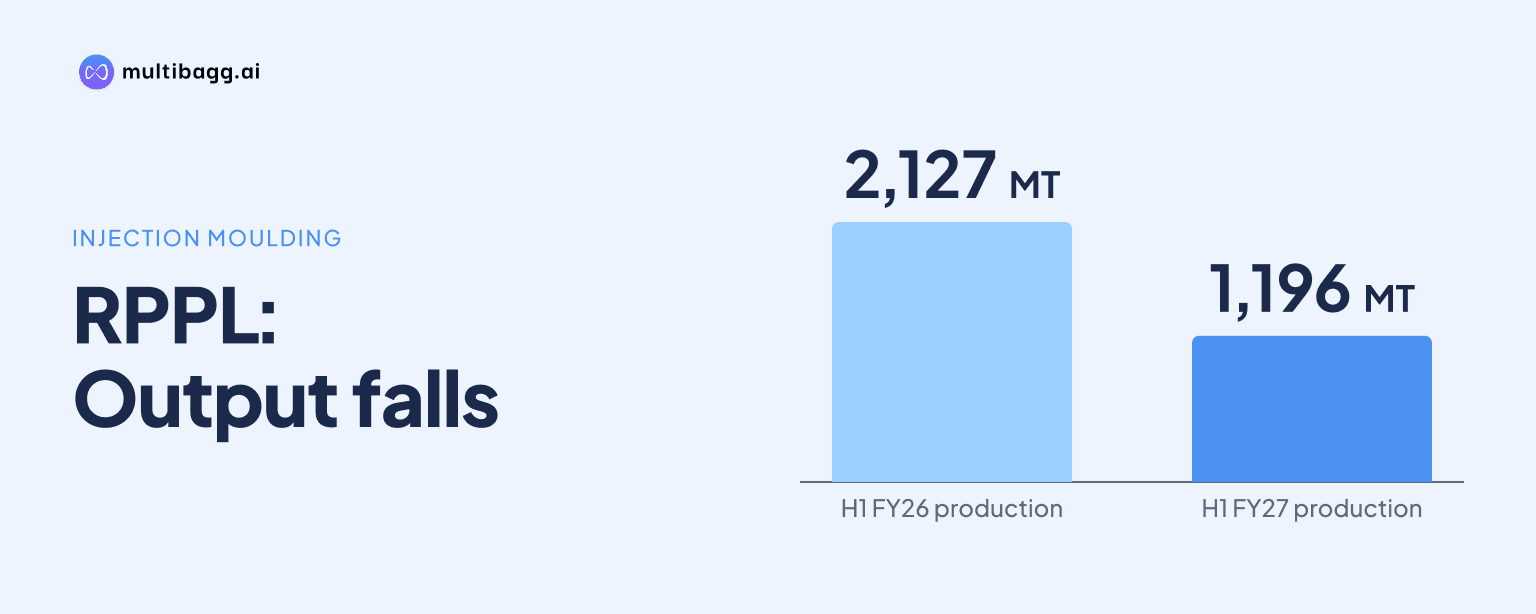
Rajshree Polypack Limited, referred to as RPPL, had injection-moulding capacity of 5,800 MT in the second quarter (Q2) of fiscal year (FY) 2027, while first-half (H1) production was 1,196 MT, 44% below H1 FY26. Its standalone H1 FY27 revenue from operations nevertheless increased 21.82% to Rs 205.81 crore, while injection moulding’s revenue share fell to 11.64% from 18.61%.
Know Rajshree Polypack inside out
Results, valuation, peers and who's buying, in one view.
What changed in RPPL’s injection-moulding capacity?
RPPL increased injection-moulding capacity to 5,800 MT in Q2 FY27, from 4,800 MT in Q2 FY26 and 1,000 MT in Q2 FY24. The company describes this as an asset-light expansion supported by one dedicated injection-moulding partner, alongside its three manufacturing units in Gujarat and Daman.
The injection-moulding build-out exceeded the changes in several other processes. Extrusion capacity rose 1,600 MT year on year to 25,600 MT in Q2 FY27, while thermoforming capacity remained 12,120 MT. Printing capacity stayed at 11,000 lakh pieces, whereas sleeving capacity increased to 1,675 lakh pieces from 1,275 lakh pieces a year earlier.
RPPL says the larger injection-moulding platform is intended to add products and expand domestic sales. It also identifies injection moulding as an export-growth avenue, using product-design and tooling capabilities for food, dairy and consumer-goods packaging, but gives no numerical sales target for the 5,800-MT capacity.
Why did RPPL’s injection-moulding output not rise with capacity?
RPPL did not provide a segment-specific explanation for the decline, but it reported H1 FY27 injection-moulding production of 1,196 MT, down 931 MT from 2,127 MT in H1 FY26. Quarterly production also fell to 511 MT in Q2 FY27 from 1,178 MT in Q2 FY26, despite the 1,000-MT increase in stated capacity over that interval.
Management said softer export demand amid geopolitical uncertainties affected the business during Q2 FY27, while robust domestic demand more than offset lower exports at the company level. This is context rather than a disclosed cause of the injection-moulding production decrease because the presentation does not split export demand, orders, customers or production by manufacturing process.
The revenue mix provides a second measure of the change. Injection moulding represented 11.64% of H1 FY27 revenue, compared with 18.61% in H1 FY26, a decrease of 6.97 percentage points. In Q2 FY27, the segment accounted for 10.97% of revenue, versus 21.49% in Q2 FY26, while total quarterly revenue increased to Rs 102.90 crore from Rs 86.43 crore.
How did RPPL’s other production lines perform in H1 FY27?
RPPL’s other reported production lines increased in H1 FY27: extrusion reached 11,402 MT, thermoforming reached 4,686 MT, printing reached 4,632 lakh pieces and sleeving reached 805 lakh pieces. Each was above the corresponding H1 FY26 figure, unlike injection moulding, which declined from 2,127 MT to 1,196 MT.
Extrusion production increased 697 MT from 10,705 MT in H1 FY26, and thermoforming increased 275 MT from 4,411 MT. These processes form part of RPPL’s integrated rigid-packaging platform, which also includes printing, sleeving and in-mould labelling (IML); the company reported Q2 FY27 capacity of 25,600 MT for extrusion and 12,120 MT for thermoforming.
Printing production increased 743 lakh pieces from 3,889 lakh pieces in H1 FY26, reversing a prior-year decline from 4,596 lakh pieces in H1 FY25. Sleeving increased 203 lakh pieces from 602 lakh pieces after capacity rose to 1,675 lakh pieces, showing growth across four reported lines while injection moulding contracted.
Got a follow-up? Ask IRIS
What did the injection-moulding decline mean for RPPL’s H1 results?
RPPL reported H1 FY27 revenue from operations of Rs 205.81 crore, up Rs 36.86 crore from Rs 168.95 crore in H1 FY26, despite lower injection-moulding output and mix. Domestic revenue increased to Rs 179.62 crore from Rs 133.49 crore, while export revenue declined to Rs 26.18 crore from Rs 35.46 crore.
Packaging product sales increased to 64.68% of revenue in H1 FY27 from 59.23% a year earlier. Sheet sales declined to 21.12% from 21.48%, while the category covering raw material, scrap and development increased to 2.56% from 0.68%, indicating that the revenue gain came from categories other than injection moulding.
Operating earnings before interest, tax, depreciation and amortisation, or operating EBITDA, increased 30.50% to Rs 27.47 crore in H1 FY27 and its margin rose to 13.35% from 12.46%. Reported EBITDA increased to Rs 30.11 crore from Rs 24.96 crore, though the reported EBITDA margin decreased to 14.63% from 14.78%.
Profit after tax increased to Rs 12.27 crore from Rs 8.71 crore, and the margin rose to 5.96% from 5.15%. In Q2 FY27, reported EBITDA margin was 13.21%, below 14.91% in Q2 FY26, while management cited sharply higher raw-material prices alongside softer export demand.
How is RPPL supporting expansion and what should investors monitor?
RPPL reported total debt of Rs 106.56 crore at H1 FY27, compared with Rs 106.47 crore at FY26, while total equity increased to Rs 200.33 crore from Rs 188.05 crore. Net debt was Rs 101.27 crore, marginally below Rs 101.44 crore at FY26, and debt-to-equity was 0.53 times compared with 0.57 times.
Cash flow from operations was Rs 17.72 crore in H1 FY27, compared with Rs 18.80 crore for all of FY26. Receivables days declined to 58.81 from 62.62 at FY26, inventory days declined to 127.30 from 161.07, and payables days increased to 45.16 from 35.31.
Management said RPPL will expand its injection-moulding range for the domestic market and improve manufacturing productivity. It also said the newly commissioned group captive wind-solar plant is expected to make a meaningful profitability contribution from next year; separately, an insurance claim for flood loss at Olive Ecopak remains under process, with no settlement amount or date disclosed.
Conclusion
RPPL’s Q2 FY27 capacity and H1 production data show a divergence in injection moulding: capacity rose by 1,000 MT year on year, while first-half output declined by 931 MT. Higher domestic revenue, a larger packaging-product sales mix and increased output in extrusion, thermoforming, printing and sleeving supported a 21.82% increase in H1 revenue to Rs 205.81 crore.
The next disclosures should show whether RPPL’s plan to broaden domestic injection-moulding products translates into a recovery from the 1,196 MT produced in H1 FY27. Investors can also track management’s expected wind-solar profitability contribution from next year, export-demand conditions and progress on Olive Ecopak’s flood-loss insurance claim.