










Orient Green Power says accruals can fund 30-40 MW yearly
Key highlights
- Orient Green Power said internal accruals can fund 30-40 MW of annual capacity additions.
- Orient Green Power funded 16.5 MW of new capacity and about 8-9 MW of repowering from operating surpluses.
- Orient Green Power said it invested about Rs 50 crore of internally generated equity in new projects in the last year.
- Orient Green Power said its borrowing cost fell from almost 11.5% to about 9.1% over two years.
powered by IRIS
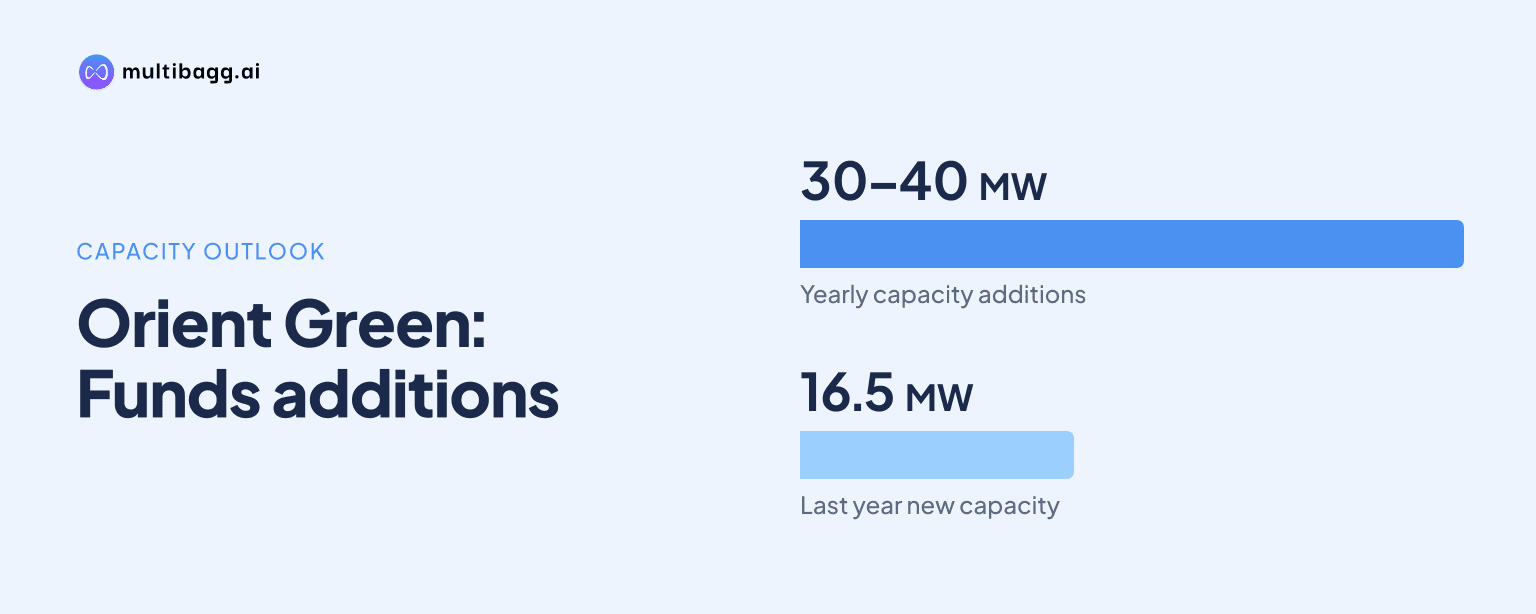
Orient Green Power said operating surpluses can fund 30-40 megawatts (MW) of capacity additions each year, after using internally generated equity for 16.5 MW of new capacity and about 8-9 MW of repowering. Management said this organic programme can continue, but will not by itself deliver the larger scale increase it seeks.
Know Orient Green Power Company inside out
Results, valuation, peers and who's buying, in one view.
How much capacity can Orient Green Power add from internal accruals?
Orient Green Power said it can add 30-40 MW a year using internal accruals as the equity component for new capacity and repowering projects. Management said that level of annual addition was “not a big challenge”, although it noted that the programme alone would not take the company to its desired scale.
The company has already used this approach for 16.5 MW of new capacity and about 8-9 MW of repowering. Management said the equity for both activities came from operating surpluses, rather than from a fresh equity issue. It also said cash available for projects could increase as older debt is repaid.
Management described the 30-40 MW programme as an activity that should continue even while it explores larger options. The call did not disclose a fixed cost per MW, a return target, or the split of future annual additions between repowering, wind projects and solar projects.
How is Orient Green Power financing its organic projects?
Orient Green Power is funding the equity portion of projects from operating cash generation and will assess bank borrowing separately for each greenfield or repowering project. Management said it uses leverage, but intends to retain room for debt servicing because wind output can vary materially with weather conditions.
Management said it put about Rs 50 crore of equity from internal generation into new projects in the last year. It also said proceeds from the previous rights issue were primarily raised for new capacity, including solar capacity, and that some surplus from that funding had been used for wind additions. The call did not provide a project-by-project allocation of the Rs 50 crore.
The company cited gross debt of Rs 562 crore and a debt service reserve account, or DSRA, of about Rs 81 crore. Management described net debt as Rs 440 crore and said it typically holds Rs 110-120 crore of cash in the system to cover one quarter of variability, operations and maintenance, and debt obligations.
Orient Green Power said its borrowing cost had fallen from almost 11.5% to about 9.1% over the previous two years. Management is targeting at least a further 25-basis-point reduction, subject to Reserve Bank of India rate conditions. One basis point equals one-hundredth of a percentage point.
Why does Orient Green Power need a larger strategic transaction?
Orient Green Power said annual additions of 30-40 MW from internal accruals will not create the step change in scale needed to improve shareholder value. Management said it was working on multiple strategic conversations and hoped to have something to disclose within the next few months, but did not identify an asset, investor, value or transaction structure.
The company said its previous rights issue was intended mainly for new capacity rather than acquisitions. Management said it had considered acquisitions through structures not necessarily requiring a fully cash-funded purchase, but added that money cannot be raised and held indefinitely while waiting for an unidentified asset to become available.
Management said listed-company status has both benefits and drawbacks in transaction discussions. Its stated issue is that private-equity investors can face mark-to-market constraints when dealing with a listed company, potentially requiring a different structure. Management said transactions were occurring in the unlisted market at values discussed by an analyst, but it did not give a valuation for Orient Green Power or confirm any proposed share price.
The difference between the two pathways is clear from management’s comments. Internal cash generation can support incremental capacity and repowering, while a strategic transaction is being pursued for a larger increase in scale. The company did not define the capacity outcome of that step change or say whether it would use equity, project debt, asset exchanges or another mechanism.
Got a follow-up? Ask IRIS
What operating conditions could affect internal-accrual growth?
Orient Green Power said demand is not the primary constraint on expansion, while management identified finance as the issue to watch. More than 70% of power sales are to commercial and industrial, or C&I, customers, principally industrial customers in Tamil Nadu; the company also sells power in Andhra Pradesh and Gujarat to State Electricity Boards.
Management said C&I customers want to buy increasing amounts of renewable power, although pricing can change. The operational challenge is structuring supply that can meet 100% of some customers’ renewable-power needs despite the variable output of wind and solar. It cited customers’ export requirements and environmental, social and governance goals as demand drivers.
Weather remains relevant because the company said the bulk of wind generation comes in the first and second quarters, while the third and fourth quarters are usually weaker. Management said solar generation should provide some support in the latter half, but it also said unusual wind patterns had reduced the accuracy of its models.
For FY '28, management said it expected about 30 MW of additions, primarily through repowering and largely in wind, with some possible solar capacity for hybrid balancing. It also said it would probably add a battery energy storage system, or BESS, in FY '28, and was evaluating a size in the region of 10-15 megawatt-hours. These were management plans, not committed project specifications.
How do delayed wind approvals affect the expansion programme?
Orient Green Power said the construction work for its Beta and Clarion wind projects was 100% complete, but grid-connectivity approvals in Tamil Nadu had delayed commissioning. Management attributed the delays to administrative changes after a state-government transition and said one substation had been commissioned in the preceding two to three weeks.
Management expected the projects to be commissioned by December and January, subject to the remaining line connection from the substation to the turbines. It said a movement from December 31 to January 15 would not significantly affect generation because that period is outside the main wind season, though the timing remains dependent on government approvals.
The approval delay illustrates why internally funded capacity does not automatically become operating capacity when construction is completed. Once connected, the projects can contribute to the generation base that supports operating surplus, but the call did not disclose their revenue, generation estimates or contribution to the 30-40 MW annual internal-accrual programme.
Conclusion
Orient Green Power has set out a capital-allocation model in which operating surplus funds project equity, project debt is assessed cautiously, and 30-40 MW of annual additions can be sustained through new capacity and repowering. Its disclosed Rs 50 crore of internally generated equity investment, 16.5 MW of new capacity and about 8-9 MW of repowering support management’s description of that model.
The next developments to watch are management’s hoped-for strategic action within the next few months, the December and January commissioning of delayed wind projects, and the FY '28 plan for about 30 MW of mostly repowering additions. Management’s final BESS sizing, indicated at 10-15 megawatt-hours, and the targeted 25-basis-point borrowing-cost reduction will also affect how the organic programme develops.