










Orient Green Power’s Completed Wind Projects Await Grid Approval
Key highlights
- Orient Green Power says construction of the delayed Tamil Nadu wind machines is 100% complete.
- Management targets commissioning of the delayed wind plants in December and January.
- The 7.8-megawatt repowering project is expected to add 1.7 crore units and about Rs 9 crore of revenue.
- Orient Green Power plans about 30 megawatts of mostly wind additions in FY '28.
powered by IRIS
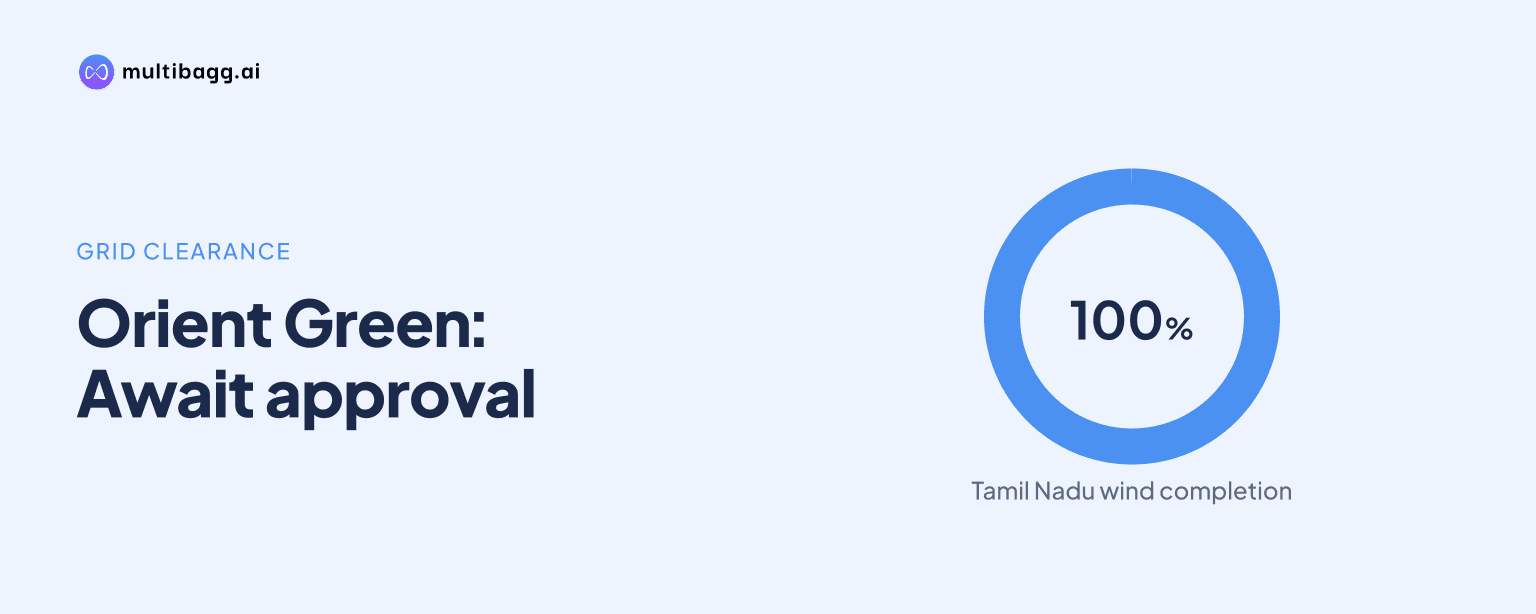
Orient Green Power says 100% of construction on its delayed Tamil Nadu wind machines is complete, but grid-connectivity approvals are preventing commissioning, which management targets for December and January. The company said it could connect the projects within 24 hours once the required state-government clearance is received.
Know Orient Green Power Company inside out
Results, valuation, peers and who's buying, in one view.
Why are Orient Green Power’s wind projects awaiting approval?
Orient Green Power says the Beta and Clarion wind-project delay results from Tamil Nadu approvals for grid connectivity rather than construction work. Management attributed the issue to a change of government and substantial churn in the relevant department, saying projects across Tamil Nadu have been affected during the transition.
The company said the state is moving towards online approvals and a single-window system, but that transition has held up existing processes. Management said it is making repeated requests to the government and meeting senior officials, while avoiding confrontation with a new administration that is addressing issues inherited from the previous government.
Construction activity on the machines is 100% complete, according to management. One delayed project’s substation has now been commissioned, but the line from the substation to the turbine still requires commissioning. The company said the machines can be switched on and connected within 24 hours after the final approval.
When does Orient Green Power expect the projects to start?
Orient Green Power expects the delayed plants to be commissioned in December and January. Management said it had observed progress over the preceding two to three weeks, including movement on the substation, and cited that progress as the basis for confidence in the revised timing.
Management did not assign a separate commissioning month to Beta or Clarion, nor did it identify an additional statutory approval beyond the outstanding connectivity process. It said there had been no significant delay on the company’s side and that the completed projects were waiting for permission to connect to the state grid.
The company said a move from December 31 to January 15 would not significantly affect generation because this period is outside the principal wind season. Its historical seasonal pattern is for the bulk of wind generation to occur in the first and second quarters, while the third and fourth quarters are relatively weaker.
That seasonal profile is management’s reason for saying commissioning in the third quarter or early fourth quarter should not materially affect overall performance. The assessment does not remove the approval risk: the remaining line must still be commissioned before the turbines can export power and begin contributing generation.
What could the 7.8-megawatt repowering project contribute?
Orient Green Power estimates its first 7.8-megawatt wind repowering project will add about 1.7 crore units of generation and about Rs 9 crore of incremental revenue. Management specified that these figures apply to the 7.8-megawatt repowering project, rather than to the wider portfolio of potential repowering and greenfield projects.
Management put the equity internal rate of return, or IRR, on that repowering investment at about 13% to 14%, while another executive cited 14.5%. It said repowered machines may generate slightly lower returns than new machines, but described both repowering and new-machine projects as falling broadly in a 13.5% to 15% range.
The company identified about 40 to 50 megawatts of wind projects that are currently suitable for repowering, plus a 25-megawatt repowering opportunity in Andhra Pradesh. That amounts to about 75 megawatts of current opportunity, with a further 20 to 30 megawatts expected to become suitable in three to four years.
Management said it evaluates repowering and greenfield projects case by case rather than favouring one category. Regulatory conditions can differ between repowered and greenfield assets, and the company said it will select projects based on the expected equity IRR rather than a fixed capacity mix.
Got a follow-up? Ask IRIS
How does grid clearance affect Orient Green Power’s growth plan?
Orient Green Power plans about 30 megawatts of capacity additions in FY '28, primarily through wind repowering and with a smaller amount of new wind capacity. Management said it may add some solar capacity to balance wind within hybrid projects and expects to install a battery energy storage system, or BESS, during FY '28.
The BESS size has not been finalised, although management gave an indicative range of 10 to 15 megawatt-hours. The proposed storage project is therefore a plan under development, whereas the 30-megawatt addition target is management’s stated FY '28 capacity plan.
More than 70% of the company’s power is sold to commercial and industrial, or C&I, customers, principally industrial users in Tamil Nadu. Management listed auto-component, textile and software customers, while power in Andhra Pradesh and Gujarat is sold to state electricity boards under long-term power purchase agreements.
Management said the company is fully sold out and currently has no surplus power to offer prospective customers, including data centres. It also said demand is not the principal constraint, but supplying 100% renewable power to certain industrial customers remains operationally difficult because wind and solar generation are variable.
What funding and return figures has Orient Green Power disclosed?
Orient Green Power said it added about Rs 50 crore of equity to new projects from internal generation in the last year. It also said borrowing costs had declined from almost 11.5% to about 9.1% over the past couple of years, and management is targeting a further reduction of at least 25 basis points.
Management said the additional borrowing-cost reduction depends on Reserve Bank of India rate movements. If policy rates remain neutral, it will seek lower borrowing costs; if rates rise, it will seek to maintain the current cost. The company said it evaluates debt separately for each repowering or greenfield project.
For comparison, the company said its recently commissioned 17-megawatt solar project is expected to generate about Rs 15.35 crore of revenue and about Rs 14.5 crore of earnings before interest, taxes, depreciation and amortisation, or EBITDA. Management placed the solar project’s equity IRR at about 14%.
Conclusion
Orient Green Power’s disclosed delay is an external grid-approval issue rather than an unfinished-construction issue: the Tamil Nadu wind machines are complete, but cannot generate until connectivity clearance and the remaining line commissioning are completed. The company’s seasonal pattern means management expects limited generation impact if commissioning shifts from December into January, when wind output is typically lower than in the first and second quarters.
The next event to watch is whether the remaining substation-to-turbine line receives clearance in time for the December and January commissioning targets. Management’s FY '28 plan also calls for about 30 megawatts of mainly wind additions and a BESS of an indicative 10 to 15 megawatt-hours, although the storage system’s final capacity remains unresolved.