










Oriental Aromatics Limited confirms FY27 revenue, profit goals
Key highlights
- Oriental Aromatics confirmed FY27 turnover of Rs 1,000 crore and net profit of Rs 50 crore.
- Mahad plant utilisation was around 50% to 55%, with management targeting at least 80% within two to three quarters.
- Net debt to equity rose to 0.64 in Q2 FY'27 from 0.56 in the preceding quarter.
- An analyst cited a Q2 FY'27 EBITDA margin of approximately 7.9%, while management's first objective is 10%.
powered by IRIS
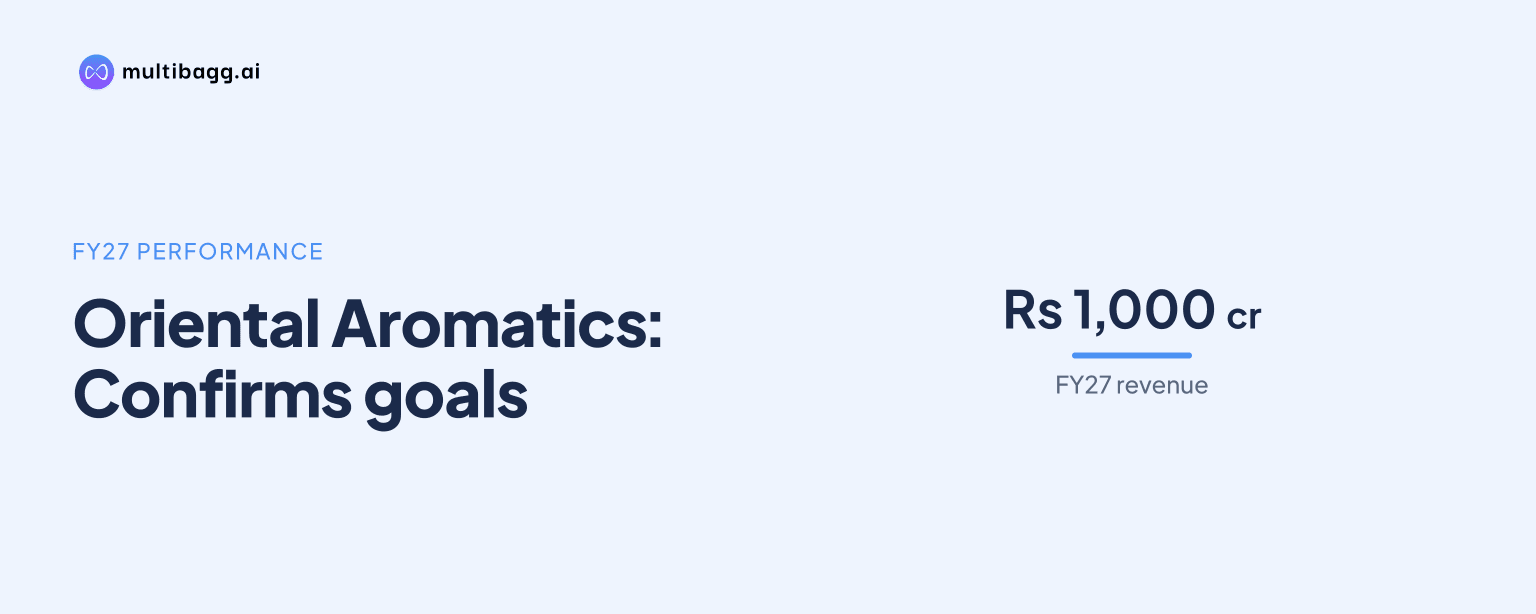
Oriental Aromatics Limited confirmed FY27 guidance of Rs 1,000 crore in turnover and Rs 50 crore in net profit when management accepted an investor's interpretation of its full-year expectations. Finance executive Girish Khandelwal replied, “Yes, yes. Correct,” and did not indicate any revision to either FY27 figure.
Know Oriental Aromatics inside out
Results, valuation, peers and who's buying, in one view.
What FY27 guidance did Oriental Aromatics confirm?
Oriental Aromatics confirmed FY27 turnover of Rs 1,000 crore and net profit of Rs 50 crore. The confirmation came after an individual investor said advance-tax payments appeared to indicate those full-year figures and asked whether they were correct or would be revised; Khandelwal replied, “Yes, yes. Correct.”
The call therefore provides management acceptance of both figures, rather than only an investor estimate. Oriental Aromatics did not state a range, a revised target, or a different definition of turnover in its response. It also did not provide a quarterly revenue or profit run rate for the remaining FY27 reporting periods.
A Rs 50 crore net-profit target on Rs 1,000 crore of turnover implies a 5% net-profit-to-revenue ratio. That percentage is arithmetic based on the two confirmed targets and is not a net-margin target separately stated by management. The figures establish a full-year benchmark against which later FY27 disclosures can be assessed.
How does the FY27 target fit Q2 FY'27 operations?
The FY27 target follows a Q2 FY'27 period in which Oriental Aromatics said both production and sales volumes increased after customer requests for quotation, or RFQs, became operational from July. Parag Satoskar said RFQs completed in June started contributing from July, explaining the increase in quarterly production and sales volume.
An analyst cited a Q2 FY'27 earnings before interest, tax, depreciation and amortisation, or EBITDA, margin of approximately 7.9%. Satoskar said the operational-efficiency programme is intended first to help Oriental Aromatics reach a 10% EBITDA margin and then move beyond it, but he did not quantify anticipated savings from the programme.
Management described the efficiency initiative as product-driven rather than a programme designed to extract a stated percentage of savings. Satoskar said its purpose is to make products more competitive in global markets, which management expects eventually to support the 10% EBITDA objective. The call did not establish a direct bridge from the 7.9% Q2 FY'27 EBITDA margin to the implied 5% FY27 net-profit-to-revenue ratio.
Working-capital requirements also rose during Q2 FY'27. Net debt to equity increased to 0.64 at the end of Q2 FY'27 from 0.56 in the preceding quarter, according to the investor's question. Management attributed the increase to higher inventory levels, higher inventory costs, and receivables from sales completed in the final days of the quarter.
Got a follow-up? Ask IRIS
Which businesses are expected to support Oriental Aromatics' growth?
Oriental Aromatics said its fragrance division has shown encouraging growth over the past few years across Indian fast-moving consumer goods, or FMCG, customers and global customers. Satoskar said management expects fragrance to continue growing, while other parts of the business are also expected to grow.
Management linked part of fragrance growth to its internalisation programme, which it said allows Oriental Aromatics to deliver better-value and better-performing fragrances at a lower price. Satoskar cautioned that much of the fragrance business has longer-term pricing, while saying the company intends to maintain a one-third, one-third, one-third mix across its business components.
Camphor was a contrasting business line in Q2 FY'27. Management said year-on-year camphor performance was lower in both formulated products and powder, with costs driving the decline. It cited a pre-war structural mismatch of excess supply and lower demand, followed by a rise in camphor prices in a market management described as highly price-sensitive.
The call did not quantify fragrance revenue, camphor revenue, or the contribution of either business to the Rs 1,000 crore FY27 turnover target. It nevertheless indicates that management expects growth from fragrance, other businesses, and higher production volumes, while camphor continues to face separate price and supply-demand pressures.
What operational milestones could affect FY27 delivery?
Oriental Aromatics reported Mahad plant utilisation of around 50% to 55% of installed capacity and expects to reach at least 80% over the next two to three quarters. Satoskar said management believes the plant can bridge the gap to 80%, if not more, during that period.
The two-to-three-quarter timetable overlaps with the remaining period for executing the confirmed FY27 turnover and net-profit targets. However, Oriental Aromatics did not disclose Mahad's expected turnover contribution at full capacity. When asked for that figure, Satoskar directed the investor to investor-relations personnel or Khandelwal for the exact contribution.
RFQ conversion is a second disclosed operating mechanism. Management said RFQs filled in June became operational in July and lifted both production and sales volumes in Q2 FY'27. The company did not disclose the number of RFQs, contract values, contract duration, or their expected sales contribution for the rest of FY27.
Net debt to equity of 0.64, compared with 0.56 in the preceding quarter, leaves inventory and receivables as additional factors to monitor. Management linked the increase to working-capital use and did not associate it with any stated change to the Rs 1,000 crore turnover or Rs 50 crore net-profit targets. The call did not provide a net-debt-to-equity target for the next quarter or FY27 year-end.
Conclusion
Oriental Aromatics has made its FY27 benchmark explicit: Rs 1,000 crore of turnover and Rs 50 crore of net profit. The confirmation came alongside management's account of higher Q2 FY'27 production and sales volumes after June RFQs became operational in July, as well as a stated objective to first reach a 10% EBITDA margin. Fragrance growth across Indian FMCG and global customers contrasts with year-on-year pressure in formulated camphor products and powder.
The next disclosed operational marker is Mahad utilisation. Management said the plant was operating at around 50% to 55% and expects at least 80% utilisation within two to three quarters, while not disclosing its full-capacity turnover contribution. Later FY27 updates can also show whether RFQ activity, the efficiency programme, and inventory and receivables movements align with the confirmed Rs 1,000 crore and Rs 50 crore objectives.