










Oriental Aromatics targets Mahad ramp-up within three quarters
Key highlights
- Mahad production rose 51% sequentially and sales volume increased 74% in Q2 FY'27.
- Oriental Aromatics targets at least 80% Mahad utilisation within two to three quarters, from roughly 50% to 55%.
- H1 FY'27 standalone EBITDA margin was 8.6%, versus a 7.8% consolidated margin affected by Mahad.
- Q2 FY'27 revenue from operations reached a record Rs 318.19 crore, up about 17% year on year.
powered by IRIS
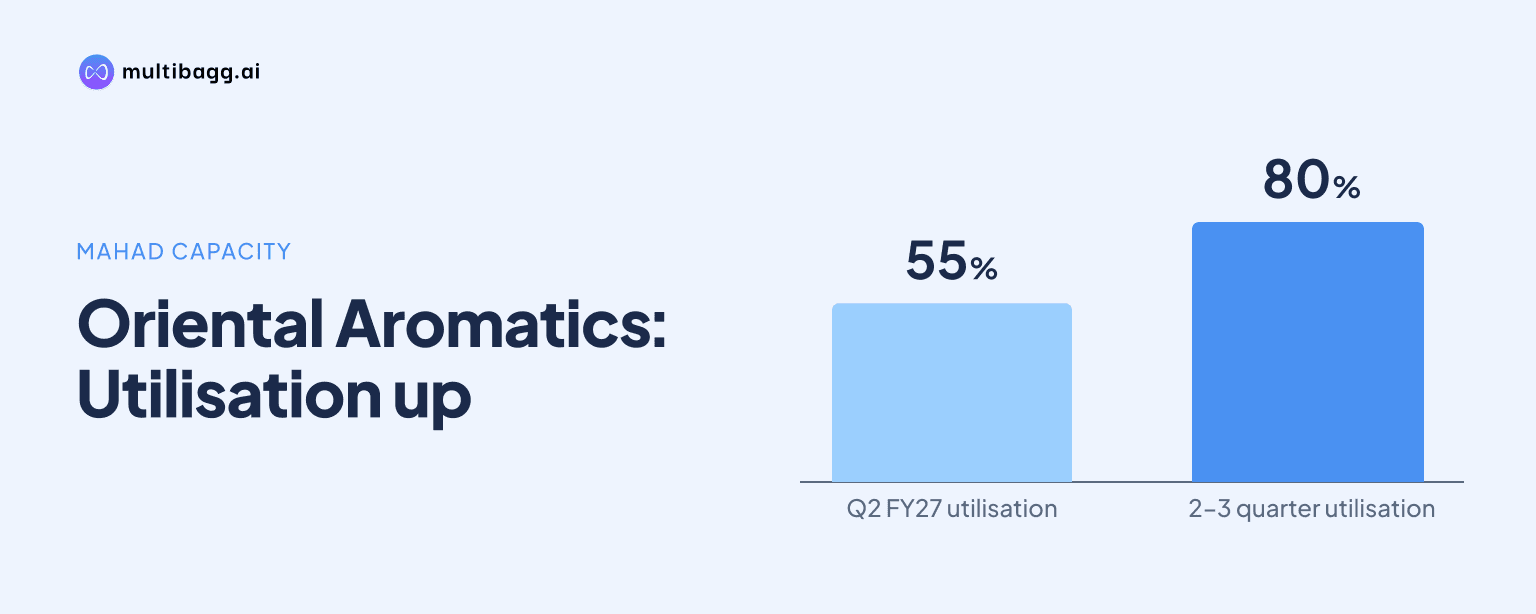
Oriental Aromatics Limited expects its Mahad specialty aroma ingredients facility to reach at least 80% utilisation within two to three quarters, from roughly 50% to 55% currently, after Q2 FY'27 production rose 51% sequentially and sales volume increased 74% from Q1 FY'27. Management said the facility remains a drag on consolidated profitability until higher volumes absorb fixed costs.
Know Oriental Aromatics inside out
Results, valuation, peers and who's buying, in one view.
When will Oriental Aromatics' Mahad plant reach optimal utilisation?
Oriental Aromatics expects Mahad’s current operations to reach optimal volume utilisation within two to three quarters from the Q2 FY'27 earnings call. Management indicated that Mahad is operating at about 50% to 55% utilisation and identified at least 80% as the level required for optimal operations.
The timetable depends on converting product acceptance and customer qualifications into regular commercial allocations. Management said specialty aroma ingredients have a long approval and commercialisation cycle, while allocations in requests for quotation, or RFQs, can gradually scale with existing and new customers. It did not provide a quarterly Mahad revenue forecast or an earnings before interest, tax, depreciation and amortisation, or EBITDA, break-even date.
Management said its first objective is volume utilisation rather than pricing. Once the facility reaches its targeted utilisation, it plans to assess Mahad’s contribution to growth and the ability to increase prices for certain customers. The company also said the site’s infrastructure can accommodate additional molecules and future expansion phases beyond its existing manufacturing programme.
How quickly did Oriental Aromatics' Mahad volumes grow in Q2 FY'27?
Oriental Aromatics' Mahad production increased 51% quarter on quarter in Q2 FY'27, while sales volume rose 74% compared with Q1 FY'27. For H1 FY'27, production was 36% higher year on year, and management said sales volumes increased significantly from a relatively small base.
Sales volume rose faster than production in Q2 FY'27, with the 74% sales increase exceeding the 51% production increase. Management attributed the progress to customer qualifications and commercial opportunities becoming actual sales, but said the plant remained below optimal utilisation because commercialisation in specialty ingredients takes time.
The company did not confirm an analyst’s reference to about Rs 4 crore of Mahad revenue in Q2 FY'27. It also did not answer a question on whether the facility could break even at the EBITDA level during FY'27. The disclosed operating target was instead the two-to-three-quarter path to optimal volume utilisation.
Why is Mahad affecting Oriental Aromatics' consolidated profitability?
Mahad is reducing Oriental Aromatics' consolidated profitability because its current utilisation does not yet absorb fixed costs effectively. In H1 FY'27, standalone EBITDA margin was 8.6%, compared with the consolidated margin of 7.8%, a gap of 80 basis points, where one basis point equals one-hundredth of a percentage point.
The group’s consolidated financial results nevertheless improved in H1 FY'27. Revenue from operations rose about 16.3% year on year to Rs 578 crore, EBITDA increased to Rs 45.07 crore from Rs 35.31 crore, and profit after tax rose to Rs 8.3 crore from Rs 1.2 crore.
Consolidated EBITDA margin improved to 7.8% in H1 FY'27 from 7.1% in H1 FY'26. Management attributed the improvement to better sales realisation, product mix and operating-efficiency programmes, while the finance chief identified the Mahad subsidiary as the continuing factor affecting the consolidated margin relative to the standalone result.
Management’s stated mechanism for improving Mahad’s contribution is to secure regular allocations, raise manufacturing efficiency and build commercial volumes. It expects the resulting fixed-cost absorption to allow Mahad to contribute positively to profitability, but this remains management’s expectation rather than a reported financial outcome.
Got a follow-up? Ask IRIS
What market conditions could affect Oriental Aromatics' Mahad ramp-up?
Oriental Aromatics' Mahad ramp-up is taking place in a specialty aroma ingredients market with substantial capacity and pricing pressure, particularly from capacity additions in Asia. Management said fragrance-ingredient demand remains healthy, but competitive conditions can restrict the pace at which higher input costs are passed through to customers.
Terpene-based and petrochemical-derived raw materials remained elevated and volatile during H1 FY'27, according to management. It also cited geopolitical uncertainty, currency movements, petrochemical-feedstock volatility and the availability of certain natural raw materials as influences on procurement and manufacturing costs.
The company said it is responding through product-technology and portfolio optimisation, supply-security measures and price adjustments where commercially feasible. At Baroda, its specialty aroma ingredients facility recorded a 12% sequential increase in sales volume and an 8% year-on-year increase in Q2 FY'27, showing demand growth in a segment that still faces price competition.
Conditions differed in camphor and terpene chemicals. Bareilly production increased 4% sequentially in Q2 FY'27, but sales volume declined 5% from Q1 FY'27 and 8% year on year as higher alpha-pinene prices increased camphor selling prices and affected off-take in the price-sensitive pooja segment.
What does Oriental Aromatics' wider Q2 FY'27 performance show?
Oriental Aromatics reported record quarterly revenue from operations of Rs 318.19 crore in Q2 FY'27, up about 17% year on year and 22% quarter on quarter. Quarterly EBITDA was Rs 25.26 crore, compared with Rs 19.8 crore in Q1 FY'27 and Rs 17.2 crore in the corresponding prior-year quarter.
Q2 FY'27 EBITDA margin was 7.94%, up 32 basis points sequentially and 158 basis points year on year. Profit after tax was Rs 5.70 crore, up about 130% sequentially, while cash profit reached Rs 13.58 crore compared with Rs 10.23 crore in Q1 FY'27.
The fragrances and flavors operation also added volume growth during Q2 FY'27. Ambernath production increased 14% sequentially and sales volume rose 20%, compared with a 7% sequential increase in total company production and a 4% increase in total sales volume. Management said it remains focused on customer relationships, new fragrance briefs and internalising aroma-ingredient programmes.
Conclusion
Mahad’s Q2 FY'27 volume growth shows that customer qualifications are translating into commercial sales, but its roughly 50% to 55% utilisation remains below management’s at-least-80% operating objective. The 80-basis-point difference between standalone and consolidated H1 FY'27 EBITDA margins also quantifies the facility’s current effect on group profitability.
The next indicator is whether Oriental Aromatics reaches its two-to-three-quarter utilisation timetable through regular customer allocations and manufacturing efficiencies. Management also said it intends to announce brownfield or greenfield expansion plans in coming quarters, while raw-material prices, competitive ingredient pricing and the developing Unilever Industries Private Limited arrangement remain matters to monitor.