










Orkla India Q2 revenue grows 18.4%, margin falls 100 bp
Key highlights
- Orkla India reported 18.4% Q2 FY27 product-sales growth and 2.9% volume growth.
- Q2 FY27 EBITDA rose 12.6% to Rs 124 crore, while EBITDA margin was 15.9%.
- Spices grew 25.1%, domestic revenue rose 20%, and GCC revenue increased 22.7% in Q2 FY27.
- Digital commerce reached 10% of domestic business in Q2 FY27, up from 8.9% in Q1 FY27.
powered by IRIS
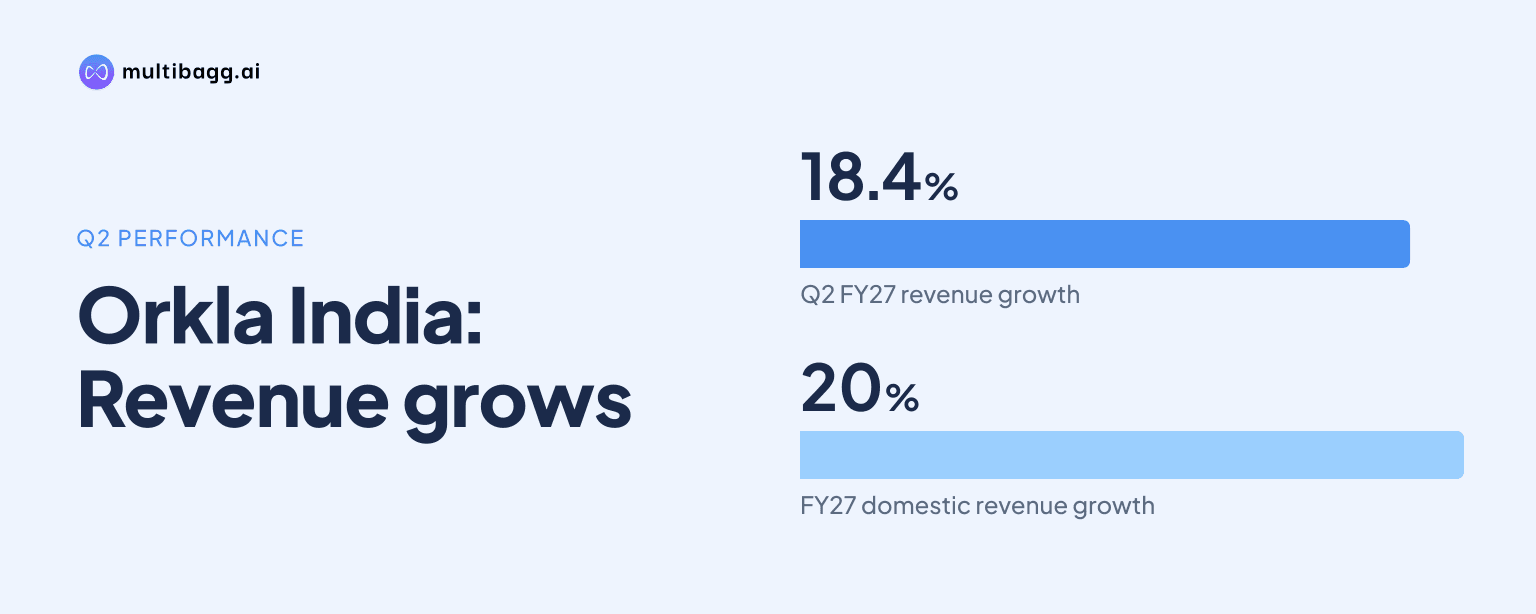
Orkla India Limited reported 18.4% revenue-from-sale-of-products growth in Q2 FY27, while earnings before interest, tax, depreciation and amortisation (EBITDA) rose 12.6% to Rs 124 crore and margin fell about 100 basis points to 15.9%. Higher spice costs outpaced price recovery, although volumes still increased 2.9%.
Know Orkla India inside out
Results, valuation, peers and who's buying, in one view.
How did Orkla India perform in Q2 FY27?
Orkla India delivered faster top-line growth in Q2 FY27, with revenue from sale of products up 18.4%, volume growth of 2.9% and EBITDA growth of 12.6%. Revenue from operations rose 19.4% year on year to Rs 776 crore, while EBITDA reached Rs 124 crore. Management said volume growth improved from the preceding two quarters despite substantial price increases in spices.
The different growth rates in product-sales revenue and revenue from operations reflect the two measures disclosed by management for the quarter. EBITDA grew more slowly than revenue, resulting in a 15.9% margin, about 100 basis points below the prior-year period. A basis point is one-hundredth of a percentage point. Profit after tax increased 19.2%, supported by operating performance, production-linked incentive (PLI) benefits and other income, mainly returns on surplus cash balances.
For H1 FY27, Orkla India reported revenue from operations of Rs 14.35 thousand crore, up 15.1%, with volume growth of 2.3%. EBITDA increased 7.8% and the reported margin was 16.6%. Management said that excluding PLI and Project Bolt investments, underlying EBITDA growth was 12.2% and adjusted EBITDA margin was 17.2%, a year-on-year moderation of 40 basis points.
Why did Orkla India’s EBITDA margin fall in Q2 FY27?
Orkla India’s EBITDA margin declined because sharp input-cost inflation, led by chilli and coriander, was only partly offset by calibrated price increases. Management said spice price increases exceeded 20%, affecting volume growth, while the company continued to balance price recovery with consumer affordability, volumes and market competitiveness.
The company contrasted the FY27 commodity environment with FY23 to FY26, when EBITDA margin expanded 250 basis points from 14.4% to 16.9%. Management attributed about half of that improvement to operating efficiencies and the remaining half to commodity deflation. With commodity costs now inflating, management said pricing actions substantially mitigated the effect but did not fully prevent near-term margin moderation.
Management also identified a timing effect in Q2 FY27 because some price increases were implemented during the quarter, with the full benefit expected in the following quarter. Excluding PLI effects in both periods, Q2 EBITDA growth was 6.3%. Excluding both PLI and time-bound Project Bolt investment, management said underlying Q2 EBITDA growth was 11.6%.
Got a follow-up? Ask IRIS
Which businesses and markets drove Orkla India’s growth?
Orkla India’s spices business was the largest reported growth contributor, increasing 25.1% in Q2 FY27, while convenience foods grew 7.7%. Management said much of spices growth was price-led, though volumes remained positive. Convenience-food growth faced a higher comparison base because the prior-year Q2 included the festive period, while Dussehra and Diwali moved into Q3 this year.
Domestic revenue increased 20%, ahead of the 11.7% growth in international business. The Gulf Cooperation Council (GCC) business grew 22.7%, despite what management described as a volatile geopolitical environment. In Kerala, stronger Onam execution supported spice volumes, and management said other states also recorded positive spice-volume growth without providing state-level figures.
Management said pure-spice prices track commodity-market movements more directly, whereas blended-spice pricing is calibrated to support competitiveness and volumes. Chilli and coriander were the two main drivers of spice inflation in Q2 FY27. Management said prices were relatively stable after a speculative increase late in September, although it cautioned that occasional speculative movements can occur.
How are Orkla India’s growth initiatives progressing?
Orkla India said Project Bolt and the Kerala distribution restructuring produced early operating gains in Q2 FY27, although both are multi-quarter programmes. Project Bolt is intended to expand digital-commerce capabilities across India’s top 28 cities, while the Kerala programme separates and improves distribution across convenience foods, standalone modern trade and spices.
Digital commerce accounted for 10% of domestic business in Q2 FY27, up from 8.9% in Q1 FY27. Digital-commerce revenue from rest of India grew 33.6% year on year, and management said consumer reach had tripled through scaled social-media content. Orkla India launched 23 innovations in the prior quarter and 15 more in Q2, taking H1 FY27 launches to 38.
In Kerala, the convenience-food distribution separation was completed in June 2026. Sales productivity reached 1.27 times its Q4 FY26 level and effective outlet coverage reached 1.1 times that level. The standalone-modern-trade programme was about 50% complete and is targeted for completion by December 2026; spice volumes in that channel grew 16% quarter on quarter in Q2 FY27, compared with 4% in Q1.
The broader spices-distribution rollout began in Kerala’s Kasaragod and Kannur districts and is expected to continue through March 2027. Management said the programme aims to expand outlet coverage and reach for spices across Kerala. It described the early improvement in productivity, coverage and modern-trade volumes as evidence of progress, while noting that benefits should build progressively as the model is scaled.
Conclusion
Orkla India combined 18.4% Q2 FY27 product-sales growth with 2.9% volume growth despite spice price increases exceeding 20%. Spices, domestic sales and GCC growth supported revenue, but chilli and coriander inflation, selective price recovery and Project Bolt investment meant EBITDA growth of 12.6% lagged the top line and margin declined to 15.9%.
The next results will show whether Q2 price actions improve margin recovery and whether Q3 festival timing supports convenience-food growth. Management’s disclosed milestones are the completion of the standalone-modern-trade restructuring by December 2026, Project Bolt entering its final implementation and realisation quarter, and the Kerala spices-distribution rollout continuing through March 2027.