










MaxVolt says 12% EBITDA margin can hold for 24-30 months
Key highlights
- MaxVolt reported H1 FY27 EBITDA of Rs 28.98 crore and an EBITDA margin of 11.93%.
- MaxVolt’s EBITDA margin increased by 163 basis points from H2 FY26.
- Management said the current margin level can remain stable for 24 to 30 months.
- MaxVolt had about Rs 72 crore of advances, including roughly Rs 40 crore to Rs 45 crore of cell-supply hedging value.
powered by IRIS
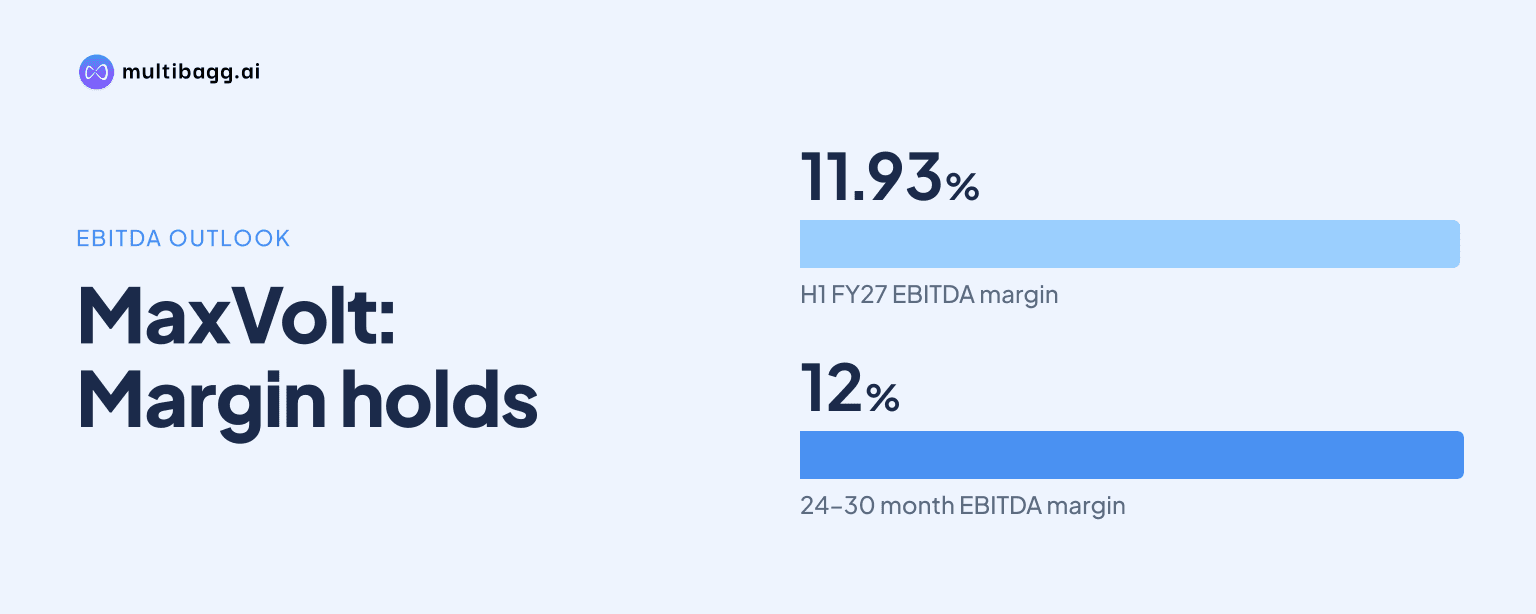
MaxVolt Energy Industries Limited said its H1 FY27 earnings before interest, tax, depreciation and amortisation (EBITDA) margin of 11.93%, based on EBITDA of Rs 28.98 crore on Rs 242.96 crore of revenue, can remain stable for 24 to 30 months. Management cited stabilised Chinese supplier conditions, one-month original equipment manufacturer (OEM) price terms and supplier advances used to secure imported cells.
Know Maxvolt Energy Industries inside out
Results, valuation, peers and who's buying, in one view.
Can MaxVolt sustain a 12% EBITDA margin?
MaxVolt said its currently reported EBITDA margin, which rounds to 12%, can remain stable for the next 24 to 30 months. Chief Executive Officer Satendra Shukla said he did not expect material changes over the coming two to three years, based on demand conditions, but this was management’s outlook rather than formal margin guidance.
Management also said industry pricing and margins could remain stable for three to four years because demand is high relative to the time needed to establish cell manufacturing capacity. Shukla referred to an estimated 30% market conversion taking 10 to 15 years, and said recycling could provide an additional contribution to profitability as MaxVolt develops its circular-economy operations.
The H1 FY27 margin was higher than in the preceding half. EBITDA margin increased by 163 basis points, with one basis point equal to one-hundredth of a percentage point, from H2 FY26 to 11.93%; profit after tax margin rose by 140 basis points to 8.26%. Profit after tax reached Rs 20.08 crore, up 75.3% half on half.
Why did MaxVolt’s margin improve in H1 FY27?
MaxVolt attributed the earlier pressure on margins to changes in Chinese concessions, duties and taxes, alongside geopolitical disruption affecting suppliers. Shukla said China had withdrawn exemptions previously available to suppliers, creating a direct cost impact, but told the call that the relevant conditions had since stabilised.
The company said its OEM contracts are intended to limit the immediate effect of a cell-price increase. According to Shukla, prices in these agreements are generally valid for one month, and MaxVolt can pass a subsequent price hike to the customer. Management did not disclose the share of sales covered by such terms or quantify the timing of cost recovery.
Revenue grew faster than EBITDA year on year, even as the margin improved against H2 FY26. Revenue from operations rose 86.8% year on year and 45.7% half on half to Rs 242.96 crore, while EBITDA increased 57.2% year on year and 68.8% half on half to Rs 28.98 crore. An analyst noted that the company had previously posted margins near 14%, while management focused on sustaining the current reported level.
Got a follow-up? Ask IRIS
How does MaxVolt manage imported-cell price volatility?
MaxVolt said it manages its import dependence through advance commitments to cell suppliers. The company had about Rs 72 crore of advances, of which management said roughly Rs 40 crore to Rs 45 crore was hedging value used to reserve material and stabilise pricing for specified cell chemistries.
Management said these hedging payments can equal 5% to 7% of annual demand commitments. The remaining advances comprised transit and production advances, with initial production bookings requiring token payments of about 5% to 10% before the full amount is released for dispatch.
MaxVolt said it made advances to key suppliers while revenue expanded in order to secure uninterrupted cell supply and stable pricing. This working-capital approach is central to the margin outlook because Shukla described the market as largely dependent on imports; supplier advances and contractual price resets are the two mechanisms management identified to reduce immediate profit-margin effects from input-cost changes.
What do MaxVolt’s H1 FY27 results indicate about its margin base?
MaxVolt generated Rs 242.96 crore of revenue in H1 FY27, equal to 81.9% of its full-year FY26 revenue, and recorded EBITDA of Rs 28.98 crore. Profit after tax was Rs 20.08 crore, up 55.4% year on year, while earnings per share for the half were Rs 18.42; the call did not provide a comparable earnings-per-share figure for an earlier period.
The revenue mix shifted away from e-scooter batteries compared with FY26. E-scooter batteries generated Rs 131.2 crore, or 54% of H1 FY27 revenue, versus a 73% share in FY26. E-rickshaw batteries, energy-storage systems and chargers together contributed 38.5% of revenue, compared with 21.4% in FY26.
At the segment level, e-rickshaw batteries generated Rs 38.9 crore in H1 FY27, compared with Rs 22 crore for all of FY26. Energy-storage systems contributed Rs 31.6 crore, about 1.5 times the FY26 level, while chargers generated Rs 23.1 crore against Rs 20 crore in FY26. Management expects FY27 revenue to be nearly double FY26 revenue and said it expects a stronger second half.
Conclusion
MaxVolt’s 11.93% H1 FY27 EBITDA margin represented a 163-basis-point increase from H2 FY26, alongside Rs 242.96 crore of revenue and a less concentrated product mix. Management’s view that the approximately 12% margin can hold for 24 to 30 months rests on stabilised Chinese supply conditions, contract-based price pass-through and supplier advances that reserve imported-cell supply.
The next test is execution as capacity ramps and demand develops across product lines. Management said recently installed Phase 2 capacity was expected to be fully operational by January, while Phase 1 of the planned 5-gigawatt-hour Aligarh facility is targeted for completion in 24 to 30 months. MaxVolt also said it was working to begin quarterly financial reporting from Q3.