










MaxVolt H1 FY27 Profit Rose Despite ₹46.32 Crore Cash Outflow
Key highlights
- MaxVolt’s H1 FY27 revenue rose 86.8% year on year to ₹242.96 crore.
- MaxVolt reported H1 FY27 profit after tax of ₹20.08 crore, up 55.4% year on year.
- Working-capital changes used ₹80.09 crore in Sep-26, resulting in ₹46.32 crore of negative operating cash flow.
- MaxVolt’s cash and cash equivalents fell to ₹37.60 lakh at Sep-26 from ₹26.37 crore at Mar-26.
powered by IRIS
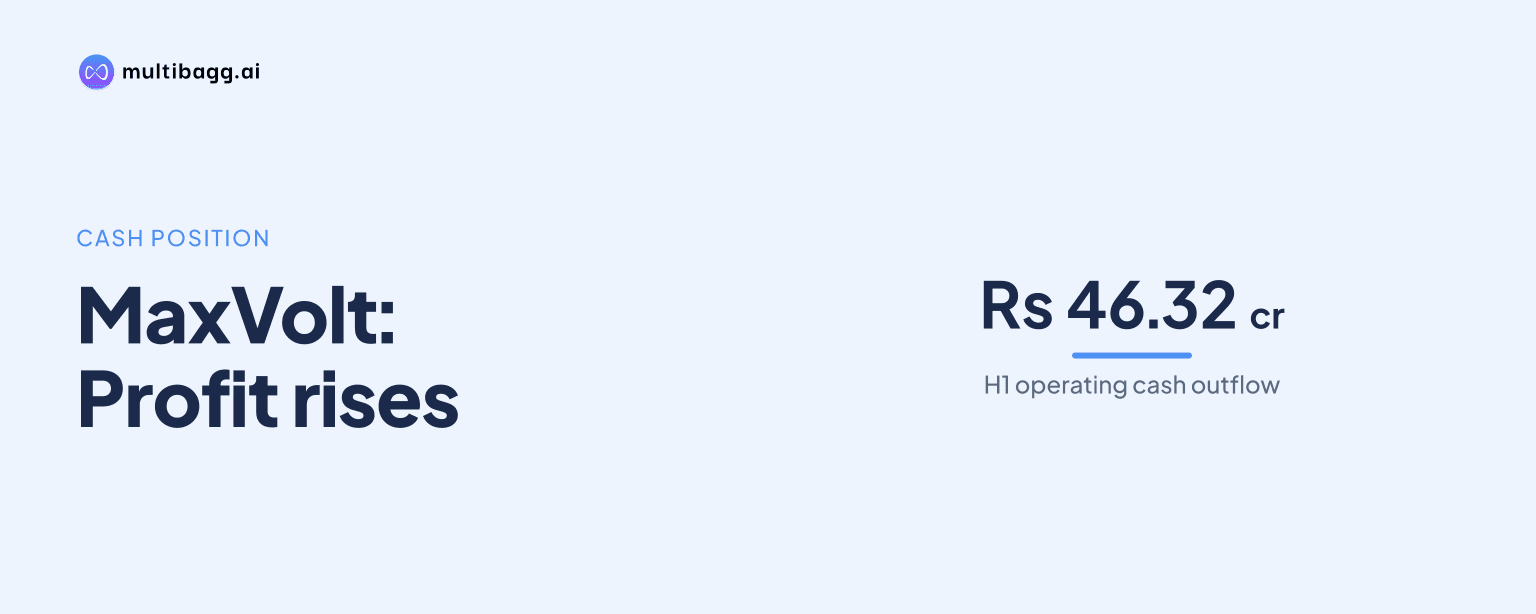
MaxVolt Energy Industries Limited reported H1 FY27 profit after tax of ₹20.08 crore, up 55.4% year on year, but operating activities used ₹46.32 crore of cash after working-capital changes consumed ₹80.09 crore. MaxVolt’s revenue rose 86.8% to ₹242.96 crore, placing cash conversion alongside reported earnings growth.
Know Maxvolt Energy Industries inside out
Results, valuation, peers and who's buying, in one view.
How fast did MaxVolt’s H1 FY27 earnings grow?
MaxVolt’s H1 FY27 revenue from operations increased 86.8% year on year to ₹242.96 crore from ₹130.04 crore in H1 FY26, while profit after tax increased 55.4% to ₹20.08 crore from ₹12.92 crore. Compared with H2 FY26, revenue was 45.7% higher than ₹166.73 crore and profit after tax was 75.3% above ₹11.45 crore.
Earnings before interest, tax, depreciation and amortisation, or EBITDA, reached ₹28.98 crore in H1 FY27, up 57.2% from ₹18.43 crore in H1 FY26 and 68.8% from ₹17.17 crore in H2 FY26. Profit before tax rose 48.3% year on year to ₹26.56 crore, while finance cost increased to ₹5.53 crore from ₹0.83 crore.
MaxVolt’s H1 FY27 segmental revenue was led by e-scooters at ₹131.17 crore, followed by e-rickshaws at ₹38.87 crore and energy storage systems at ₹31.58 crore. Battery chargers generated ₹23.08 crore and other products contributed ₹18.22 crore, according to the historical segmental revenue table.
What happened to MaxVolt’s margins in H1 FY27?
MaxVolt’s gross profit margin was 18.1% in H1 FY27, below 19.5% in H1 FY26 but above 17.9% in H2 FY26. Gross profit nevertheless increased to ₹44.08 crore from ₹25.36 crore year on year as cost of materials consumed rose to ₹198.88 crore from ₹104.68 crore.
MaxVolt’s EBITDA margin declined to 11.9% in H1 FY27 from 14.2% a year earlier, while profit-after-tax margin declined to 8.3% from 9.9%. Both measures improved from H2 FY26, when EBITDA margin was 10.3% and profit-after-tax margin was 6.9%.
Other income rose to ₹4.78 crore in H1 FY27 from ₹0.77 crore in H1 FY26, while depreciation rose to ₹1.67 crore from ₹0.45 crore. EBIT, or earnings before interest and tax, was ₹32.09 crore, 71.2% higher year on year, and its margin was 13.2% compared with 14.4% in H1 FY26.
Got a follow-up? Ask IRIS
Why was MaxVolt’s operating cash flow negative?
MaxVolt recorded ₹33.76 crore of operating profit before working-capital changes in the Sep-26 cash-flow period, but working-capital changes used ₹80.09 crore. This converted the pre-working-capital operating profit into ₹46.32 crore of cash used from operations; the statement shows no direct taxes paid for Sep-26.
The ₹80.09 crore working-capital use in Sep-26 exceeded the ₹63.46 crore use reported for Mar-26, the presentation’s FY26 comparison period. Net cash used in operating activities consequently widened to ₹46.32 crore from ₹28.99 crore, despite Sep-26 profit before tax of ₹26.56 crore.
MaxVolt identifies working-capital intensity as a key risk, with potential cash-flow pressure during growth. Management lists phased capital deployment and diversified revenue channels as mitigants, but the presentation provides no target date or stated level for positive operating cash flow.
Investing activities used ₹23.59 crore in Sep-26, while financing activities generated ₹43.92 crore. The combined movements resulted in a ₹25.99 crore net decrease in cash and cash equivalents, compared with a ₹25.04 crore net increase in the Mar-26 cash-flow period.
Which balance-sheet movements coincided with the cash outflow?
MaxVolt’s inventories increased to ₹83.02 crore at Sep-26 from ₹62.23 crore at Mar-26, while trade receivables rose to ₹67.47 crore from ₹39.13 crore. Short-term loans and advances increased to ₹75.48 crore from ₹33.11 crore, and other current assets rose to ₹15.67 crore from ₹8.83 crore.
Cash and cash equivalents fell to ₹37.60 lakh at Sep-26 from ₹26.37 crore at Mar-26. Total current assets still increased to ₹262.79 crore from ₹192.10 crore, but more of those assets were represented by inventory, receivables and short-term loans and advances.
MaxVolt’s current borrowings rose to ₹118.82 crore at Sep-26 from ₹73.20 crore at Mar-26, while non-current borrowings increased to ₹15.83 crore from ₹12.05 crore. Total equity rose to ₹124.54 crore from ₹104.41 crore, and total assets increased to ₹317.32 crore from ₹224.72 crore over the same dates.
Conclusion
MaxVolt’s H1 FY27 presentation shows reported growth in revenue, EBITDA and profit after tax, with revenue reaching ₹242.96 crore and profit after tax reaching ₹20.08 crore. At the same time, the ₹80.09 crore working-capital use exceeded the ₹33.76 crore operating profit before working-capital changes, resulting in a ₹46.32 crore operating-cash outflow.
The next issue to watch is whether management’s stated mitigants of phased capital deployment and diversified revenue channels change the working-capital and cash-flow profile. The presentation also identifies a planned 10 gigawatt-hour manufacturing expansion, while it does not disclose a cash-conversion target or timetable for a return to positive operating cash flow.