










MaxVolt targets 12.3 GWh platform through Aligarh build-out
Key highlights
- MaxVolt plans a 10 GWh Aligarh facility through two 5 GWh phases.
- Phase 1 assigns 2.5 GWh each to BESS and electric mobility.
- MaxVolt reports 2.3 GWh of installed annual capacity and about 40,000 monthly battery-pack output.
- The proposed Aligarh addition would take total platform capacity to approximately 12.3 GWh.
powered by IRIS
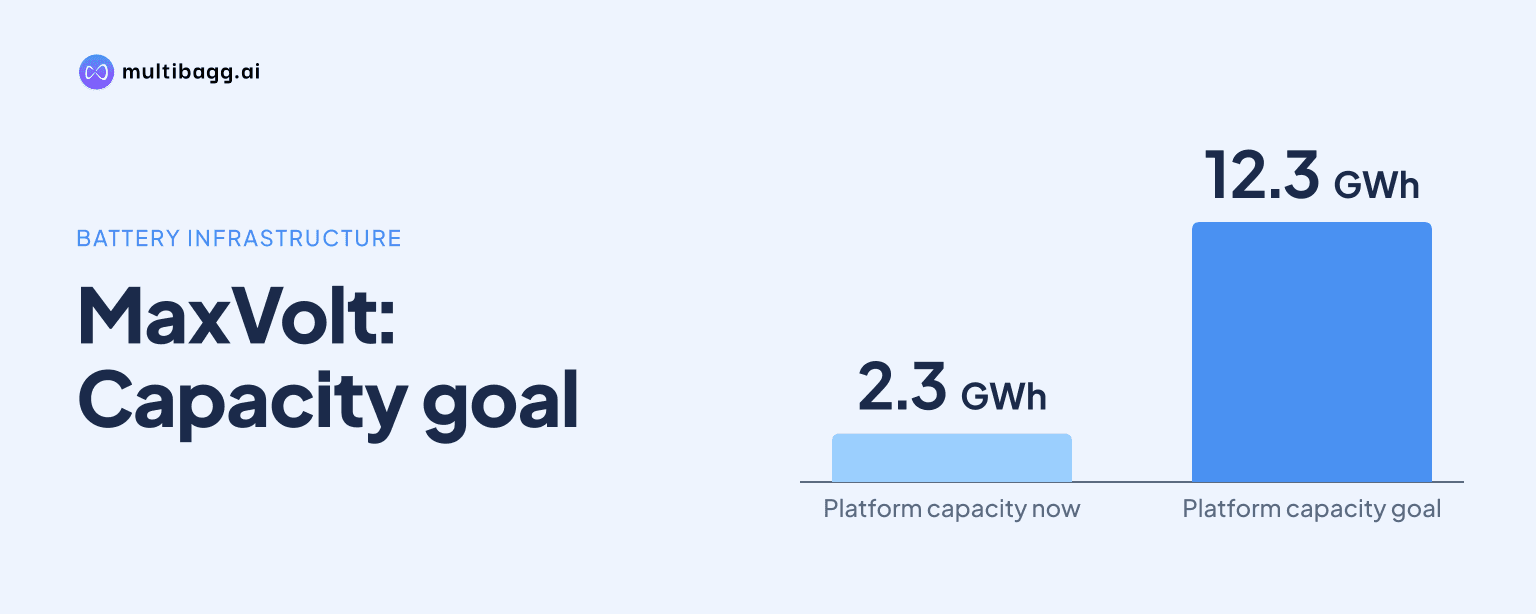
MaxVolt Energy Industries Limited plans a phased 10 GWh Aligarh facility that would take total platform capacity to about 12.3 GWh from 2.3 GWh, with the first 5 GWh targeted in 24–30 months and the second in 42–48 months, subject to commissioning and approvals.
Know Maxvolt Energy Industries inside out
Results, valuation, peers and who's buying, in one view.
What capacity is MaxVolt planning at Aligarh?
MaxVolt is planning 10 GWh of manufacturing capacity at an upcoming six-acre integrated campus in Aligarh. The project comprises two 5 GWh phases rather than one build-out, and the presentation describes the site as the next stage of manufacturing scale for mobility and energy-storage applications. The 10 GWh figure is planned capacity, not current output.
Phase 1 is a 5 GWh initial build-out across battery energy storage systems, or BESS, and electric mobility. Phase 2 would add another 5 GWh for broader market and export demand. MaxVolt’s capacity bridge combines the 10 GWh project with its existing 2.3 GWh installed annual capacity, resulting in approximately 12.3 GWh at full planned scale.
The planned addition is 10 GWh above MaxVolt’s 2.3 GWh operating base, so Aligarh would represent most of the proposed 12.3 GWh platform. The presentation gives duration targets but no calendar starting date, meaning the 24–30-month and 42–48-month measures are not dated commissioning commitments.
How will MaxVolt use the first 5 GWh phase?
MaxVolt plans to divide Phase 1 equally between 2.5 GWh of BESS capacity and 2.5 GWh for electric mobility. The storage allocation covers home storage, commercial and industrial, or C&I, systems, and utility-scale containerized BESS. Storage would therefore account for half of the initial Aligarh capacity.
The mobility allocation covers L3 e-rickshaws, L5 mobility, cargo electric vehicles and original equipment manufacturer, or OEM, custom packs. The source does not provide expected pack volumes from either 2.5 GWh allocation, so the capacity split is not a shipment forecast.
MaxVolt also lists BESS, OEM lithium packs, commercial electric-vehicle batteries and residential energy storage as its fastest-growing segments. Its wider portfolio includes electric-vehicle packs, solar and telecom storage, customized lithium packs and industrial conversion solutions, but the presentation does not disclose segment revenue, orders or utilization for Aligarh.
Got a follow-up? Ask IRIS
How does Aligarh compare with MaxVolt’s current footprint?
MaxVolt reports 2.3 GWh of installed annual capacity and monthly output of about 40,000 battery packs, compared with the planned 10 GWh Aligarh addition. Its Duhai manufacturing facility covers 55,000 square feet, while its corporate office, centre of excellence and new product development space covers 23,000 square feet and its Silver City warehouse covers 26,500 square feet.
At full planned scale, the approximately 12.3 GWh platform would combine the operating 2.3 GWh base with the proposed 10 GWh facility. The presentation qualifies that figure by stating that planned capacity and timelines remain subject to commissioning and approvals. Accordingly, 2.3 GWh is reported installed annual capacity, while 12.3 GWh is a planned platform measure.
Current production is split between 70–75% standard products, principally retail and replacement-market packs, and 25–30% customized OEM packs. The presentation does not state how the 10 GWh will be allocated between standard production and application-specific OEM supply.
What will determine Aligarh’s expansion progress?
MaxVolt says deployment will be phased in line with market development, with Phase 1 targeted in 24–30 months and Phase 2 in 42–48 months. Management says modular expansion lowers execution concentration, while higher utilization supports operating leverage and product mix affects revenue realization. These are stated expansion principles rather than forecasts of utilization, revenue or margin.
Commissioning and approvals are the explicit conditions attached to the planned 10 GWh facility and approximately 12.3 GWh platform. MaxVolt also identifies automated production, advanced testing systems, thermal and safety validation, and higher-volume consistency as next-stage manufacturing priorities for the Aligarh plan.
Market access is another part of the stated strategy. MaxVolt reports more than 1,000 dealers and retail partners, more than 100 OEM partners, more than 18 warehouses and depots, and service availability across more than 1,750 pin codes. The presentation does not disclose Aligarh-linked customer contracts, export orders or committed utilization.
Conclusion
MaxVolt’s disclosed plan is a sequenced 5 GWh first phase and 5 GWh second phase that would lift capacity from 2.3 GWh to about 12.3 GWh at full planned scale. The equal 2.5 GWh Phase 1 allocations indicate that BESS and electric mobility are both intended to underpin the initial Aligarh deployment.
The next items to watch are commissioning and approval milestones, along with progress against the 24–30-month and 42–48-month targets. MaxVolt’s disclosed priorities of automation, advanced testing, thermal and safety validation and higher-volume consistency will determine how the six-acre campus progresses from planned capacity to operating output.