










MaxVolt ReEarth targets 15,000 MT annual battery processing
Key highlights
- ReEarth targets 15,000 MT per annum of planned commercial battery-processing capacity in Phase 2.
- ReEarth targets 8,500 MT per annum of planned critical-mineral refining capacity in Phase 3.
- ReEarth states a target outcome of more than 99% battery-grade material purity.
- Environmental clearances, recycler registration and operational approvals are listed as in progress.
powered by IRIS
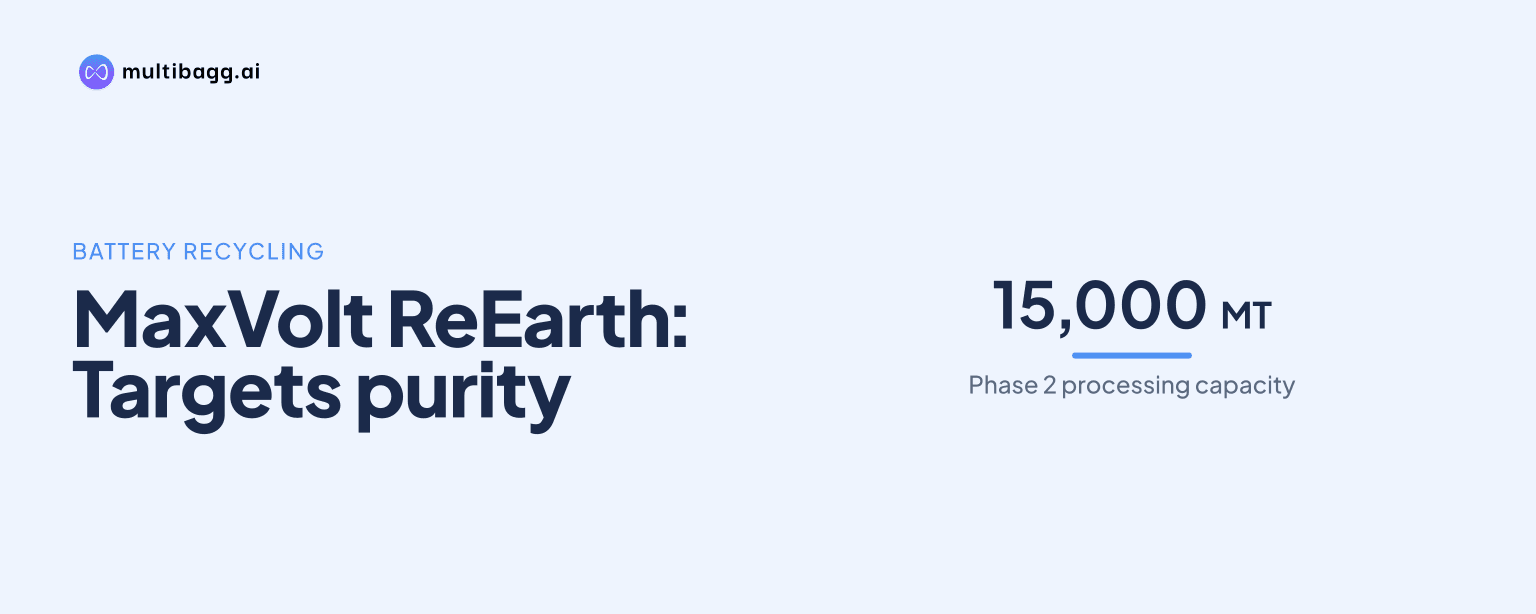
MaxVolt ReEarth targets 15,000 metric tonnes (MT) a year of commercial battery processing in Phase 2 and 8,500 MT a year of critical-mineral refining in Phase 3, following laboratory development and pilot testing. ReEarth lists environmental clearances, recycler registration and operational approvals as in progress, so the capacities remain planned rather than operating assets.
Know Maxvolt Energy Industries inside out
Results, valuation, peers and who's buying, in one view.
Why is ReEarth building a circular battery platform?
ReEarth is building a platform for battery collection, health assessment, second-life applications, recycling and critical-material recovery. Its stated five-step lifecycle starts with collecting end-of-life batteries, then assessing their condition, recovering black mass and reusable materials, refining minerals, and reintegrating materials into the battery value chain.
The platform scope includes second-life applications, battery recycling, black-mass production, extended producer responsibility, or EPR, support, and critical-mineral recovery. ReEarth identifies lithium, nickel, cobalt, manganese and graphite as target materials, and states a target outcome of more than 99% battery-grade material purity.
The more-than-99% purity figure is a target, not a reported result. The presentation does not disclose current battery-processing volumes, commercial recovery yields, an operating recycling plant or the chemistry mix of collected batteries, while Phase 1 is explicitly described as laboratory development and pilot testing.
What battery-processing capacity does ReEarth plan?
ReEarth plans a three-phase progression from technology validation to 15,000 MT a year of commercial battery processing and then 8,500 MT a year of critical-mineral refining. Phase 1 has no stated capacity because it consists of laboratory development and pilot testing before the two proposed commercial-scale stages.
The planned refining capacity is 6,500 MT a year below the planned processing capacity. ReEarth does not disclose the expected conversion yield from processed batteries or black mass to refined minerals, so the presentation does not establish how the two capacity figures would translate into material output.
ReEarth separates processing from refining in its technology roadmap. Processing encompasses safe dismantling, shredding, separation and concentration to form black mass, while refining is linked to hydrometallurgical leaching, purification and mineral recovery for battery-grade materials.
How will ReEarth collect and trace used batteries?
ReEarth plans four feedstock channels: original equipment manufacturer and EPR partners, the MaxVolt channel network, fleet and energy operators, and aggregation partners. The listed battery sources include electric-vehicle fleets, telecom systems, solar installations and energy-storage systems, alongside dealer, distributor and service touchpoints.
Aggregation partners are expected to include authorised collectors and informal-network integration. ReEarth does not disclose signed collection contracts, annual feedstock volumes, collection locations or the expected contribution of each channel to the 15,000 MT planned processing capacity.
ReEarth’s traceability system combines a Battery Passport, geographic information system, or GIS, tracking, and reverse logistics. The Battery Passport is intended to provide battery identity and lifecycle records; GIS is intended to track collection sources and movement; and reverse logistics covers safe aggregation, transport and storage.
The company presents verified feedstock, chain of custody and EPR-ready reporting as the intended outcome of those mechanisms. It also identifies possible recurring revenue from reverse-logistics support, EPR compliance services, and diagnostics and health assessment, alongside lifecycle-value recovery from second-life solutions, recycling services, recovered-material sales and material-offtake agreements.
Got a follow-up? Ask IRIS
What technology pathway does ReEarth intend to use?
ReEarth’s near-term platform is mechanical processing and black-mass production, followed by hydrometallurgical mineral recovery as a scale-up capability. It describes the input platform as chemistry-flexible across lithium iron phosphate, nickel manganese cobalt, nickel cobalt aluminium and lithium cobalt oxide batteries.
Mechanical recovery is designed to begin with discharge, dismantling and segregation, before shredding, separation and concentration form black mass. Hydrometallurgical recovery would then use leaching, purification and mineral recovery to produce battery-grade materials; ReEarth describes both pathways as under phased development.
Direct recycling is positioned as a next-generation direction rather than the near-term operating platform. Its planned functions are cathode preservation, active-material restoration and closed-loop reuse, while artificial intelligence, or AI, based chemistry identification, automated sorting, process monitoring and yield-and-purity optimisation form the proposed digital process layer.
The sequence distinguishes black-mass production from later material regeneration. ReEarth states that AI-enabled sorting and direct recycling are future roadmap technologies, and it does not disclose a commissioning date, pilot throughput, capital expenditure or commercial start date for mechanical, hydrometallurgical or direct-recycling operations.
Which research work supports ReEarth’s scale-up plan?
ReEarth identifies RISE Foundation in Kolkata, CSIR-NML in Ranchi and the University of Birmingham in the United Kingdom as research participants in its planned scale-up. RISE Foundation is associated with applied research and incubation, CSIR-NML with metallurgy and critical materials, and the University of Birmingham with direct recovery and recycling research.
The stated research priorities are lower plant-investment intensity, faster processing, higher efficiency and commercial scalability from pilot to industrial scale. ReEarth also lists process intellectual property for recycling workflows, digital intellectual property for AI-based chemistry identification and monitoring, and material intellectual property for purification and reuse.
Additional collaborations with IIT Roorkee and IIT Delhi cover advanced battery-management systems, energy-storage systems and electric-vehicle 1/3/5 platform development. ReEarth’s intellectual-property roadmap moves from developing concepts to laboratory and pilot validation, patents and publications, commercial deployment, and potential licensing and consultancy.
The intellectual-property portfolio remains under development, with multiple patent filings planned once technologies achieve technical and commercial readiness. The presentation does not state the number of patents filed, granted or licensed, or whether a research partner has transferred a commercial recycling process to ReEarth.
Conclusion
ReEarth’s plan combines collection, traceability, health grading, second-life assessment, black-mass production and a proposed move into critical-mineral refining. Its central scale targets are 15,000 MT a year of battery processing and 8,500 MT a year of refining, but both follow an initial technology-validation phase and are not presented as current operating capacity.
The next developments to watch are Phase 1 laboratory and pilot validation, plus environmental clearances, recycler registration and operational approvals, all listed as in progress. ReEarth also identifies AI-enabled sorting, direct recycling, planned patent filings, licensing and consultancy as later-stage opportunities, without disclosing a timetable, budget or commissioning schedule.