










Maxvolt Energy H1 FY27 Revenue Rises 86.8% to ₹243 Crore
Key highlights
- Maxvolt reported H1 FY27 revenue of ₹242.96 crore, up 86.8% year-on-year.
- H1 FY27 PAT increased 55.4% year-on-year to ₹20.08 crore.
- EBITDA margin declined to 11.93% from 14.2% in H1 FY26.
- Maxvolt plans a 10 GWh Aligarh capacity addition in two 5 GWh phases.
powered by IRIS
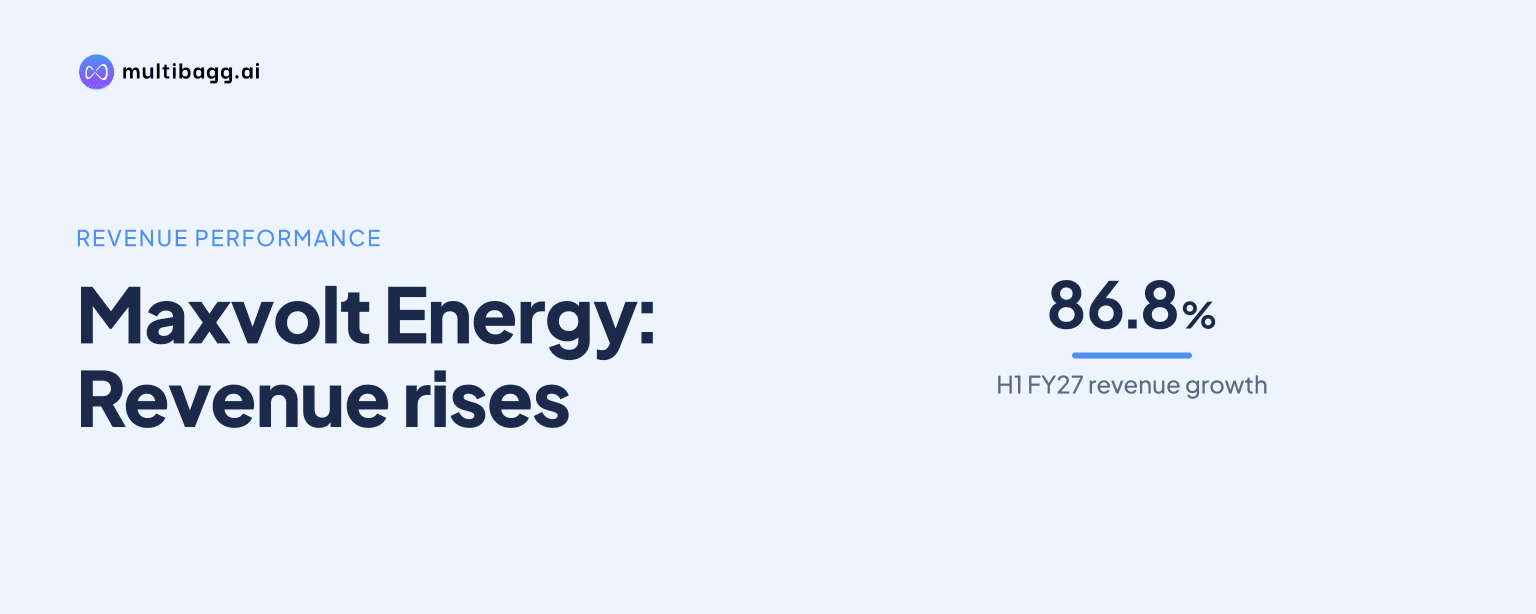
Maxvolt Energy Industries Limited reported H1 FY27 revenue from operations of ₹242.96 crore, up 86.8% year-on-year, with net profit rising 55.4% to ₹20.08 crore for the half year ended September 30, 2026. The result matters because Maxvolt is expanding battery capacity and pursuing recycling operations while managing lower operating margins and higher financing costs.
Know Maxvolt Energy Industries inside out
Results, valuation, peers and who's buying, in one view.
What did Maxvolt report for H1 FY27?
Maxvolt reported operational revenue of ₹242.96 crore for H1 FY27, compared with ₹130.04 crore in H1 FY26. EBITDA was ₹28.98 crore, translating into an EBITDA margin of 11.93%, while profit after tax was ₹20.08 crore and the PAT margin was 8.26%.
The Ghaziabad-based lithium battery pack manufacturer said demand across e-mobility and energy-storage applications supported the revenue increase. Its board approved the unaudited H1 FY27 results on November 14, 2026. The company subsequently filed the results, press release and investor presentation with the National Stock Exchange.
The first-half revenue was equivalent to about 81.9% of Maxvolt's FY26 revenue of ₹296.76 crore. That comparison indicates the higher pace of sales recorded in the first six months, although the company did not provide explicit financial growth guidance for the full year in the presentation.
Why did Maxvolt's profitability margins decline?
Maxvolt's EBITDA margin declined to 11.9% from 14.2% a year earlier, while its PAT margin fell to 8.3% from 9.9%. This meant profit growth, though substantial, was slower than the increase in revenue during the reporting period.
The investor presentation also showed finance cost of ₹5.5 crore, short-term debt of ₹118.8 crore and cash of ₹0.4 crore. These figures are relevant for investors because production expansion and working-capital requirements can increase the need for external funding.
Maxvolt had reported negative operating cash flow of ₹46.32 crore in FY26, which it attributed to working-capital intensity. The presentation also identified raw-material supply issues and elevated aluminium scrap costs as risk factors. It did not quantify the financial impact of these risks for H1 FY27.
How is Maxvolt expanding battery manufacturing capacity?
Maxvolt operates a 2.3 GWh manufacturing base at Duhai and plans to add 10 GWh of capacity at Aligarh. The proposed Aligarh development is planned in two 5 GWh phases over a 24 to 48-month period, according to the investor presentation.
The capacity plan is intended to support demand across mobility, battery energy storage systems, original equipment manufacturers and industrial energy applications. Maxvolt cited retail, OEM, BESS and export demand as areas of opportunity, but did not disclose quantified order visibility or customer-level commitments.
The company said it has expanded its commercial reach to more than 1,000 dealers and over 100 OEM partners across more than 15 states. These channels are central to the company's existing battery-pack business, where sales depend on both distribution coverage and relationships with equipment makers.
Got a follow-up? Ask IRIS
What is Maxvolt ReEarth and why does it matter?
Maxvolt is building MaxVolt ReEarth as a battery recycling and material-recovery platform alongside its manufacturing business. The recycling operation has a stated processing target of 15,000 metric tonnes a year, although the presentation did not provide current processing volumes or revenue contribution.
The strategy places manufacturing, end-of-life battery handling and material recovery within the same broader battery-lifecycle platform. For an energy-storage company, recycled material recovery can be commercially relevant because batteries require metals and other inputs whose availability and cost affect manufacturing economics.
The company described the move as a transition towards integrated circular-energy operations. However, investors have limited financial detail at this stage on capital expenditure, commissioning timelines, operating profitability or the eventual share of group revenue that ReEarth may contribute.
How does H1 FY27 compare with Maxvolt's recent financial growth?
Maxvolt's H1 FY27 figures follow a sharp expansion in FY26, when revenue rose 176.1% year-on-year to ₹296.76 crore. FY26 gross profit was ₹55.22 crore, EBITDA was ₹35.61 crore and PAT was ₹24.38 crore.
Over FY22 to FY26, Maxvolt's revenue increased from ₹6.15 crore to ₹296.76 crore, representing a reported revenue CAGR of 163.6%. The scale-up has occurred alongside the company's focus on lithium battery packs for mobility, energy storage, OEM uses and industrial applications.
The H1 FY27 result confirms continued top-line growth, but it also highlights the importance of margin discipline, cash conversion and funding arrangements as operations expand. The company has scheduled an investor and analyst conference call for November 16, 2026, to discuss the unaudited results for the quarter ended September 30 and the first half.
Conclusion
Maxvolt's H1 FY27 performance showed a significant rise in revenue and net profit, supported by demand across battery-related applications. Revenue reached ₹242.96 crore and PAT reached ₹20.08 crore, but EBITDA and PAT margins were below their year-earlier levels, while short-term debt and prior-year negative operating cash flow remain relevant financial considerations.
The next disclosures to watch are the company's comments from the November 16 investor call and further details on Aligarh's 10 GWh capacity addition and MaxVolt ReEarth's planned 15,000-metric-tonne recycling capability. The presentation does not disclose explicit FY27 financial guidance, capacity commissioning dates or quantified demand visibility.