










MaxVolt sets Rs 400-425 crore Aligarh phase-one funding plan
Key highlights
- MaxVolt estimates Rs 400 crore to Rs 425 crore for its initial 5-6 GWh Aligarh phase.
- Machinery for MaxVolt's first Aligarh production line is estimated at Rs 190 crore to Rs 200 crore.
- Management expects Rs 38 crore to Rs 40 crore of government support for the Aligarh green-energy project.
- MaxVolt expects Rs 100 crore to Rs 120 crore of equity margin funding in roughly six months to one year.
powered by IRIS
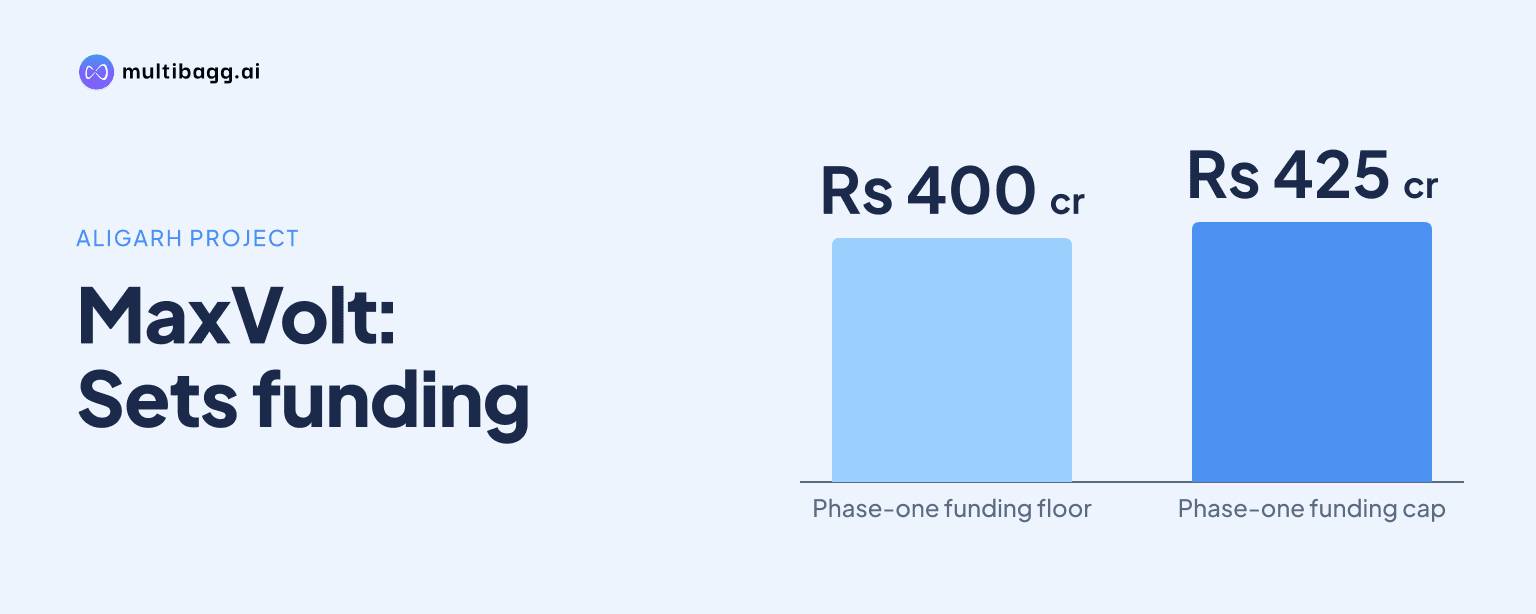
MaxVolt Energy Industries Limited said its first 5 gigawatt-hour (GWh) to 6 GWh battery-pack manufacturing phase at Aligarh will require Rs 400 crore to Rs 425 crore, rather than the full Rs 700 crore announced for the wider project. Management said project debt, an expected Rs 38 crore to Rs 40 crore subsidy and Rs 100 crore to Rs 120 crore of equity margin would form the initial funding mix.
Know Maxvolt Energy Industries inside out
Results, valuation, peers and who's buying, in one view.
What will MaxVolt's first Aligarh phase include?
MaxVolt's first Aligarh phase is planned as a 5 GWh to 6 GWh battery-pack manufacturing line with an outlay of about Rs 400 crore to Rs 425 crore. Management said the project belongs to its battery-pack manufacturing division and is separate from recycling activities undertaken through MaxVolt ReEarth.
The Aligarh building is intended to accommodate 10 GWh of eventual capacity, but MaxVolt plans to install production lines in two stages. Management said the first 5 GWh to 6 GWh lines would be established initially and the balance could be added after about 30 months, making the Rs 700 crore development a four- to five-year project rather than an immediate funding requirement.
Machinery for the initial line is estimated at Rs 190 crore to Rs 200 crore, with the remaining phase-one cost covering civil construction, infrastructure, office setup and related requirements. Management said the bhumi pujan, or ground-breaking ceremony, was completed in September and that initial construction would begin thereafter.
How will MaxVolt finance the Rs 400-425 crore phase?
MaxVolt intends to use project financing as the main source for the Rs 400 crore to Rs 425 crore first phase. Management said it had discussed financing with existing bankers State Bank of India and Bank of Baroda, which it said were aligned with the Aligarh project, although no sanctioned debt amount or lending terms were disclosed.
The company said it had applied for funding with a detailed project report, or DPR, and was working on a techno-economic viability, or TEV, study. Management also said the project-finance discussions included a moratorium, but did not disclose the proposed interest rate, repayment period, security or the timing of final approvals.
Management expects government support of about Rs 38 crore to Rs 40 crore because it described Aligarh as a green-energy project. It did not specify the subsidy programme, eligibility conditions, payment timing or whether the subsidy would be received before or after the relevant capital expenditure.
Got a follow-up? Ask IRIS
How much equity does MaxVolt expect to raise?
MaxVolt expects to provide about Rs 100 crore to Rs 120 crore of equity margin for the first Aligarh phase. Management said it would seek this funding from the market while attempting to minimise equity dilution, with project debt expected to finance a larger portion of the Rs 400 crore to Rs 425 crore requirement.
Management said a market raise was not immediate because Aligarh expenditure would be phased and bulk equity would be needed in roughly six months to one year. An investor cited promoter holding of 39% and asked about dilution, but MaxVolt did not confirm that figure or identify a specific instrument such as a qualified institutional placement or preferential issue.
The company said equity could also be considered if essential liquidity was required during project execution. That leaves the final split between bank debt, subsidy and equity unresolved, despite management's stated expectation that the Rs 100 crore to Rs 120 crore margin component would be raised externally.
Why is MaxVolt pursuing Aligarh while existing capacity is ramping?
MaxVolt said it is pursuing Aligarh because management sees demand for additional battery-pack capacity, even as recently installed capacity is still being brought into operation. It said overall utilisation, including the newer phase-two capacity, was around 35% to 40%, while its earlier phase was operating above 100% through shifts.
The company said its daily battery capacity had risen from 14,000 batteries to 40,000 batteries, an almost threefold increase. Management said phase two had recently been installed and was not yet fully operational, with full operation expected by January.
MaxVolt said its installed machine capacity was 2.3 GWh, measured using higher-capacity 314 cells, and estimated a revenue range of Rs 1,200 crore to Rs 1,400 crore from that capacity because its product mix includes both smaller and larger battery packs. Management targets utilisation of existing capacity by 2028 and expects some generation from the Aligarh factory in year three.
Management cited retail, solar and mobility demand, including design and development work with Piaggio, Eastman and Kinetic. These statements describe potential demand and work in progress; MaxVolt did not disclose order values, binding agreements, a commissioning date or customer commitments for the 5 GWh to 6 GWh Aligarh line.
Conclusion
MaxVolt has presented Aligarh as a staged capacity programme rather than a one-time Rs 700 crore funding event. The immediate project is a Rs 400 crore to Rs 425 crore, 5 GWh to 6 GWh battery-pack phase, for which machinery alone is estimated at Rs 190 crore to Rs 200 crore and management expects project debt, subsidy support and equity margin funding.
The next developments to watch are completion of the DPR and TEV study, the outcome of financing discussions with State Bank of India and Bank of Baroda, and the timing and structure of the proposed Rs 100 crore to Rs 120 crore equity raise. Management has also said phase two should be fully operational by January and has set a 2028 target to utilise existing capacity.