










MaxVolt says no working-capital equity needed for growth
Key highlights
- MaxVolt said Rs 57 crore is its long-term debt within total debt discussed at around Rs 130 crore to Rs 135 crore.
- Management said imported-material procurement has a 90-to-120-day cycle, while factoring can be repaid in 60 to 90 days.
- MaxVolt said Tier 2 and Tier 3 OEM customers seek 45 to 60 days of credit, unlike mostly cash-based two-wheeler dealer sales.
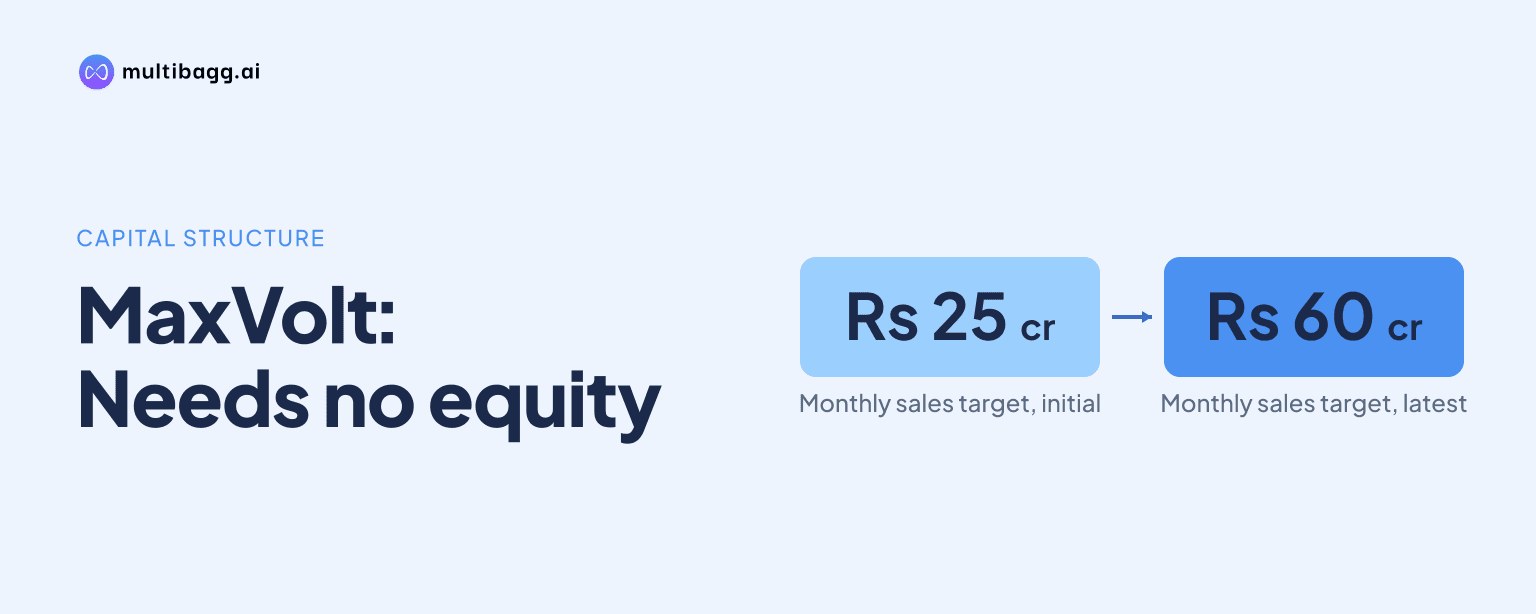
- MaxVolt raised its monthly sales target from Rs 25 crore to Rs 30 crore to Rs 50 crore to Rs 60 crore.
powered by IRIS
MaxVolt said during its earnings call that it does not currently need equity to fund working capital, despite planning for monthly sales of Rs 50 crore to Rs 60 crore. Management said supplier credit, factoring, letters of credit and bill discounting are intended to finance a 90-to-120-day import cycle and 45-to-60-day original equipment manufacturer credit.
Know Maxvolt Energy Industries inside out
Results, valuation, peers and who's buying, in one view.
How is MaxVolt funding its longer working-capital cycle?
MaxVolt said it is funding working capital through short-term facilities, supplier credit and customer-side financing rather than a stated equity raise. Management said its import-based procurement cycle lasts about 90 to 120 days and that it is hedging China-sourced materials to stabilise supply as demand rises.
The company said it is planning procurement for the full financial year, compared with six months of planning last year. Management said the earlier six-month approach affected business and performance in the later second quarter, leading MaxVolt to hold inventory for a longer period this year.
Factoring is one of the mechanisms MaxVolt identified to circulate funds through that cycle. Management described factoring as short-term finance repayable in 60 to 90 days, rather than long-term borrowing. It also said it is working on non-fund-based products, including letters of credit, or LCs, that can provide credit lines of 90 to 120 days.
How much of MaxVolt's debt is long term?
MaxVolt said Rs 57 crore is its existing long-term debt, while debt discussed on the call was about Rs 130 crore to Rs 135 crore. Management said the balance largely comprises short-duration financing through M1 Exchange, factoring and similar banking channels used to purchase materials.
Management said the short-term facilities are generally repaid bill by bill over 60, 90 or three-month periods. Its distinction between the Rs 57 crore long-term line and the higher overall debt figure is based on the use of short-term funds to finance inventory purchases, not permanent project borrowing.
For capital expenditure, or capex, MaxVolt described a separate financing structure. Management said project funding would be drawn in phases and that a bank had agreed to a 30-month moratorium, allowing revenue to begin before equated monthly instalments, or EMIs, start. The call did not disclose a project-loan amount or repayment start date.
Why does MaxVolt need new financing for OEM sales?
MaxVolt said original equipment manufacturer, or OEM, sales require a different funding model because Tier 2 and Tier 3 OEM customers ask for 45 to 60 days of credit. By comparison, management said its two-wheeler dealer business is mostly cash based.
To support OEM receivables, MaxVolt said it has introduced bill discounting, under which it can seek financing against customer bills instead of waiting through the full credit period. Management added that some customers participate in this process while others do not, so the facility is not uniformly available across its customer base.
MaxVolt also said it is using receivables insurance as it extends OEM credit. Management described insurance as a measure to prevent the issue associated with customer credit, but did not identify the insurer, insurance coverage, premium cost, participating OEMs or any claim history.
The company described this combination of factoring, LCs, bill discounting and insurance as financial engineering developed over the past year. Management said it plans to reduce a finance-related figure during the current year, but did not specify whether it meant finance costs, financing outstanding or another measure.
Got a follow-up? Ask IRIS
How does MaxVolt's inventory target change funding needs?
MaxVolt said it has increased inventory because it is now targeting monthly sales of Rs 50 crore to Rs 60 crore, compared with its initial target of Rs 25 crore to Rs 30 crore. The revised monthly target is twice the earlier range at both the lower and upper ends.
Management linked the increase in inventory to full-year hedging of materials sourced from China. It said holding stock for the entire financial year is intended to keep supply stable, whereas last year's six-month procurement planning contributed to an impact in the later second quarter.
The call did not disclose the inventory value, inventory days, hedging instrument or cost of the hedge. It also did not provide receivable days or supplier-credit limits, so the scale of cash tied up in inventory and OEM receivables cannot be calculated from management's remarks.
The stated funding structure addresses two longer periods in the operating cycle: imported material procurement of 90 to 120 days and OEM customer credit of 45 to 60 days. MaxVolt's approach is to use separate trade-finance and receivable-finance tools at different stages, rather than rely on a single facility.
Does MaxVolt expect equity funding for working capital?
MaxVolt said it does not currently expect to raise equity for working capital. In response to a question about the next one-and-a-half years, management cited support from existing bankers, supplier credit lines and what it described as profitable operations.
Management's position was not presented as quantified financing guidance. It also said it had not seen profitability and margins being affected over the next three years because it sees substantial demand, but the call provided no revenue forecast, cash-flow forecast, margin projection or financing sensitivity analysis.
MaxVolt did leave open the possibility of equity dilution for capex. Management said any equity funding would be for the banker margin money required for the 10-gigawatt Aligarh project, rather than for operating working capital. It did not disclose the project's total cost, required equity contribution, fundraising timetable or approval for an equity issue.
Conclusion
MaxVolt's stated plan is to match a 90-to-120-day import cycle and 45-to-60-day OEM credit with trade-linked funding rather than equity. Management separates Rs 57 crore of long-term debt from about Rs 130 crore to Rs 135 crore of total debt discussed, saying the difference largely consists of short-term purchase and factoring facilities.
The next issue to watch is whether trade-finance tools continue to support higher inventory and OEM receivables as MaxVolt targets Rs 50 crore to Rs 60 crore in monthly sales. Management has identified potential equity funding only for capex and banker margin money for the 10-gigawatt Aligarh project, while a 30-month project-financing moratorium is part of its disclosed plan.