










MaxVolt H1 FY27 revenue climbs 87% as e-scooter mix falls
Key highlights
- MaxVolt reported H1 FY27 revenue of Rs 242.96 crore, up 86.8% year on year.
- E-scooter batteries contributed 54% of H1 FY27 revenue, compared with 73% in FY26.
- E-rickshaw batteries generated Rs 38.9 crore in H1 FY27, about 1.8 times FY26 revenue of Rs 22 crore.
- H1 FY27 EBITDA was Rs 28.98 crore and EBITDA margin expanded 163 basis points from H2 FY26.
powered by IRIS
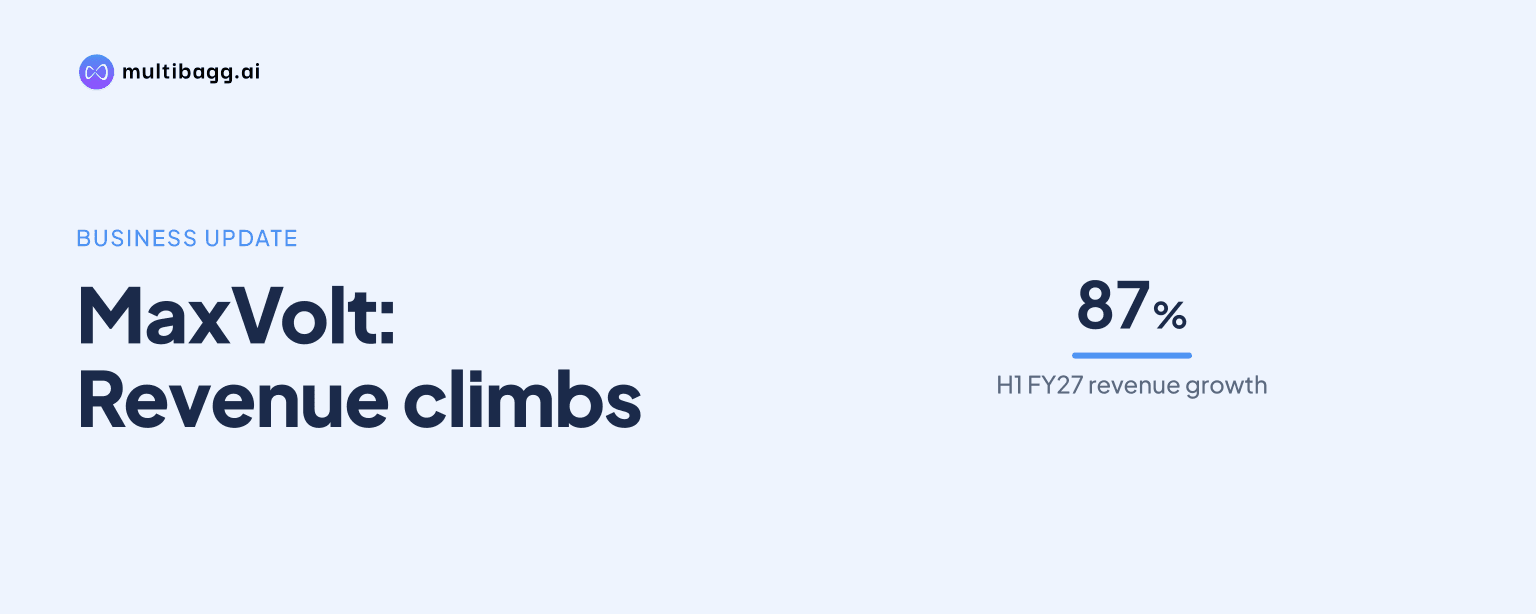
MaxVolt Energy Industries Limited reported H1 FY27 revenue from operations of Rs 242.96 crore, up 86.8% year on year, while e-scooter batteries accounted for 54% of sales versus 73% in FY26. E-rickshaw batteries, energy-storage systems and chargers together contributed 38.5% of the H1 FY27 revenue mix, compared with 21.4% in FY26.
Know Maxvolt Energy Industries inside out
Results, valuation, peers and who's buying, in one view.
How did MaxVolt’s H1 FY27 revenue and profit change?
MaxVolt’s H1 FY27 revenue from operations was Rs 242.96 crore, increasing 86.8% year on year and 45.7% half on half. Management said the six-month revenue equalled 81.9% of the company’s full-year FY26 revenue, placing H1 FY27 sales above four-fifths of the preceding full-year total.
Earnings before interest, tax, depreciation and amortisation, or EBITDA, reached Rs 28.98 crore in H1 FY27, up 57.2% year on year and 68.8% half on half. The EBITDA margin was 11.93%, an expansion of 163 basis points from H2 FY26, equivalent to a 1.63-percentage-point increase from the preceding half-year.
Profit after tax, or PAT, was Rs 20.08 crore, a 55.4% year-on-year increase and a 75.3% half-on-half increase. PAT margin was 8.26%, up 140 basis points from H2 FY26, while earnings per share, or EPS, for the six months was Rs 18.42.
How has MaxVolt reduced its reliance on e-scooter batteries?
MaxVolt reduced e-scooter batteries’ revenue contribution to 54% in H1 FY27 from 73% in FY26, although the segment remained its largest at Rs 131.2 crore. Management said e-scooter battery revenue had grown nearly 20 times between FY23 and FY26, providing the base from which newer product lines expanded.
E-rickshaw battery revenue reached Rs 38.9 crore in H1 FY27, about 1.8 times the Rs 22 crore recorded for the whole of FY26. Energy-storage systems contributed Rs 31.6 crore in six months, or about 1.5 times FY26 revenue, after management said that line grew more than sixfold during FY26.
Battery chargers delivered Rs 23.1 crore in H1 FY27, ahead of Rs 20 crore for full-year FY26, while other product lines generated Rs 18.2 crore, above FY26’s Rs 15.2 crore. Together, e-rickshaw batteries, energy-storage systems and chargers represented 38.5% of H1 FY27 revenue, versus 21.4% in FY26, an increase of 17.1 percentage points.
Got a follow-up? Ask IRIS
What manufacturing capacity is MaxVolt operating and building?
MaxVolt said installed capacity at its Duhai plant stood at 2.3 gigawatt-hours, or GWh, in H1 FY27, with monthly output of about 40,000 battery packs. That compares with 14,000 packs at the end of FY26, an increase of about 26,000 packs a month as the newly installed capacity is brought into operation.
Management said the recently installed Phase 2 expansion was expected to be fully operational by January, while total current capacity utilisation was about 35% to 40%. It separately said utilisation of the earlier Phase 1 capacity exceeded 100% because production was being run in shifts, distinguishing the earlier line from the wider recently installed base.
At Aligarh, MaxVolt held a Bhoomi Pujan during the half for a six-acre campus planned for 10 GWh in two phases. Management targets completion of the first 5 GWh phase, spanning energy storage and electric mobility, in 24 to 30 months; at full scale, it said the platform would have about 12.3 GWh of capacity including Duhai.
What is MaxVolt’s outlook and what could affect execution?
Management expects FY27 revenue to be nearly double FY26 revenue, citing demand across its segments and a stronger second half. This is management’s outlook rather than reported performance, and it follows H1 FY27 revenue of Rs 242.96 crore, already equal to 81.9% of the FY26 full-year figure.
On profitability, management said the 11.93% H1 FY27 EBITDA margin should remain stable over the next 24 to 30 months, based on its view of demand and price arrangements with original equipment manufacturers. It said agreements allow input-price increases to be passed through to customers, after referring to prior supply disruptions, duties and tax-related changes.
Working-capital execution remains relevant because management said supplier advances were about Rs 72 crore, including roughly Rs 40 crore to Rs 45 crore of hedging-related advances. The company said these payments reserve specified cell chemistries and help secure cell supply and pricing; other advances cover transit and production bookings, with initial booking amounts described as 5% to 10%.
Conclusion
MaxVolt’s H1 FY27 results show both faster revenue growth and a changed product mix. Revenue of Rs 242.96 crore was accompanied by 54% dependence on e-scooter batteries, down from 73% in FY26, while e-rickshaw batteries, energy-storage systems and chargers supplied 38.5% of revenue. EBITDA and PAT margins were 11.93% and 8.26%, respectively.
The next disclosed operational milestone is management’s expectation that the recently installed Phase 2 capacity will be fully operational by January. Longer term, management targets completion of Aligarh Phase 1 within 24 to 30 months, while its expectation of FY27 revenue nearing twice FY26 will depend on demand conversion, Duhai capacity utilisation and the management of supplier advances of about Rs 72 crore.