










Maxvolt Energy Industries Revenue Rises 86.8% to ₹243 Crore in H1
Key highlights
- Maxvolt reported H1 FY27 revenue of ₹242.96 crore, up 86.8% year on year.
- H1 FY27 EBITDA was about ₹29 crore, with an EBITDA margin of 11.9%.
- Net profit reached ₹20.1 crore in H1 FY27, up 55.8% year on year.
- H1 FY27 revenue equalled 81.9% of Maxvolt's FY26 revenue of ₹296.76 crore.
powered by IRIS
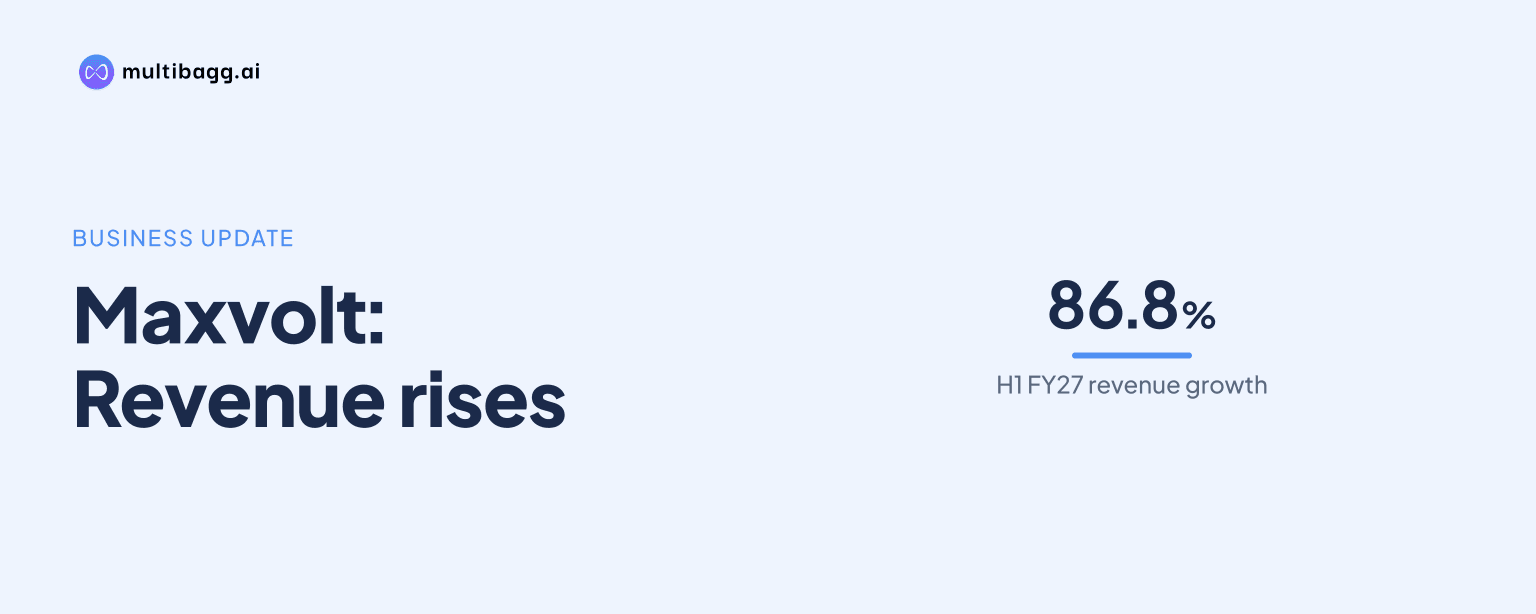
Maxvolt Energy Industries Limited reported H1 FY27 revenue of ₹242.96 crore, up 86.8% year on year, with EBITDA of ₹29 crore and an EBITDA margin of 11.9%. The performance placed first-half revenue at 81.9% of the ₹296.76 crore reported in FY26, while management outlined further capacity and recycling plans.
Know Maxvolt Energy Industries inside out
Results, valuation, peers and who's buying, in one view.
What did Maxvolt report for H1 FY27?
Maxvolt reported revenue from operations of ₹242.96 crore for the half year ended 30 September 2026, compared with the corresponding prior-year period, representing growth of 86.8%. Net profit was ₹20.1 crore, up 55.8% year on year, while the company reported a PAT margin of 8.3%.
EBITDA rose 57.2% year on year to about ₹29 crore. The EBITDA margin was 11.9%, below the rate of revenue growth, while profit after tax rose 55.4% in the earnings-call summary and 55.8% in the results update. The company also said no one-off items were flagged in the reported revenue growth.
The first-half revenue number is significant because it already equals 81.9% of Maxvolt's full-year FY26 revenue of ₹296.76 crore. Management guided for FY27 revenue to be nearly double FY26 revenue, supported by a stronger second half, but it did not provide an exact revenue target, quarterly outlook or margin guidance.
Which businesses supported Maxvolt's growth?
Maxvolt said e-scooter batteries remained its largest business, although the segment's share of revenue reduced to 54% in H1 FY27 from 73% in FY26. Growth in e-rickshaw batteries, energy storage systems and chargers contributed to a more diversified revenue mix.
Management cited broad demand across e-mobility and energy storage as the basis for its outlook. However, the call summary did not disclose order-book figures, customer-wise demand data or segment-wise revenue amounts. This limits the ability to quantify the contribution of each product category to the 86.8% rise in first-half revenue.
The company also described its strategy as extending beyond battery-pack manufacturing. Its stated operating model includes engineering, cell sourcing, distribution, servicing, battery passports, repurposing and recycling. Maxvolt indicated that it is focused on producing cell-grade materials rather than committing to cell manufacturing.
How is Maxvolt expanding battery-pack capacity?
Maxvolt reported installed capacity of 2.3 GWh at Duhai, where monthly output capacity was raised from 14,000 packs to about 40,000 packs. It also outlined a planned 10 GWh campus at Aligarh, to be developed in phases.
Management said it was building capacity ahead of demand. The call material did not specify current utilisation at Duhai, the commissioning schedule for individual Aligarh phases, project cost or funding requirements. Analysts sought clarity on capacity utilisation, but the reported responses were described as vague or inconsistent.
Capacity expansion is relevant to the FY27 growth plan because management expects a stronger H2. Yet the company gave no numerical bridge showing how additional production, product mix, customer additions or pricing would translate into its full-year revenue expectation. Investors therefore have a reported direction of travel but not a quantified operating roadmap.
Got a follow-up? Ask IRIS
What are the margin and supply-chain issues?
Maxvolt said its H1 FY27 EBITDA margin was 11.93%, broadly reflected in the reported 11.9% margin. When asked whether margins could return to the previously discussed level of about 14%, management said past pressure had stemmed from duty, tax and geopolitical changes, which it believes have stabilised and can be passed through to customers.
Management said it expects margins to remain stable for 24 to 30 months, without setting a forward margin range. It also said recycling could improve profitability over time. The company relies materially on imported cells and is using supplier advances and annual bookings to secure supplies and pricing, making sourcing conditions and working-capital management relevant to margins.
The gap between revenue growth and EBITDA growth is also notable. Revenue increased 86.8%, while EBITDA increased 57.2%, resulting in the reported 11.9% margin. The call did not provide a detailed reconciliation of input costs, logistics, product mix, pricing, duties or working-capital movements that would explain the margin outcome.
What is the status of Maxvolt's recycling business?
Maxvolt Rear, a 66% holding subsidiary, remains at the laboratory and pilot stage for recycling. Management described a circular-economy plan involving repurposing before black-mass generation, with recycling mandates preventing black-mass exports outside India.
The company has branded the recycling initiative as ReEarth and said it intends to expand the business. But management did not disclose a commercial start date, processing capacity, capital requirement or revenue contribution target. As a result, recycling remains an early-stage initiative rather than a disclosed driver of H1 FY27 financial performance.
The regulatory restriction cited by management shapes the proposed operating flow. Repurposing batteries before generating black mass is presented as part of the process required to operate within the domestic framework. The call did not provide further details on feedstock availability, offtake arrangements or the economics of the planned recycling operations.
Conclusion
Maxvolt delivered strong H1 FY27 revenue and profit growth, with ₹242.96 crore of revenue, ₹29 crore of EBITDA and ₹20.1 crore of net profit. Its changing revenue mix, higher Duhai output capacity and plan for a phased Aligarh facility provide the operational context for management's expectation of a stronger second half.
The next disclosures to watch are the company's exact FY27 revenue outcome versus its nearly doubled-FY26 aspiration, the progress and funding of the 10 GWh Aligarh project, and commercial milestones for ReEarth. Further clarity on capacity utilisation, debt, working capital and a quantified margin outlook remains unresolved after the H1 FY27 call.