










Orkla India Q2 Revenue Rises 19.4% as EBITDA Margin Moderates
Key highlights
- Orkla India reported Q2 FY2027 revenue from operations of ₹776 crore, up 19.4% year on year.
- Q2 FY2027 EBITDA rose 12.6% to ₹124 crore, while reported EBITDA margin was 15.9%.
- Volume growth improved to 2.9% in Q2 FY2027, higher than in the preceding two quarters.
- Digital commerce contributed 10% of domestic business, while GCC revenue grew 22.7% year on year.
powered by IRIS
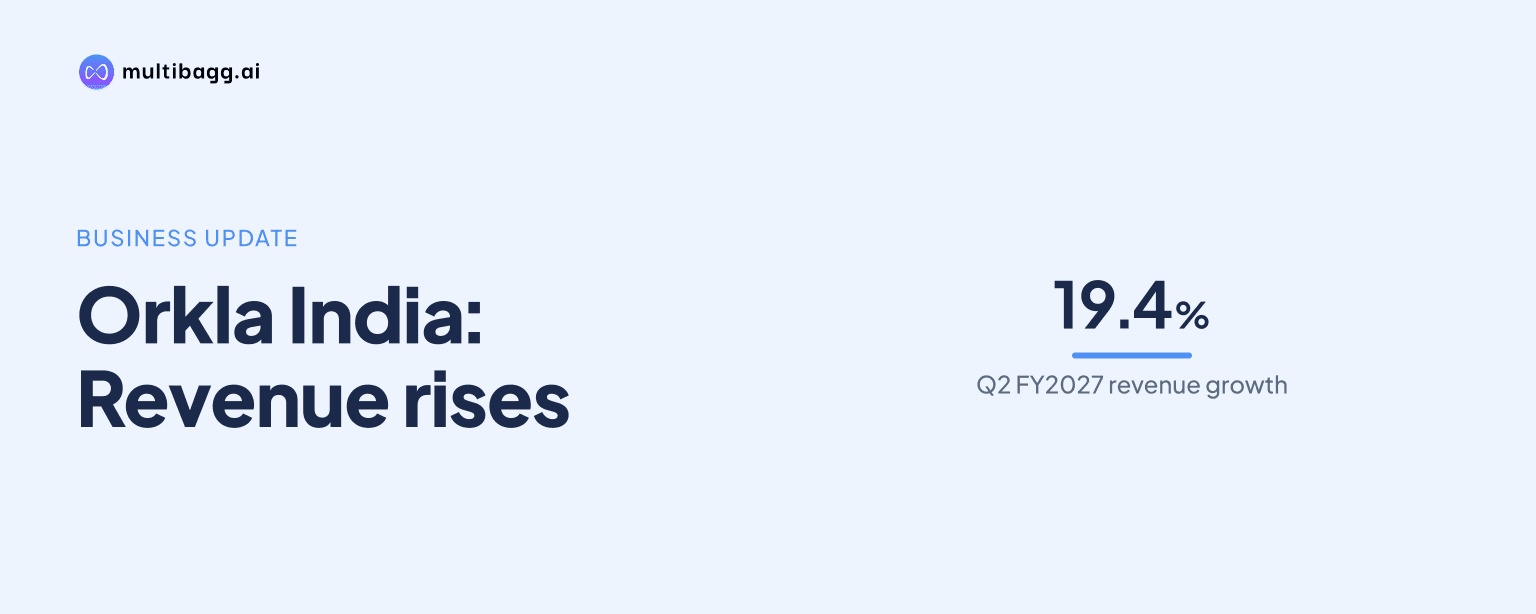
Orkla India Ltd reported Q2 FY2027 revenue from operations of ₹776 crore, up 19.4% year on year, while reported EBITDA margin moderated to 15.9%. The performance was supported by broad-based category growth, Onam-led execution in Kerala and increased digital commerce sales, although commodity inflation continued to weigh on profitability.
Know Orkla India inside out
Results, valuation, peers and who's buying, in one view.
What drove Orkla India's Q2 FY2027 revenue growth?
Orkla India's Q2 revenue growth was driven by broad-based demand across categories and geographies, with revenue from operations reaching ₹776 crore. The company said growth accelerated during the quarter, aided by its Kerala execution during the Onam season and continued expansion across its domestic portfolio. Revenue growth was reported at 19.4% year on year in the financial results.
Volume growth improved to 2.9% in Q2, exceeding the pace of the preceding two quarters. This improvement is important because price increases in spices had limited underlying volume expansion. Management indicated that spices volumes received support from the Onam season, while Kerala volumes returned to positive growth during the quarter.
Convenience foods grew 7.7%, a slower rate than the wider business. The company attributed the moderation to a festive-season shift and a high comparison base. It nevertheless continued to position convenience foods as an area of focus, including through product launches aimed at consumers in major cities.
How did commodity costs affect Orkla India's profitability?
Commodity inflation reduced Orkla India's operating-margin expansion despite double-digit revenue and EBITDA growth. EBITDA increased 12.6% to ₹124 crore, but the reported margin was 15.9%, around 100 basis points lower than the year-earlier level. The company cited elevated input costs as well as investments in strategic projects as key factors behind the margin movement.
Spice costs rose by about 48% year on year during the quarter, according to the CFO. Chilli and coriander were the main inflationary inputs. Management said crop cycles had ended and stocks were largely held in cold storage, making prices broadly stable at present, although speculative price spikes can still occur.
The company implemented price increases of more than 20% in spices, which affected volume growth in the category. Management said pure-spice prices are linked directly to raw-commodity movements, while blended-spice pricing is calibrated with a greater focus on retaining competitiveness and supporting volumes. For pure spices, the stated markup is 10% over wholesale raw commodity prices.
Orkla India also clarified its EBITDA calculation during the call. The measure excludes finance costs, certain foreign-exchange losses and fair-value losses on financial instruments classified under other expenses, along with exceptional items and depreciation. This explanation addressed the difference between the reported EBITDA figure and operating-profit line items.
Got a follow-up? Ask IRIS
Which channels and markets supported Orkla India's performance?
Digital commerce and international operations supported Orkla India's Q2 growth alongside its domestic retail business. Digital commerce accounted for 10% of domestic business, up from 8.9%, while revenue from digital commerce in the rest of India rose about 33.6%. The company has linked this progress to ongoing digital investments and distribution initiatives.
Project Vault is scheduled for implementation in the final quarter across quick-commerce operations in the top 28 cities. The company also reported 38 product launches in the first half, comprising 23 in the first quarter and 15 in the second. It expects the results of close to 15 festive-season sweets launches to be clearer in Q3.
International business grew 11.7% in the quarter. Growth in the Gulf Cooperation Council region was stronger at 22.7%, despite geopolitical challenges noted by management. These numbers indicate that overseas markets remained a supplementary contributor to growth rather than a sole driver of the quarter's performance.
What are Orkla India's key execution priorities?
Orkla India's immediate execution priorities are distribution restructuring, digital expansion and a broader portfolio transition for the Eastern brand. The Kerala distribution restructuring remains at an early stage, with full rollout expected by March 2027. Management said effective coverage has improved by almost 10% and sales productivity has increased around 1.27 times through the work completed so far.
Project Bolt and the Kerala restructuring are intended to strengthen availability and sales execution. However, the company acknowledged that underlying EBITDA growth, excluding PLI and Project Bolt investments, was 6.3% in Q2. This indicates that the pace of core profit growth was lower than the reported EBITDA growth after accounting for the stated adjustments.
Management said its longer-term growth aspiration exceeds 10% to 12%. It stated that volume growth could exceed 8% to 10% if inflation moderates to 5% to 7%, supported by consumers moving from unorganised products to branded offerings and by demand for value-added products. This is an aspiration dependent on the commodity environment, not a formal reported forecast.
The company is also seeking to expand Eastern beyond pure spices into a wider foods offering. The strategy matters because blended masalas and convenience foods can carry greater value addition than pure spices, where prices remain more directly tied to commodity movements. The pace of progress will depend on execution, product acceptance and input-cost conditions.
Conclusion
Orkla India's Q2 FY2027 results showed strong reported revenue growth of 19.4% to ₹776 crore and a 19.2% rise in net profit to ₹91 crore. Improved volume growth, Kerala's Onam-season performance, digital commerce and overseas growth supported the quarter, while steep spice inflation restricted margin expansion.
Investors will watch whether spice costs remain stable, whether volume growth continues to improve, and how the Kerala distribution restructuring progresses toward its expected March 2027 completion. The planned Project Vault rollout in the final quarter and the performance of recent product launches are also relevant indicators for the company's growth and profitability trajectory.