










OSEL Bharat Mandapam concession targets Rs 15 crore annually
Key highlights
- OSEL expects about Rs 15 crore of annual revenue from its 10-year Bharat Mandapam LED concession.
- The Bharat Mandapam concession covers about 15,000 square feet of LED displays and has about 25% expected annual growth.
- OSEL's CMS operated on more than 1,000 displays across more than 300 locations in H1 FY27.
- LED displays represented about 38% of OSEL's Rs 193.6 crore H1 FY27 revenue from operations.
powered by IRIS
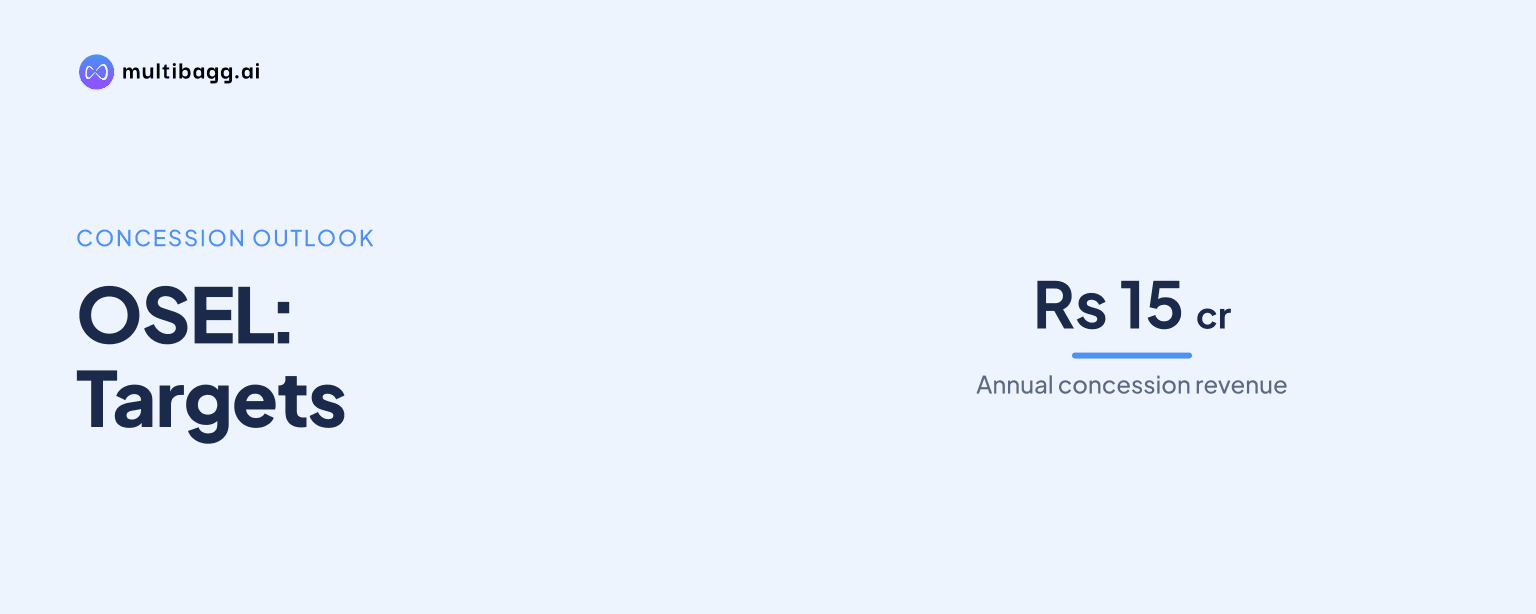
Osel Devices Limited said its 10-year Bharat Mandapam public-private partnership concession, won after the first half of fiscal year 2027 (H1 FY27), is expected to generate about Rs 15 crore in annual revenue from roughly 15,000 square feet of light-emitting diode (LED) displays. The company disclosed the target alongside a content management system operating on more than 1,000 displays across more than 300 locations.
Know OSEL Devices inside out
Results, valuation, peers and who's buying, in one view.
What does OSEL's Bharat Mandapam concession cover?
OSEL's Bharat Mandapam concession covers about 15,000 square feet of LED displays at the New Delhi exhibition venue for 10 years. The company said it operates the installation under a concession with ITPO, and its LED walls were used at hall entrances during the 45th India International Trade Fair in November 2026.
Management expects the arrangement to add about Rs 15 crore in annual revenue and indicated expected annual growth of about 25%. This is an expectation rather than reported revenue because OSEL said it won the concession after H1 FY27, meaning the target was not included in its reported H1 FY27 revenue from operations of Rs 193.6 crore.
The arrangement differs from a conventional display sale because OSEL classifies concessions as part of the LED segment's recurring-revenue model. The LED model also includes leasing and monthly software subscriptions, whereas hardware supply and installation are one-time sources of revenue.
How does the concession compare with OSEL's current business?
The annual Rs 15 crore target is being added to a business that generated Rs 193.6 crore of revenue from operations in H1 FY27, up 31.8% from Rs 146.9 crore in H1 FY26. LED displays represented about 38% of H1 FY27 revenue, compared with about 35% for hearing aids and about 27% for Philips Mobile.
The H1 FY27 mix made LED displays OSEL's largest disclosed vertical by revenue share, although the company did not provide segment revenue in rupees. The Bharat Mandapam estimate is therefore linked to the largest component of the reported mix, but OSEL did not disclose segment profit, concession cash collection or capital spending.
OSEL reported earnings before interest, tax, depreciation and amortisation (EBITDA) of Rs 32.5 crore in H1 FY27, up 31.9% from Rs 24.7 crore a year earlier, while its EBITDA margin was unchanged at 16.8%. Profit after tax rose 19.1% to Rs 18.1 crore, but the profit-after-tax margin declined to 9.3% from 10.3%.
Revenue in H1 FY27 also exceeded each half of FY26: H2 FY26 revenue was Rs 145.8 crore, following Rs 146.9 crore in H1 FY26. Management said it continues to target FY27 growth in line with FY26, without publishing a numerical full-year revenue forecast.
Got a follow-up? Ask IRIS
How do CMS and leasing support OSEL's recurring LED plan?
OSEL's content management system (CMS) is billed monthly at Rs 700 to Rs 800 per display and was live on more than 1,000 displays across more than 300 locations. The software enables remote content management for indoor, outdoor, transparent and custom LED displays.
Management illustrated that CMS deployment on 1 lakh screens could produce about Rs 84 crore to Rs 96 crore a year. That is a scenario rather than a current run rate, since the disclosed live base is more than 1,000 displays, but it explains why OSEL groups CMS subscriptions with concessions and leasing in its recurring-revenue strategy.
Leasing is conducted through Proxima Leasing Pvt Ltd, OSEL's 100%-owned subsidiary offering LED displays through an operating-expenditure lease model. OSEL's LED model includes direct enterprise and institutional sales, original equipment manufacturer (OEM) supply, exports, concessions and leasing.
Management describes LED as a scale and recurring-revenue vertical with moderate margins, but it has not quantified profitability for the Bharat Mandapam concession. The source provides a 10-year term, an annual revenue expectation and a 25% expected annual growth figure, but not operating costs, revenue-share terms or cash-flow timing.
What could expand OSEL's LED business beyond Bharat Mandapam?
OSEL said its Colorlight OEM agreement will bring LED controller and video-processor assembly to India. The company cited a market in which China accounts for 86% of flat-panel displays purchased by India and nearly all panels are imported, with local activity largely limited to final assembly.
The presentation cites 15% to 20% annual growth in active LED within a Rs 2,000 crore-plus market. It also cites 10.7% growth for Indian digital signage from 2026 to 2033, compared with 5.0% for LED displays from 2025 to 2034, supporting management's stated focus on software and service layers.
OSEL lists enterprise and institutional installations for GMR Airports, Doordarshan, Apollo, Kotak, Lulu Mall and Miniso. Its stated plan is to pursue more CMS subscribers, Bharat Mandapam-type concessions and leasing, while building a dedicated sales team for public-sector, defence and government customers.
The company's safe-harbour statement says forward-looking outcomes can differ because of competition, economic conditions, contract time and cost overruns, regulations and growth-management challenges. Accordingly, the annual Rs 15 crore estimate and the 25% expected growth rate are management projections rather than reported results.
Conclusion
The Bharat Mandapam concession gives OSEL a disclosed 10-year LED operating arrangement with expected annual revenue of about Rs 15 crore instead of a single installation sale. Together with more than 1,000 CMS-connected displays, monthly per-screen billing and a 100%-owned leasing subsidiary, it sets out the mechanisms management is using to build recurring LED revenue.
The next items to watch are whether the concession contributes in line with the stated annual target, whether the CMS base expands beyond 300 locations, and how controller assembly progresses under the Colorlight agreement. Management also targets commercialisation from April 2027 of its planned 5.01-acre export and OEM hub, while targeting FY27 exports of about Rs 50 crore against about Rs 23 crore in FY26.