










OSEL H1 FY27 revenue rose 31.8%, PAT growth was 19.1%
Key highlights
- OSEL reported H1 FY27 revenue of Rs 193.6 crore, up 31.8% from Rs 146.9 crore in H1 FY26.
- OSEL's H1 FY27 EBITDA was Rs 32.5 crore, up 31.9%, while EBITDA margin remained 16.8%.
- OSEL's H1 FY27 PAT rose 19.1% to Rs 18.1 crore as finance cost increased to Rs 7.5742 crore from Rs 3.6572 crore.
- OSEL's H1 FY27 revenue mix was approximately 38% LED displays, 35% hearing aids and 27% Philips Mobile.
powered by IRIS
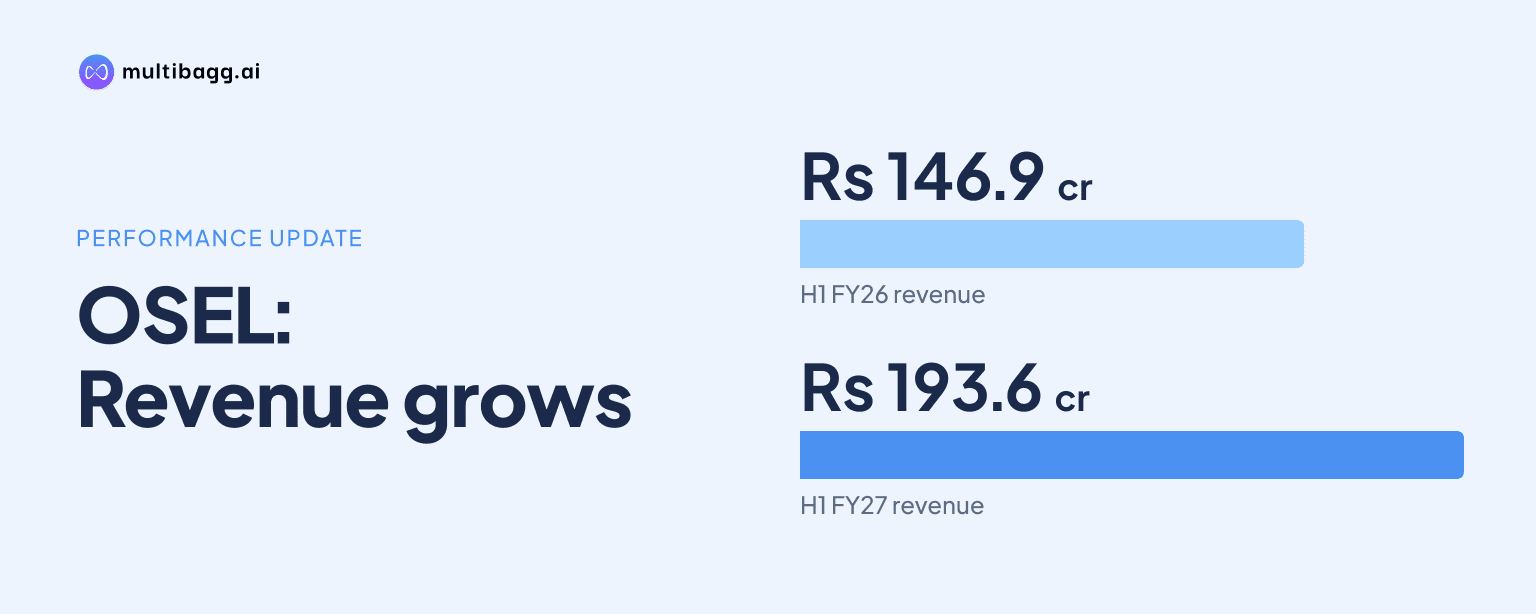
Osel Devices Limited reported H1 FY27 revenue of Rs 193.6 crore, up 31.8% year on year, but profit after tax (PAT) increased 19.1% to Rs 18.1 crore as finance cost rose to Rs 7.5742 crore and depreciation and amortisation reached Rs 1.0353 crore. EBITDA rose 31.9% to Rs 32.5 crore while its margin stayed at 16.8%.
Know OSEL Devices inside out
Results, valuation, peers and who's buying, in one view.
Why did OSEL's PAT grow slower than revenue in H1 FY27?
OSEL's PAT grew slower than revenue because costs below earnings before interest, tax, depreciation and amortisation (EBITDA) increased. Revenue from operations rose to Rs 193.6337 crore in H1 FY27 from Rs 146.8613 crore in H1 FY26, while EBITDA increased to Rs 32.5133 crore from Rs 24.6541 crore. EBITDA margin was unchanged at 16.79% in both periods, placing the difference between revenue and PAT after the operating-profit line.
Finance cost increased to Rs 7.5742 crore in H1 FY27 from Rs 3.6572 crore in H1 FY26, a rise of Rs 3.917 crore. Depreciation and amortisation rose to Rs 1.0353 crore from Rs 56.65 lakh, while tax increased to Rs 7.0771 crore from Rs 5.2669 crore. Profit before tax therefore rose 23.0% to Rs 25.1574 crore, but PAT rose 19.1% to Rs 18.0803 crore.
OSEL's PAT margin declined to 9.34% in H1 FY27 from 10.34% in H1 FY26, a fall of 1.00 percentage point. Compared with H2 FY26, EBITDA margin declined from 19.66% to 16.79%, while PAT margin declined from 9.62% to 9.34%. Diluted earnings per share rose 7.4% to Rs 9.96 from Rs 9.27, while basic earnings per share were Rs 10.17.
Which OSEL businesses made up H1 FY27 revenue?
OSEL's H1 FY27 revenue mix was approximately 38% LED displays, 35% hearing aids and 27% Philips Mobile. Management said mobile led the revenue increase, but the presentation does not quantify each segment's H1 revenue in rupees. The three disclosed mix shares apply to the Rs 193.6 crore consolidated revenue figure.
The Philips Mobile business sold through 268 distributors and more than 13,800 touchpoints, as well as Amazon, in H1 FY27. OSEL launched the Philips S7221 5G in September 2026 at Rs 20,499 and Rs 22,499. Management described feature-phone sales as steady and said mobile represented approximately 27% of H1 revenue.
In LED displays, OSEL's Colorlight original equipment manufacturer agreement covers Indian assembly of controllers and video processors. Its content management system (CMS) operated more than 1,000 displays across more than 300 locations, with monthly billing of Rs 700 to Rs 800 per display. After H1 FY27, OSEL won a 10-year public-private partnership concession for about 15,000 square feet of LED displays at Bharat Mandapam.
OSEL held a 90.69% stake in SFL Hearing Solutions, which had 41 audiologist-staffed clinics following the Petals Healthcare tie-up. Management cited clinic average selling prices of Rs 35,000 to Rs 40,000 per device, compared with Rs 2,500 to Rs 3,000 for government-tender units. The Greater Noida facility was US Food and Drug Administration registered and held ZED Gold certification.
Got a follow-up? Ask IRIS
What do OSEL's cash flow and balance sheet changes show?
OSEL recorded net cash used in operating activities of Rs 7.6469 crore in H1 FY27, as working-capital changes used Rs 43.3524 crore. Operating profit before working-capital changes was Rs 35.7055 crore during the half year. The presentation attributed the operating cash outflow to growth absorbing working capital.
Trade receivables rose by Rs 30.7465 crore to Rs 137.9821 crore at September 30, 2026, from Rs 107.2356 crore at March 31, 2026. Inventories increased by Rs 15.6957 crore to Rs 73.6525 crore, and other current assets rose by Rs 39.6815 crore to Rs 99.5318 crore. Trade payables increased by Rs 24.0458 crore to Rs 58.6262 crore over the same period.
Short-term borrowings increased to Rs 145.3331 crore at September 30, 2026 from Rs 94.3761 crore at March 31, 2026. The cash-flow statement showed Rs 55.0548 crore of financing inflow and Rs 47.9672 crore of investing outflow in H1 FY27. It reported closing cash and cash equivalents of Rs 1.0772 crore, while the balance sheet separately listed Rs 1.2141 crore at September 30, 2026.
Total assets rose to Rs 476.2275 crore at September 30, 2026 from Rs 356.8831 crore at March 31, 2026. Intangible assets were Rs 21.4091 crore at the half-year end against nil at the March year-end, while other non-current assets increased to Rs 41.7090 crore from Rs 11.1007 crore. Total equity increased to Rs 242.8028 crore from Rs 209.3053 crore.
What is OSEL planning after H1 FY27?
OSEL plans to expand clinics, CMS subscriptions, public-private partnership concessions and its consumer mobile range, according to management's FY27 strategy. Management said it continued to target FY27 growth in line with FY26, while describing customer relationships in hearing health, LED services and mobile as its route to revenue and margin expansion.
Management expects the Bharat Mandapam concession to add about Rs 15 crore of annual revenue and disclosed expected annual growth of about 25%. The 10-year concession covers about 15,000 square feet of LED displays. OSEL also presented an illustration that 1 lakh CMS screens could generate Rs 84 crore to Rs 96 crore annually at the stated monthly charge; that screen count is not an existing deployment.
For exports, management said OSEL recorded about Rs 23 crore in FY26 and targets about Rs 50 crore in FY27, led by LED original equipment manufacturer supply and hearing aids. The company has a letter of intent for 5.01 acres at the Jawaharlal Nehru Port Authority special economic zone, with commercialisation targeted from April 2027 as an export and electronics manufacturing services hub.
OSEL also expects Philips tablets to launch in December 2026 and intends to widen its smartphone range. Its plans include localising LED controllers with Colorlight and bringing phone assembly in house at scale. These are management plans rather than reported H1 FY27 financial contributions.
Conclusion
OSEL's H1 FY27 results show revenue and EBITDA rising by about 32%, while PAT rose 19.1% as finance cost, depreciation and tax increased. The stable 16.79% EBITDA margin and the decline in PAT margin to 9.34% distinguish operating performance from the expenses recorded after EBITDA.
The next disclosed milestones are the expected Philips tablet launch in December 2026, commercialisation of the 5.01-acre JNPA special economic zone site from April 2027, and management's FY27 export target of about Rs 50 crore. The start of Bharat Mandapam revenue is also relevant to management's estimate of about Rs 15 crore in annual revenue.