










Paluck Expects Negative H2 Cash Flow Despite Rs 18 Crore PAT Target
Key highlights
- Paluck confirmed that operating cash flow is expected to remain negative in H2 FY27 after approximately negative Rs 9 crore in H1 FY27.
- Management targets FY27 revenue of Rs 130 crore to Rs 140 crore and PAT of Rs 17 crore to Rs 18 crore.
- Paluck expects H2 FY27 revenue of Rs 85 crore to Rs 90 crore and PAT of Rs 12 crore to Rs 13 crore.
- Management estimates FY28 revenue of Rs 190 crore to Rs 200 crore and expects IPO funds to have their main effect then.
powered by IRIS
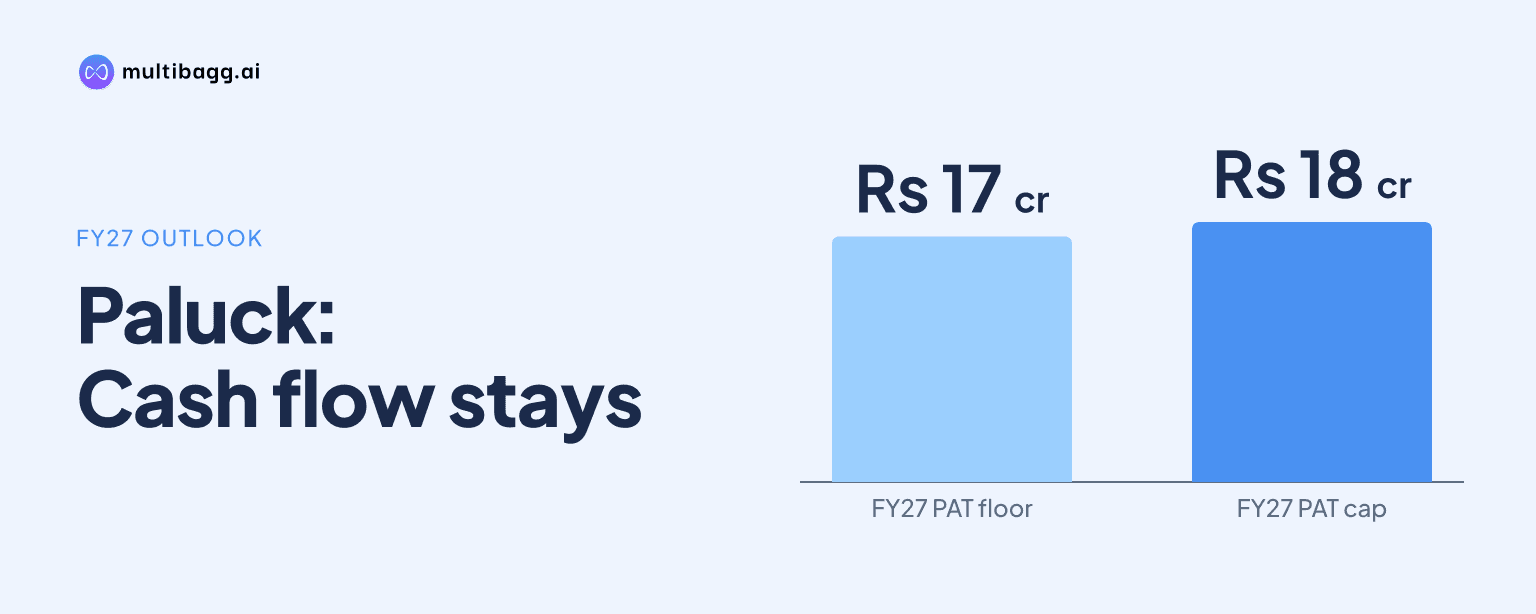
Paluck Technologies Limited expects operating cash flow to remain negative in the second half of financial year 2026-27 (H2 FY27), following approximately Rs 9 crore of negative operating cash flow in the first half (H1 FY27), while management targets Rs 17 crore to Rs 18 crore in full-year profit after tax. Management linked the cash use to telecom inventory replenishment and equipment capital expenditure.
Know Paluck Technologies inside out
Results, valuation, peers and who's buying, in one view.
Why will Paluck's operating cash flow remain negative in H2 FY27?
Paluck expects negative operating cash flow in H2 FY27 because telecom inventory requirements will remain elevated. An analyst said H1 FY27 operating cash flow was approximately negative Rs 9 crore and working capital absorbed around Rs 10 crore. Management said the telecom business serves sites across India and therefore needs inventory at almost every location, which raised inventory during the replenishment cycle.
Management answered “yes” when asked whether cash flow from operations would also be negative in H2 FY27. It said inventory could reduce somewhat in the next financial year as the business reaches a larger scale, including as a percentage of revenue or in inventory-day terms. That expectation does not indicate an immediate reduction in H2 FY27 inventory needs.
How did telecom inventory and receivables absorb cash in H1 FY27?
Paluck said H1 FY27 inventory rose because it replenished certain telecom parts. The nationwide telecom service model requires stock at service locations, meaning cash can be committed to parts before related collections are received. Management described the higher H1 inventory as a replenishment-related increase and said it should move towards a normal level later.
An analyst said trade receivables had increased by almost 80% year on year. Management said its normal receivables ageing is 90 to 120 days and attributed some delayed collections to one-off events involving amounts that should have been received earlier. It expects receivable days to reduce in H2 FY27, although it separately confirmed negative operating cash flow for that period.
How does Paluck's expansion plan require more cash?
Paluck operates two businesses with different capital requirements: telecom is working-capital heavy, while construction-equipment leasing is capital-expenditure heavy. Telecom requires inventory across sites, while the leasing operation needs periodic purchases of construction equipment. Management said these requirements are relevant to its longer-term five-year target of four-times growth, subject to meeting capital needs over time.
Paluck said its initial public offering (IPO) funds arrived in September and were not utilised in H1 FY27. Management plans to deploy IPO proceeds in H2 FY27, including on equipment purchases, and said this will create higher cash outflows. It expects the main financial effect of IPO-fund deployment to be reflected in financial year 2027-28 (FY28).
Got a follow-up? Ask IRIS
Can Paluck's H2 FY27 profit rise while operating cash flow is negative?
Yes. Paluck expects H2 FY27 profit to increase while operating cash flow remains negative because the second half is seasonally larger and expenses are broadly similar across the year. Management said H1 typically accounts for about 40% of annual revenue because of the rainy season, while H2 contributes about 60%. It also said profit after tax is usually weighted at roughly one-third in H1 and two-thirds in H2.
Paluck's expected H2 FY27 revenue of Rs 85 crore to Rs 90 crore is substantially above H1 revenue of Rs 51.2 crore, while H2 PAT is projected at Rs 12 crore to Rs 13 crore versus Rs 5.09 crore in H1. The comparison illustrates the company’s expected second-half earnings concentration. It does not change the cash-flow outlook because inventory replenishment and the collection cycle can absorb cash while accounting profit rises.
What margins and orders does Paluck expect for H2 FY27?
Paluck said full-year margins should remain similar, after an analyst cited a 17% operating profit margin in H1 FY27 compared with a 20% to 23% range mentioned for H1 and the prior year’s H2. Management attributed the H1 movement to a higher recurrence of certain expenses. It did not give a specific H2 FY27 operating-margin target.
By segment, Paluck said telecom gross margins are approximately 20% to 23%, compared with approximately 35% for construction-equipment leasing. Management put the blended gross margin at 23% to 25%. It also said it was working on approximately Rs 50 crore of additional orders that it expected could materialise within two to three months.
Management gave a ballpark FY28 revenue estimate of Rs 190 crore to Rs 200 crore, compared with its FY27 target of Rs 130 crore to Rs 140 crore. It said organic growth should be around 25% in FY27, while growth could reach around 40% from FY28 after IPO funds are deployed. Those outcomes remain management expectations, tied to equipment investment, working-capital needs and anticipated orders.
Conclusion
Paluck’s H2 FY27 outlook combines higher expected revenue and PAT with continued negative operating cash flow. Management expects Rs 85 crore to Rs 90 crore of H2 revenue and Rs 12 crore to Rs 13 crore of H2 PAT, but telecom inventory replenishment, receivables timing and equipment purchases are expected to continue absorbing cash.
The next disclosures to watch are whether receivable days reduce during H2 FY27, whether inventory normalises in the next financial year, and how quickly IPO proceeds are deployed for equipment. Management expects the principal effect of IPO-funded expansion in FY28 and has estimated FY28 revenue of Rs 190 crore to Rs 200 crore, supported in part by approximately Rs 50 crore of potential additional orders.