










Triton Valves Limited raises standalone EBITDA margin to 8.5% in Q2
Key highlights
- Triton Valves reported an 8.5% standalone EBITDA margin in Q2 FY27, up 260 basis points year on year.
- Standalone material cost fell to 63.2% of sales in Q2 FY27 from 72% a year earlier.
- Triton Valves recorded about Rs 110.70 crore of Q2 FY27 standalone revenue and about Rs 9.50 crore of EBITDA.
- Management targets an inventory reduction of about Rs 20 crore to Rs 25 crore by December.
powered by IRIS
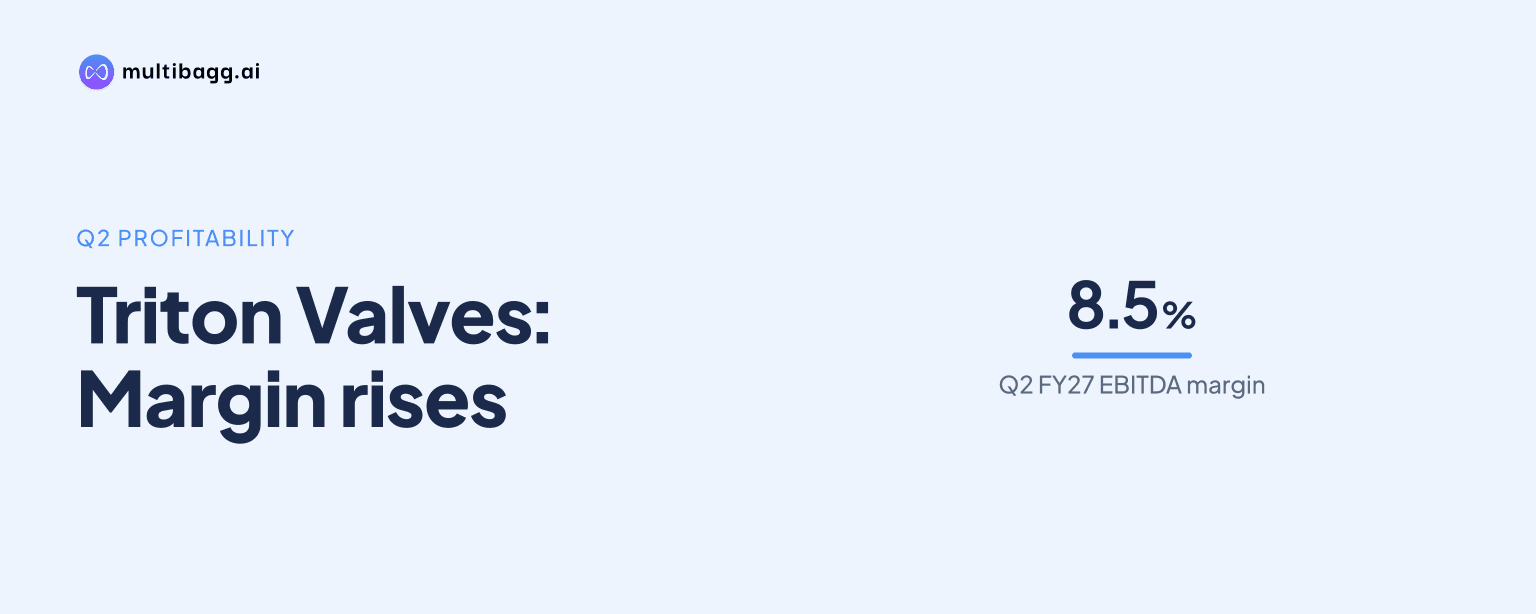
Triton Valves Limited raised standalone earnings before interest, tax, depreciation and amortisation (EBITDA) margin to 8.5% in Q2 FY27 from about 5.9% a year earlier, supported by material cost falling to 63.2% of sales from 72%. Management is seeking a double-digit margin through product mix, cost reductions and higher sales.
Know Triton Valves inside out
Results, valuation, peers and who's buying, in one view.
How did Triton Valves improve its Q2 FY27 standalone margin?
Triton Valves improved Q2 FY27 standalone profitability through lower material intensity, a favourable product mix and internal cost-reduction initiatives. The standalone business, comprising automotive and climate control operations but excluding the metals subsidiary, reported revenue of Rs 110.70 crore and EBITDA of about Rs 9.50 crore, versus EBITDA of about Rs 6.30 crore in the comparable prior-year quarter.
The 8.5% EBITDA margin was 260 basis points higher year on year, according to management. Material cost declined to 63.2% of standalone sales from 72%, a reduction of 8.8 percentage points, which management described as roughly 10 percentage points. The company said cost-control measures had been implemented over the preceding two quarters, while the Q2 product mix also supported the improvement.
The revenue comparison has an accounting qualification. Triton Valves said Q2 FY27 standalone revenue of Rs 110.70 crore excludes scrap sales, whereas the earlier accounting method included them. Management therefore said the comparison with FY26 was not like for like, although it said underlying sales growth was higher than the stated 52% increase.
How much of Triton Valves' sales growth was driven by volume?
Triton Valves said reported growth was not entirely volume-led because commodity-linked price realisations also rose. Management estimated overall volume growth at about 35%, while standalone sales increased about 52% in Q2 FY27. Copper, zinc and, to a lesser extent, butyl rubber affect revenue realisation because customer prices are indexed quarterly to a three-month commodity average.
The difference between revenue and volume growth was more pronounced in the metals business. Metals revenue grew 77% year on year, but management put physical-volume growth at about 20% to 22%, with the rest largely reflecting higher commodity prices. Management said it focuses on volume growth because a decline in copper prices could reduce reported sales even without a change in demand.
Automotive and climate-control sales grew 36% year on year, while automotive component demand rose more than 100%, according to management. Climate-control sales, however, were only about Rs 2.50 crore in the July-to-September Q2 period, which management identified as the seasonal low point for room and commercial air-conditioner production.
Got a follow-up? Ask IRIS
What is Triton Valves' plan for a double-digit EBITDA margin?
Triton Valves is targeting a standalone EBITDA margin above 10% by improving product mix, maintaining cost discipline and raising sales, management said. It described the Q2 FY27 margin of 8.5% as progress rather than an endpoint and said it intended to move into upper single-digit and double-digit margins as quickly as possible.
A key mechanism is the internal hedge between components and metals. Management said copper-price increases can pressure automotive component margins within a quarter because customer pricing is reset quarterly, while the metals business can reflect commodity-price movements more quickly. It said this structure has helped offset part of the timing mismatch and improved resilience through copper-price and rupee-dollar fluctuations.
For the first half of FY27, standalone revenue was close to Rs 220 crore and EBITDA was about Rs 17.50 crore, compared with about Rs 12 crore in the previous-year period. Management said Q1 faced higher shipping, fuel, consumable and raw-material costs after the outbreak of war, making the first-half result a combination of Q2 margin improvement and earlier disruption.
Some deliveries scheduled for late Q2 were delayed by customers and are expected to move into Q3, management said. It said this deferred sales and profit that could have lifted Q2 results, while adding that the undelivered goods would be supplied in Q3. The margin plan therefore also depends on planned customer deliveries being completed.
What could affect Triton Valves' Q3 FY27 performance?
Triton Valves expects climate-control sales to improve in Q3 FY27, with an order book of about Rs 8 crore to Rs 10 crore compared with Q2 sales of about Rs 2.50 crore. Management also reported demand momentum across original equipment manufacturer, aftermarket and export channels, including increased orders from US customers after tariff-related uncertainty had earlier slowed buying.
Inventory is the main working-capital matter identified by management. It said brass inventory value had increased by more than 50% year on year as copper prices rose, while delayed Q1 shipments also arrived in Q2. Management's internal target is to reduce inventory by about Rs 20 crore to Rs 25 crore by the end of December.
At the consolidated level, Triton Valves reported Q2 revenue of about Rs 200 crore, EBITDA of about Rs 14.50 crore and an EBITDA margin of 7.2%. Management cautioned that consolidated sales include a commodity-price element and said volume growth of more than 20% was the more relevant operational measure. Group profit before tax rose to about Rs 7.50 crore from about Rs 3 crore a year earlier.
Management said large tyre-pressure monitoring system (TPMS) programmes are due to launch in Q1 FY28, so they are not expected to add significant revenue during FY27. It also expects certain automotive climate-control programmes to start in Q4 FY27 and said electric-vehicle component customers, including River Mobility and Simple Energy, were planning larger production ramps from Q4.
Conclusion
The Q2 FY27 result shows that lower material costs, mix changes and cost actions lifted standalone EBITDA by about Rs 3.20 crore year on year to about Rs 9.50 crore. The comparison also requires caution: reported sales included commodity-linked price effects, and climate-control revenue remained at a seasonal low of about Rs 2.50 crore in the quarter.
The next disclosed tests are the planned Rs 20 crore to Rs 25 crore inventory reduction by December, delivery of Q2-deferred orders in Q3 and climate-control orders of about Rs 8 crore to Rs 10 crore. Management's margin objective will also depend on Q4 FY27 programme launches and the scheduled Q1 FY28 TPMS programmes improving the sales mix.