










Triton climate-control unit sees break-even at Rs 5-6 crore
Key highlights
- Triton said climate-control break-even requires average monthly sales of about Rs 5 crore to Rs 6 crore.
- Triton’s third-quarter climate-control order-book outlook was Rs 8 crore to Rs 10 crore, versus Rs 2.5 crore of second-quarter sales.
- November climate-control orders exceeded Rs 5 crore after October sales of about Rs 2 crore to Rs 2.5 crore.
- Triton said Panasonic granted global approval for its service valves during the quarter.
powered by IRIS
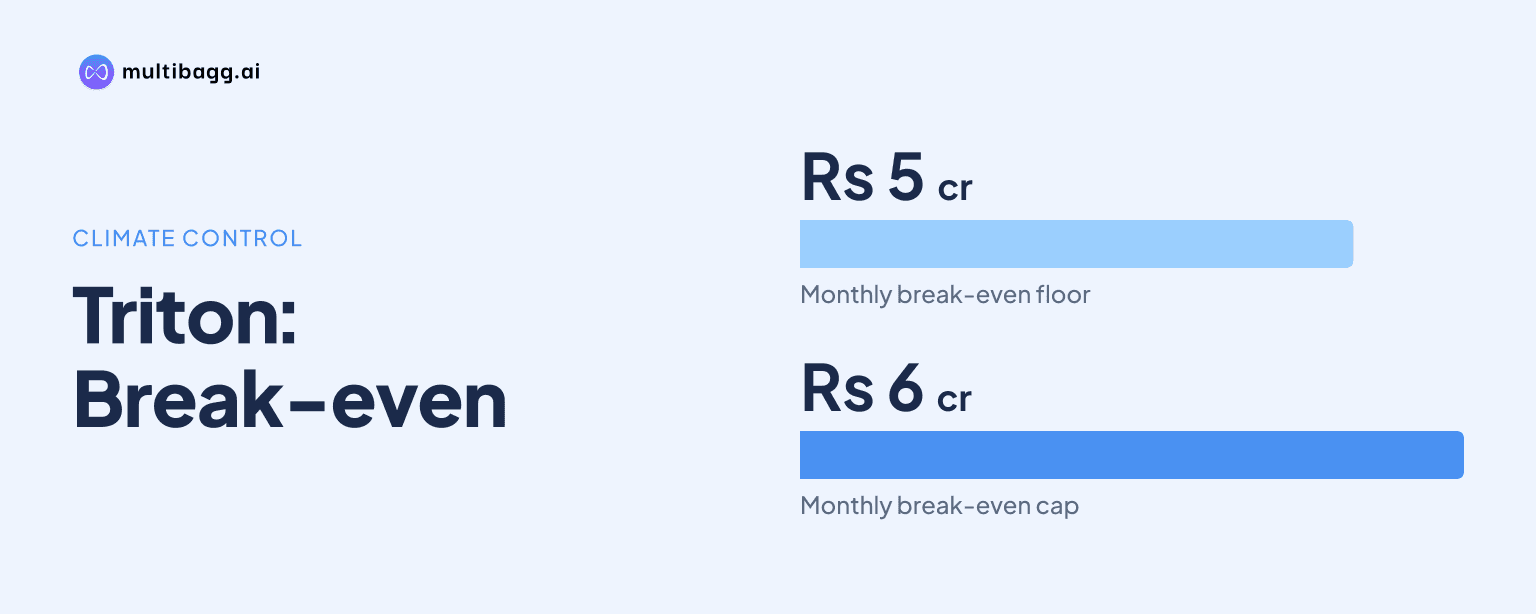
Triton Valves Limited said its climate-control unit could break even in the current financial year if monthly sales average Rs 5 crore to Rs 6 crore. The company reported November climate-control orders exceeding Rs 5 crore, after October sales of about Rs 2 crore to Rs 2.5 crore, but management said Chinese imports remain a constraint.
Know Triton Valves inside out
Results, valuation, peers and who's buying, in one view.
What monthly sales does Triton need for climate-control break-even?
Triton said the climate-control business should turn positive at average monthly sales of roughly Rs 5 crore to Rs 6 crore. Management presented this as a conditional threshold rather than formal guidance, saying the unit could come out of the red in the current financial year if the recent sales momentum continues.
The threshold is well above the business’s second-quarter level. Triton said climate-control sales were about Rs 2.5 crore for the entire second quarter, while the third-quarter order book was then expected at Rs 8 crore to Rs 10 crore. October sales reached about Rs 2 crore to Rs 2.5 crore, and November orders had exceeded Rs 5 crore at the time of the call.
The third-quarter order-book range would represent a sequential increase from the Rs 2.5 crore of sales in the second quarter, though orders are not the same as delivered revenue. Triton’s stated break-even requirement also means that a single month with orders above Rs 5 crore must translate into recurring sales, rather than remain an isolated order-book milestone.
Why has Triton’s climate-control unit remained loss-making?
Triton attributed the delayed profitability primarily to what management called indiscriminate dumping of Chinese parts into India. Management said the company is ready on products and capacity, but imported competition has prevented the climate-control operation from reaching the sales scale needed to cover its costs.
Triton said it had made representations to the commerce ministry, the commerce minister and the Department for Promotion of Industry and Internal Trade, or DPIIT. Management said even a 20% to 30% reduction in Chinese dumping could alter the unit’s economics, while cautioning that government action was not within the company’s control.
The company described the Indian market for service valves, one of its air-conditioner component lines, as above Rs 1,000 crore. That was management’s estimate of the market opportunity, not a revenue forecast for Triton. Management said the company had created a manufacturing setup and developed the products for the Make in India opportunity, but the pricing environment had remained unfavourable.
Triton also cited its brass mill as an internal supply advantage because brass is a key material for room-air-conditioner components. Management said the unit has relatively high selling prices per part and an engineering team that has completed product development, making sales scale the principal commercial variable behind the Rs 5 crore to Rs 6 crore monthly threshold.
What does Panasonic approval mean for Triton’s sales?
Triton said it received global approval from Panasonic during the quarter for service valves used in air-conditioner production. Panasonic’s India plant is placing orders currently, while management said the global approval could allow other Panasonic plants to draw on the approved part in the future.
The approval came without a disclosed order value, expected volume, margin or production schedule. Triton said a registered supplier’s part number and price are entered into Panasonic’s common system, so demand could potentially arise from Europe, Southeast Asia, Japan or another location, but it did not forecast sales outside India.
Triton separately identified automotive air-conditioning programmes with Hanon Systems, formerly Visteon, and Maflow, a Volkswagen system supplier. The Hanon products are charging valve ports and valve cores that management said may enter Hyundai and Kia vehicles. Triton did not disclose revenue, order-book or margin figures for either programme.
For automotive climate control, Triton said it can provide an aluminium body, plastic cap and valve core as a single package. Management said room-air-conditioner parts generally use brass and copper, whereas automotive air-conditioning parts use aluminium because they are in mobile applications. These new automotive programmes are expected to start in the fourth quarter.
Got a follow-up? Ask IRIS
How will inventory affect third-quarter climate-control deliveries?
Triton said inventory held at 30 September should support seasonal climate-control deliveries in the third quarter. Management described much of the stock as raw material and undelivered sales, adding that some raw material had been contracted at favourable rates before later changes in commodity prices.
The company acknowledged that inventory, payables and receivables had worsened the cash-conversion cycle. It nevertheless said inventory should improve by December and be further optimised by March. Management also estimated that Rs 8 crore to Rs 10 crore of customer deliveries that were not picked up would flow into the third quarter, without assigning all of that deferred amount to climate control.
Triton said customer prices are locked through December under a three-month indexation mechanism. Management therefore said lower copper prices from October to December would not affect third-quarter pricing, as any lower commodity cost would be passed to customers from January. This mechanism, alongside inventory bought at earlier rates, is intended to support third-quarter execution.
Higher working-capital borrowing was also linked to commodity inflation and inventory timing. Management illustrated the increase by saying copper had moved from roughly Rs 720 per kilogram in the prior year to around Rs 1,300 to Rs 1,400 per kilogram. It expects borrowings and inventory to moderate through the third and fourth quarters if planned sales are converted.
How do climate-control prospects compare with Triton’s other businesses?
Triton expects climate control to show its sharpest sales improvement in the third quarter, while management described the automotive business as seasonally softer in that period. In automotive, it said major product lines recorded volume growth of more than 30%, while electric-vehicle products grew 100% over the previous year, without providing corresponding revenue figures.
Tyre-pressure monitoring system, or TPMS, programmes are a longer-dated automotive opportunity. Triton said significant revenue from large TPMS programmes would begin only in the first quarter of financial year 2028. Management estimated that TPMS programmes offer about 10 percentage points more value addition than standard tubeless-valve programmes.
In metals, Triton is developing alloys for writing instruments, medical equipment and defence, with management expecting commercialisation through the third and fourth quarters and the first quarter of the following year. It also said remaining capital expenditure over the final four to four-and-a-half months of the year could be about Rs 6 crore to Rs 7 crore in automotive and Rs 2 crore to Rs 3 crore in metals.
Conclusion
Triton’s climate-control turnaround depends on converting a third-quarter order-book outlook of Rs 8 crore to Rs 10 crore into sustained monthly sales of Rs 5 crore to Rs 6 crore. November orders above Rs 5 crore and Panasonic approval point to increased commercial activity, but management continues to identify Chinese imports as the main obstacle to profitability.
The next indicators are third-quarter delivery conversion, whether November-scale orders recur, and the planned fourth-quarter launch of automotive climate-control programmes. Management also expects inventory and borrowing pressure to moderate by December and through March, while any policy action on imported components remains unresolved.