










Triton Valves targets ₹20-25 crore inventory cut by December
Key highlights
- Triton Valves targets a ₹20-25 crore inventory reduction by the end of December.
- Deferred second-quarter customer deliveries of about ₹8-10 crore are expected to move into Q3.
- Customer prices are locked through December under a three-month indexation mechanism.
- Climate-control sales were about ₹2.5 crore in Q2, with Q3 order-book visibility of ₹8-10 crore.
powered by IRIS
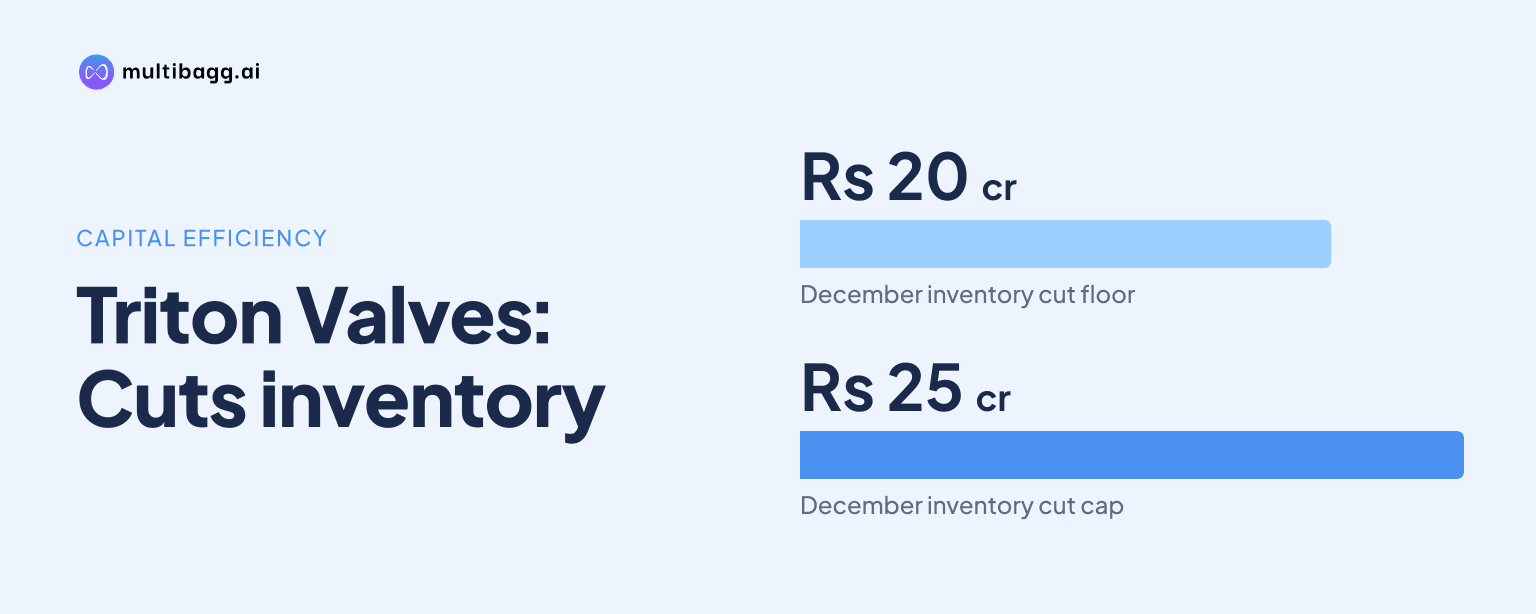
Triton Valves Limited is targeting a ₹20-25 crore inventory reduction by the end of December after its September 30 working-capital position rose with copper costs, delayed shipments and planned stock purchases. Management said customer pricing is locked through December, so lower copper prices should not reduce third-quarter margins.
Know Triton Valves inside out
Results, valuation, peers and who's buying, in one view.
Why did Triton Valves’ inventory increase at September 30?
Triton Valves said the September 30 inventory build-up resulted from raw-material purchases, undelivered customer sales and shipment delays that began in the first quarter. Management said some material normally expected to arrive during the third quarter reached the company during the second quarter, creating a timing-related pile-up at the reporting date.
Copper inflation also raised the rupee value of inventory. Management illustrated that copper bought for the brass mill had risen from about ₹720 per kg in the previous year to about ₹1,300-1,400 per kg currently, requiring more working capital for the same physical volume. Naresh Varadarajan said about 10% of the inventory increase reflected commodity-price movement between average March and average September levels.
The company also built stock deliberately for expected demand in the climate-control, automotive and electric-vehicle segments. Management cited volume growth of 25-30% in some segments and about 100% year-on-year growth in the electric-vehicle segment. It said stock was intended to prevent sales losses where customer requirements accelerated, though it acknowledged inventory could have been managed more tightly.
How much inventory does Triton Valves aim to reduce by December?
Triton Valves’ internal target is to lower inventory by ₹20-25 crore by the end of the December quarter. Management said deleveraging had already begun after the September 30 balance-sheet snapshot and expects additional inventory optimisation by March, although it did not disclose the starting inventory value or a March target.
A portion of the reduction depends on delivering sales deferred from the second quarter. Management said customers postponed acceptance of goods worth about ₹8-10 crore near the end of the quarter. It said those deliveries were not lost and should move into the third quarter, shifting associated profit recognition from the second quarter to the third quarter.
Climate-control sales are another route to convert stock. The vertical reported sales of about ₹2.5 crore in the second quarter, while management said its third-quarter order-book visibility was about ₹8-10 crore. That comparison implies materially higher third-quarter activity than the prior quarter if orders are executed, and management said the raw material on hand supports seasonal climate-control requirements.
Will lower copper prices affect Triton Valves’ third-quarter margins?
Triton Valves said softer copper prices from November should not affect third-quarter customer pricing because prices are locked until the end of December. Management described a three-month indexation mechanism under which copper-price changes during October, November and December would be passed on to customers only from January.
Management also said much of the raw-material stock was contracted at earlier, favourable rates. This inventory is intended to support the climate-control business during the third quarter, when order-book visibility is ₹8-10 crore compared with roughly ₹2.5 crore of second-quarter sales. This is management’s expectation on pricing and execution, not a confirmed margin outcome.
The group reported consolidated second-quarter revenue of about ₹200 crore and volume growth above 20%. Management cautioned that revenue contains a commodity component and could decline if copper prices fall, even if physical volumes remain stable. It said volume growth and absolute earnings are more relevant measures than commodity-influenced revenue for assessing operating progress.
Got a follow-up? Ask IRIS
Why have Triton Valves’ working-capital borrowings increased?
Triton Valves said higher commodity prices were the largest reason for increased working-capital borrowings. The rise in copper from about ₹720 per kg to ₹1,300-1,400 per kg meant the brass mill needed more funding to buy comparable input volumes. Management said it increased bank limits to accommodate the higher commodity cost.
Earlier-than-expected material arrivals and elevated stock also added to funding requirements. Naresh Varadarajan said 10-20% of the inventory increase was material in transit around the September-end cut-off. Management said inventory had been purchased for anticipated third- and fourth-quarter sales, rather than being an unplanned accumulation disconnected from demand.
Management reported debt serviceability of 2.36 times and said its debt-to-EBITDA ratio had increased because of inventory. EBITDA means earnings before interest, tax, depreciation and amortisation. It expects inventory and borrowings to moderate through the third and fourth quarters, but did not provide a numerical borrowing target or a targeted debt-to-EBITDA ratio.
What could help Triton Valves convert inventory into sales?
Triton Valves expects climate-control sales to increase in the third quarter, while describing the automotive business as seasonally softer in that period. Management said new automotive climate-control programmes are expected to launch in the January-to-March fourth quarter. It also said large tyre-pressure monitoring system programmes are scheduled for the first quarter of FY28 and are not expected to generate significant revenue before then.
In electric-vehicle components, management said customers including River Mobility and Simple Energy were planning larger production ramp-ups from the fourth quarter of the current financial year. In the metals business, the company is developing alloys for writing instruments, medical equipment and defence, with management expecting monetisation through the third and fourth quarters and into the following first quarter.
Climate-control profitability remains dependent on sales scale and market conditions. Management said the business could turn positive when monthly sales average about ₹5-6 crore, while noting competition from Chinese imports. It said November order bookings for climate-control exceeded ₹5 crore, following October sales of roughly ₹2-2.5 crore, but did not provide a full-quarter profitability forecast.
Conclusion
Triton Valves’ planned ₹20-25 crore inventory reduction is central to reversing the September working-capital build-up caused by higher copper costs, shipment timing and stock held for planned sales. Deferred deliveries of ₹8-10 crore and a climate-control order book of ₹8-10 crore provide identifiable potential routes for inventory conversion, while locked pricing through December limits the stated near-term effect of lower copper prices.
The next measure to watch is the December-quarter inventory outcome and whether working-capital borrowings moderate alongside it. Management’s disclosed milestones include fourth-quarter automotive climate-control and electric-vehicle customer ramp-ups, monthly climate-control sales of ₹5-6 crore for possible profitability, and major tyre-pressure monitoring system programme launches in the first quarter of FY28.