










Triton targets TPMS exports at 10-20% of sales in three years
Key highlights
- Triton said exports represented roughly 5% of sales in the quarter discussed on the call.
- Management targets a 10% to 20% export share within two to three years.
- Bosch’s TPMS volume forecast could be two to three times Triton’s original forecast, according to management.
- Triton plans about Rs 10 crore of capital expenditure in the remaining four to four-and-a-half months of the financial year.
powered by IRIS
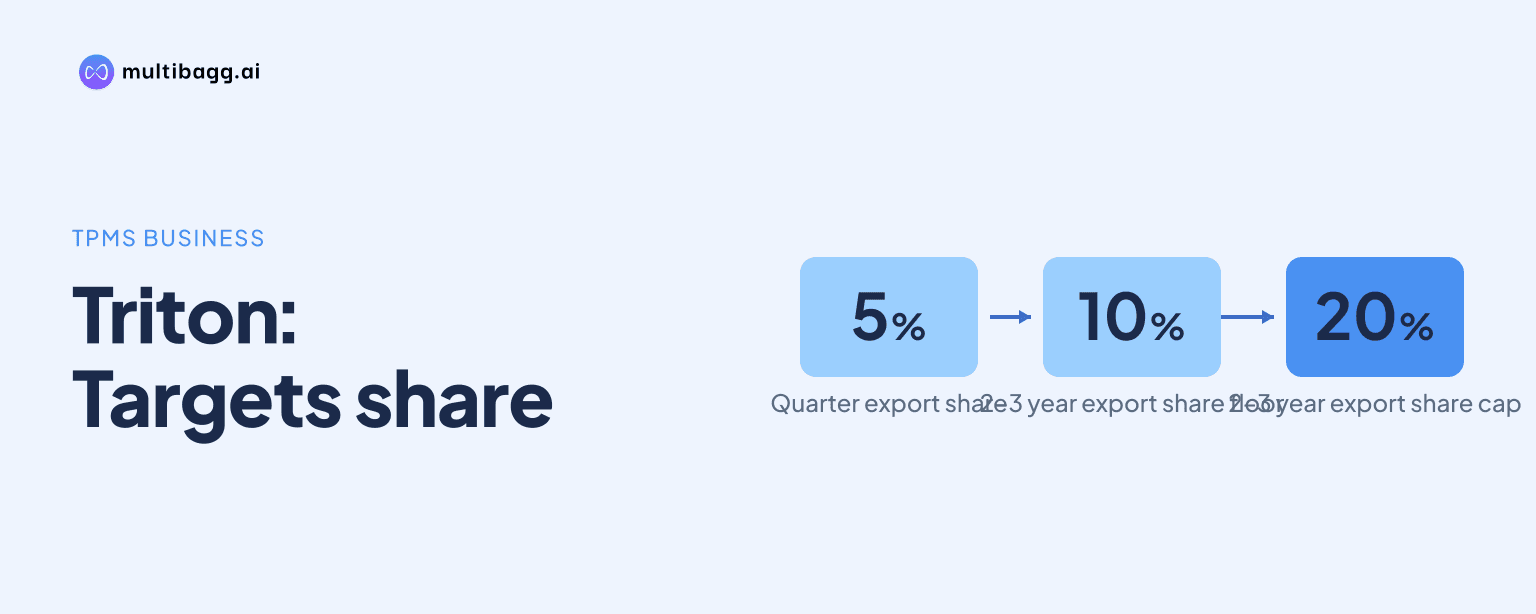
Triton Valves expects tyre-pressure monitoring system, or TPMS, exports to rise from roughly 5% of sales in the quarter discussed to 10% to 20% within two to three years. Management based that outlook on expanding global programmes, including Bosch’s forecast through 2031, which it said could be two to three times the original volume forecast.
Know Triton Valves inside out
Results, valuation, peers and who's buying, in one view.
How large could Triton's TPMS export business become?
Triton expects exports to become 10% to 20% of sales within two to three years, compared with roughly 5% in the quarter covered by the call. Management said the company has spent the last two to three years building export channels in Europe and the United States, including automotive aftermarket customers in North America and new distributors in Europe.
Management said becoming a significant supplier in the US and European markets could take another one to two years. It attributed earlier delays partly to uncertainty around tariffs, which it said led buyers to defer decisions, but said conditions had improved in the quarter. It also cited interest in sourcing from India as customers seek to reduce dependence on China.
Bosch began with a small TPMS valve programme and has shared a forecast running to 2031, according to management. Triton said the indicated volume could be two to three times the original forecast, but did not disclose programme revenue, annual production volumes or the schedule of supplies. The target is therefore an outlook based on programmes maturing rather than a stated sales commitment.
Why are TPMS programmes important for Triton's product mix?
TPMS programmes matter because management said their average value addition is about 10 percentage points higher than standard tubeless programmes. Triton described automotive technology as progressing from tube-type products to tubeless products and then to TPMS, a shift that management expects to improve the mix as new programmes increase.
About 60% to 70% of TPMS products are expected to be customised to a customer’s sensor profile and product specifications, management said. The remaining 30% to 40% would be standard stock specifications or standard part numbers. This differs from older product lines that management said have been in the market for 30 to 40 years.
Triton did not disclose profitability by customer or programme. Management said the 10-percentage-point indication was a broad rule of thumb for value addition rather than a margin forecast, because TPMS products include clamping and snap-in valves and can vary by design. It nevertheless said newer products have a better margin profile than older lines.
Which programmes support Triton's export plan?
Triton is pursuing global TPMS programmes with Bosch, Sensata and other sensor customers, aiming to establish itself as a dependable valve supplier. Management said customer approvals are global, meaning components supplied to a customer can ultimately be used in different countries rather than being designated only for India, Europe or the US.
Management said it had received two letters of intent from Amoviele and was working on additional TPMS programmes. It said further announcements could emerge over coming weeks and months, but did not provide contract values, production dates or quarterly sales estimates. That limits visibility on the pace at which the projected 10% to 20% export share could be reached.
Sensata was reported by management to be establishing sensor assembly in Chennai, although Triton said it was too early to determine where finished sensor assemblies containing its components would be sold. Management explained that customers decide their own global allocations after receiving approved components. The company is also reviewing requests for quotation for components beyond TPMS valves, while describing TPMS valves as its primary strategic focus.
Got a follow-up? Ask IRIS
Can Indian TPMS adoption support Triton's plans?
Management estimates TPMS penetration in India at about 10% currently and believes it could rise to 50% to 70% in two to three years. It linked this expectation to CAFE III norms, which it said could accelerate adoption across original equipment manufacturers and vehicle models. This is management’s market assessment, not an industry dataset disclosed on the call.
Triton said TPMS products are more difficult to engineer than regular snap-in valves, creating a higher entry barrier. Management said qualified suppliers may therefore remain in customer programmes for a longer period. It also connected wider TPMS use with highway development and increasing driving speeds, while presenting the technology as a safety and environmental requirement.
The broader automotive outlook is mixed by period and product. Management said automotive demand typically softens in the third quarter due to seasonality, while electric-vehicle product volumes had grown about 100% year on year and major automotive product lines had increased more than 30% in volume terms. It said comparisons in reported revenue were also affected because scrap sales included in the previous year’s top line were netted off in the current year.
What investment and near-term factors will affect programme execution?
Triton expects about Rs 10 crore of capital expenditure in the remaining four to four-and-a-half months of the financial year, including Rs 6 crore to Rs 7 crore for automotive and Rs 2 crore to Rs 3 crore for metals. Management said equipment ordered in the first quarter would require balance payments in the third and fourth quarters, supporting additional range and production capacity.
Management also expects delayed customer pickups worth roughly Rs 8 crore to Rs 10 crore to flow into the third quarter. It said climate-control sales should be significantly higher in the third quarter than in the second quarter, while automotive demand may soften seasonally. Those movements affect the operating backdrop but are separate from the two-to-three-year TPMS export target.
Inventory had risen following first-quarter shipment delays and earlier-than-usual arrivals, according to management. It expects inventory to moderate by the end of December and see further optimisation by March. Customer pricing uses three-month indexation until December-end, management said, so copper-price declines from October to December would be passed through from January rather than affecting third-quarter pricing.
Conclusion
Triton’s export plan depends on customised TPMS valves becoming a larger part of automotive sales. Starting from roughly 5% of sales in the quarter discussed, management expects global programmes to lift exports to 10% to 20% within two to three years. The opportunity is supported by Bosch’s longer forecast, the disclosed letters of intent and management’s view that TPMS offers about 10 percentage points more value addition than standard tubeless programmes.
The next points to watch are whether the Bosch forecast and letters of intent convert into production schedules, and whether management announces further TPMS programmes in the coming weeks and months. Management’s planned Rs 10 crore of remaining-year capital expenditure, expected Rs 8 crore to Rs 10 crore flow from delayed pickups in the third quarter, and inventory moderation by December and March will also shape execution conditions.