










Patanjali Foods’ Edible-Oil Margin Falls to 3% After Duty Cut
Key highlights
- Patanjali Foods’ edible-oil EBITDA margin fell to 3% in Q2 FY27 from 5.22% in Q1 FY27.
- Edible-oil segment EBITDA declined to Rs 256 crore in Q2 FY27 from Rs 444 crore in Q1 FY27.
- Edible-oil revenue reached a record Rs 8,532 crore in Q2 FY27, up 22% year on year.
- FMCG generated a 7.57% EBITDA margin on Q2 FY27 revenue of Rs 2,923 crore.
powered by IRIS
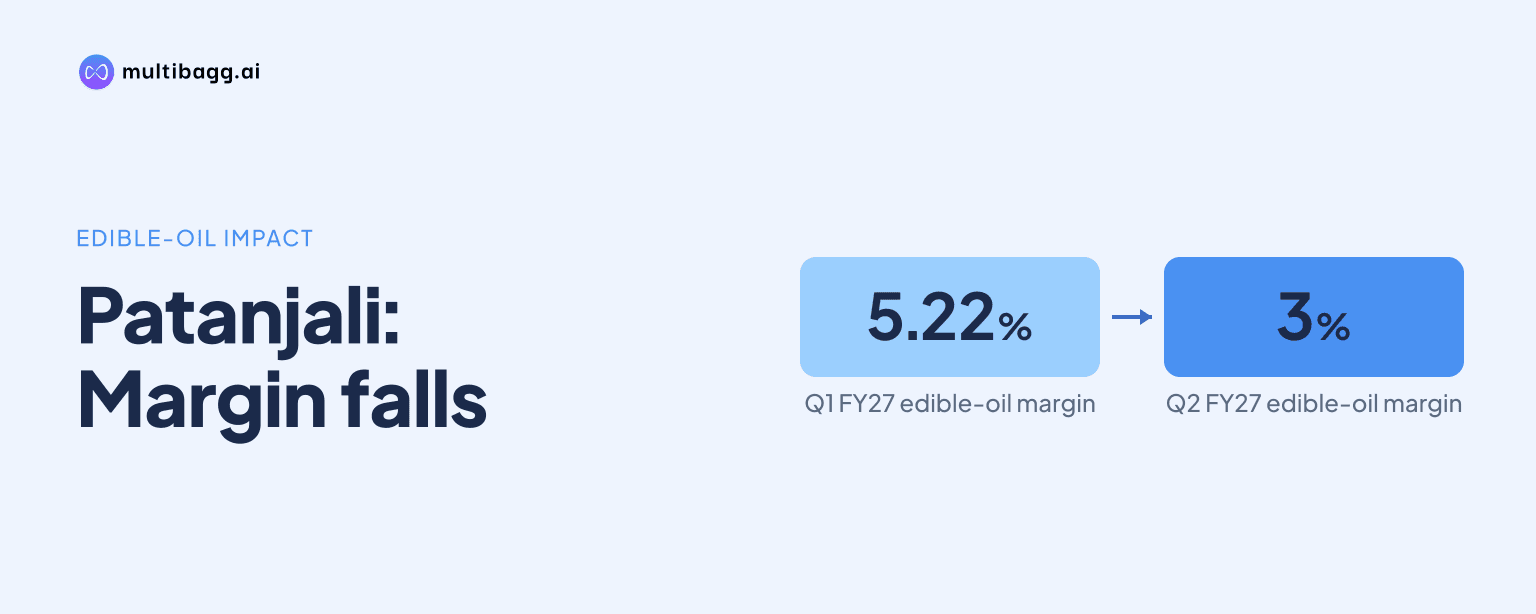
Patanjali Foods Limited’s edible-oil earnings before interest, tax, depreciation and amortisation (EBITDA) margin fell to 3% in Q2 FY27 from 5.22% in Q1 FY27 after the 24 September duty cut was passed through to consumers, reducing quarterly segment EBITDA to Rs 256 crore from Rs 444 crore despite minimal duty-related inventory impact.
Know Patanjali Foods inside out
Results, valuation, peers and who's buying, in one view.
Why did Patanjali Foods’ edible-oil margin fall to 3%?
Patanjali Foods’ edible-oil margin fell because the import-duty reduction immediately lowered domestic oil prices and the company passed the benefit to consumers. On 24 September, the government reduced effective duty on crude palm oil and crude soybean oil to 11% from 16.5%, while duty on crude sunflower oil fell to 5.5% from 16.5%.
Palm oil represents almost 50% of Patanjali Foods’ edible-oil portfolio, with soybean and sunflower oils making up the balance, making the duty changes material to segment pricing. Management said the move should improve affordability and support consumption in coming months, but the immediate pass-through reduced the margin retained on quarterly sales.
Segment EBITDA declined by Rs 188 crore sequentially and the margin narrowed by 2.22 percentage points. Yet Q2 FY27 edible-oil revenue reached a record Rs 8,532 crore, up 22% year on year, showing that higher selling prices and segment scale supported revenue while profitability declined.
Did Patanjali Foods incur a large duty-related inventory loss?
Patanjali Foods said the duty-related inventory impact was minimal, rather than absent, because much of its material was in bonded warehouses outside the duty-paid customs area or afloat. Management said it maintains a long-only position, but a significant share was not sitting at port as duty-paid stock when the rates changed.
Management said affected positions are tracked virtually daily through the profit-and-loss account and that the entire effect was accounted for in Q2 FY27. It said no duty-related inventory effect would spill into the next quarter, making the reported Rs 256 crore of segment EBITDA its stated accounting reflection of the event.
Patanjali Foods also said its physical-oriented hedging strategy and timely imports helped it manage sunflower-oil supply disruption during the quarter. Those mechanisms addressed price volatility and supply-chain disruption, while bonded and afloat inventory specifically reduced exposure to a loss following the 24 September duty change.
How did Patanjali Foods’ edible-oil volumes and prices move in Q2 FY27?
Patanjali Foods reported Q2 FY27 edible-oil volume of 5 lakh tonnes, compared with corrected volume of 5.70 lakh tonnes in Q1 FY27 and 5.22 lakh tonnes in Q2 FY26. The transcript separately described quarterly volume growth as about 3.9%, but did not reconcile that statement with the corrected tonne figures provided later in the call.
For H1 FY27, management gave corrected edible-oil volume of 11.07 lakh tonnes, versus corrected volume of 9.99 lakh tonnes in H1 FY26. Management said the balance of revenue growth beyond volume came from price inflation, consistent with its statement that palm, soybean and sunflower oils traded above year-earlier levels during the quarter.
Global conditions also shaped the segment’s input environment. Management cited tighter palm-oil supply, biofuel demand, Indonesia’s B50 biodiesel mandate effective 1 July, and a United States Department of Agriculture reduction in Indonesia’s 2026-27 palm-oil production outlook, alongside an export forecast of 21.6 million tonnes.
Got a follow-up? Ask IRIS
How did edible oil compare with Patanjali Foods’ FMCG business?
Patanjali Foods’ fast-moving consumer goods (FMCG) segment generated Q2 FY27 revenue of Rs 2,923 crore and EBITDA of Rs 221 crore, for a 7.57% margin, compared with the edible-oil segment’s 3% margin on Rs 8,532 crore of revenue. FMCG contributed 26% of revenue and 45% of EBITDA excluding unallocable income.
Within FMCG, biscuits recorded revenue of Rs 638 crore, up 28% year on year, with an 11.91% EBITDA margin. Home and personal care generated Rs 714 crore of revenue, up 11% year on year, while management reported Rs 122 crore of EBITDA on corrected revenue of Rs 713.88 crore, a 17.11% margin.
Foods remained under commodity-cost pressure. Management said staples revenue declined to Rs 838 crore in Q2 FY27 from Rs 1,110 crore in Q1 FY27 after a conscious decision not to push volumes where margins were unsupported; staples EBITDA improved to Rs 15.61 crore from negative Rs 59 crore in Q1 FY27.
Can Patanjali Foods’ oil-palm operations change its edible-oil earnings mix?
Patanjali Foods’ oil-palm plantation business generated Q2 FY27 revenue of Rs 742 crore, and management described maturing plantations as a future higher-margin earnings stream. As of 30 September 2026, cultivated area was 1,27,265 hectares against total allocated area of 6.63 lakh hectares, supported by 223 fresh-fruit-bunch collection and farmer information centres and 49 nurseries.
The planted-area profile indicates a multi-year maturation cycle rather than an immediate solution to Q2 margin pressure. About 34% of cultivated area was in the prime yielding phase of seven to 25 years, around 8% was in the young phase of up to six years, and around 57% remained immature at up to three years.
Patanjali Foods said it works with more than 90,000 farmers and has memorandums of understanding with 12 state governments. During Q2 FY27, it also submitted an expression of interest for empanelment and conditional allocation of oil-palm development area in Bihar under the National Mission on Edible Oils.
Conclusion
Patanjali Foods avoided a major duty-related inventory loss, but its pass-through model left the edible-oil segment exposed to the immediate impact of lower domestic prices. Record edible-oil revenue of Rs 8,532 crore therefore coincided with a 3% EBITDA margin, while FMCG generated a 7.57% margin on Rs 2,923 crore of revenue in Q2 FY27.
The next issues to watch are whether lower duties support edible-oil consumption in the second half of FY27 and whether margins improve after the Q2 pass-through. Management also said standardised edible-oil pack sizes had rolled out after a three-month transition, with October demand positive but the underlying volume effect still to be assessed.