










Patanjali Foods Q2 Revenue Rises 16% to ₹11,323 Crore
Key highlights
- Patanjali Foods reported Q2 FY27 revenue from operations of ₹11,323 crore, up 16% year-on-year.
- H1 FY27 revenue reached a record ₹22,660 crore, up 22% year-on-year.
- Q2 FY27 operating EBITDA was ₹426 crore, with a 3.76% operating EBITDA margin.
- Edible-oils revenue rose 22% year-on-year to ₹8,532.25 crore, while its EBITDA margin was 3%.
powered by IRIS
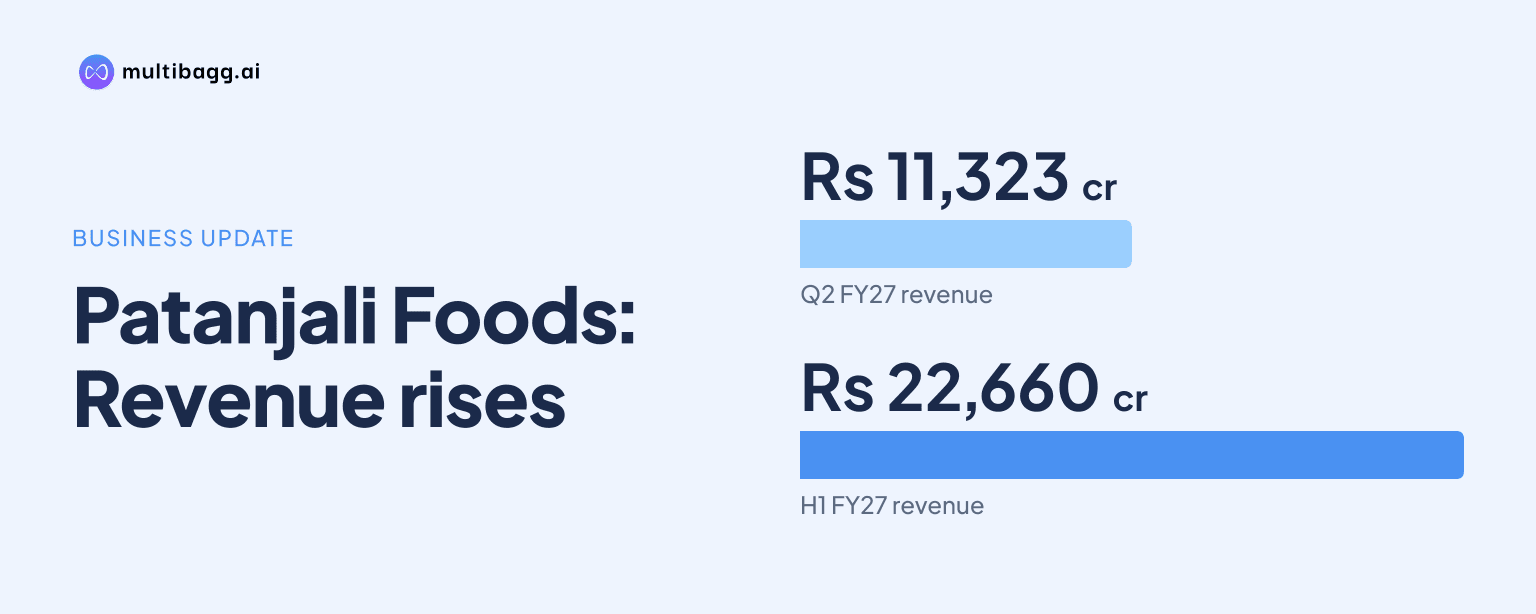
Patanjali Foods Limited reported Q2 FY27 revenue from operations of ₹11,323 crore, up 16% year-on-year, while first-half revenue reached a record ₹22,660 crore, up 22%. Operating EBITDA for the quarter was ₹426 crore, translating into a 3.76% margin, amid pressure on edible-oil profitability.
Know Patanjali Foods inside out
Results, valuation, peers and who's buying, in one view.
What did Patanjali Foods report for Q2 FY27?
Patanjali Foods reported standalone revenue from operations of ₹11,323 crore for the July-September 2026 quarter. The company said this represented year-on-year growth of about 16%. Operating EBITDA, excluding exceptional items, was ₹426 crore, with an operating EBITDA margin of 3.76%.
Profit before tax for the quarter was ₹409 crore, equivalent to a 3.59% margin. Separately reported quarterly financial coverage put standalone profit after tax at ₹419.80 crore, compared with ₹516.70 crore in the year-earlier period, a decline of 18.8%. The company also reported export revenue of ₹29 crore during the quarter.
The financial update was discussed on Patanjali Foods' earnings conference call held on November 14, 2026. Sanjeev Asthana, speaking for management, said the call and the stated operating metrics referred to standalone financials. This distinction is relevant because some published quarterly reports use consolidated figures and may show small differences in presentation.
Which businesses supported revenue growth?
Edible oils and FMCG supported Patanjali Foods' revenue growth during the quarter. The edible-oils business reported revenue of ₹8,532.25 crore, an increase of 22% year-on-year, while FMCG revenue rose marginally to ₹2,923.48 crore.
The figures underline the continued importance of edible oils in the company's overall revenue mix. The business is exposed to import prices and the availability of different oils. Management said India's import mix would continue to be guided by relative prices and availability across oils, indicating the importance of commodity-market conditions to sourcing decisions.
Patanjali Foods also cited a structural shift in India towards branded and packaged foods, particularly staples. This provides the context for the company's FMCG operations, although the quarter's disclosed segment data showed faster revenue growth in edible oils than in FMCG.
Why did operating margins remain under pressure?
Operating margins remained under pressure as inflation and input costs affected profitability, even as revenue increased. The Q2 operating EBITDA margin was 3.76%, and the edible-oil EBITDA margin was reported at 3%, lower than 5.22% in the preceding quarter.
This margin movement matters because the edible-oil business accounted for ₹8,532.25 crore of the company's Q2 revenue. A change in profitability in this segment can therefore materially influence group-level operating performance. Total expenses for the quarter were reported at ₹10,997.51 crore, up around 18% from ₹9,344.98 crore a year earlier.
The government reduced customs duties on most edible oils during September, according to an analyst question on the earnings call. Patanjali Foods did not provide a quantified financial impact from that change in the disclosed call material. The available information therefore supports an assessment of a commodity- and policy-sensitive operating environment, rather than a conclusion on the precise effect of the duty revision.
Got a follow-up? Ask IRIS
How did the first half of FY27 perform?
Patanjali Foods recorded its highest-ever first-half revenue from operations of ₹22,660 crore in H1 FY27, an increase of 22% year-on-year. Operating EBITDA for the six months was ₹969 crore, with an operating margin of 4.28%, while profit before tax was ₹862 crore at a 3.79% margin.
The H1 operating EBITDA margin was higher than the 3.76% reported for the second quarter alone. The half-year figures capture the company's performance across April to September, whereas the Q2 numbers reflect the July-September period and the margin pressure reported in edible oils.
Standalone profit after tax for H1 FY27 was ₹755.65 crore, compared with ₹697.10 crore in the prior-year half. The differing quarterly and half-year profit movements show why revenue growth alone does not provide a complete view of performance. Investors will also track segment margins, input costs and the relationship between revenue growth and earnings.
What does the update mean for investors and consumers?
For investors, the update shows that Patanjali Foods expanded revenue at a double-digit pace in both Q2 and H1, but faced a lower quarter-on-quarter edible-oil margin. The record H1 revenue establishes the scale of sales growth, while the disclosed margin figures point to costs and commodity conditions as key variables in assessing operating performance.
For consumers and the wider packaged-foods industry, the company linked demand conditions to the seasonal calendar. Management indicated that festive demand shifted into October and November, placing more of that consumption period in the third quarter rather than the July-September quarter. The company also described urban demand as resilient and rural demand as muted in the available earnings summary.
Patanjali Foods' comments on branded and packaged staples reflect a broader consumption trend, but no quantified outlook for its FMCG segment was given in the disclosed material. The company said its home and personal care business, referred to as HPC, is expected to deliver 15% growth in FY27. Maturing oil-palm plantations are also expected to support production and profitability over time, although no financial contribution was quantified.
Conclusion
Patanjali Foods delivered revenue growth of 16% in Q2 FY27 and 22% in the first half, taking H1 revenue to a record ₹22,660 crore. However, operating performance was shaped by input-cost pressure and a lower edible-oil margin, with Q2 EBITDA margin at 3.76% and edible-oil EBITDA margin reported at 3%.
The next results will show how festive demand in October and November translated into third-quarter sales and margins. Investors will also watch the company's stated FY27 expectation of 15% growth in HPC, developments in edible-oil prices and availability, and any quantified contribution from maturing oil-palm plantations.