










Patanjali Foods FMCG delivered 45% of Q2 FY27 segment EBITDA
Key highlights
- Patanjali Foods FMCG generated Rs 221 crore of EBITDA in Q2 FY27, equal to 45% of EBITDA excluding unallocable income.
- Patanjali Foods FMCG revenue was Rs 2,923 crore in Q2 FY27, or 26% of company revenue, at a 7.57% EBITDA margin.
- Patanjali Foods biscuit revenue rose 28% year on year to Rs 638 crore in Q2 FY27, with an 11.91% EBITDA margin.
- Patanjali Foods HPC revenue rose 11% year on year to Rs 714 crore in Q2 FY27, including Rs 378 crore from dental care.
powered by IRIS
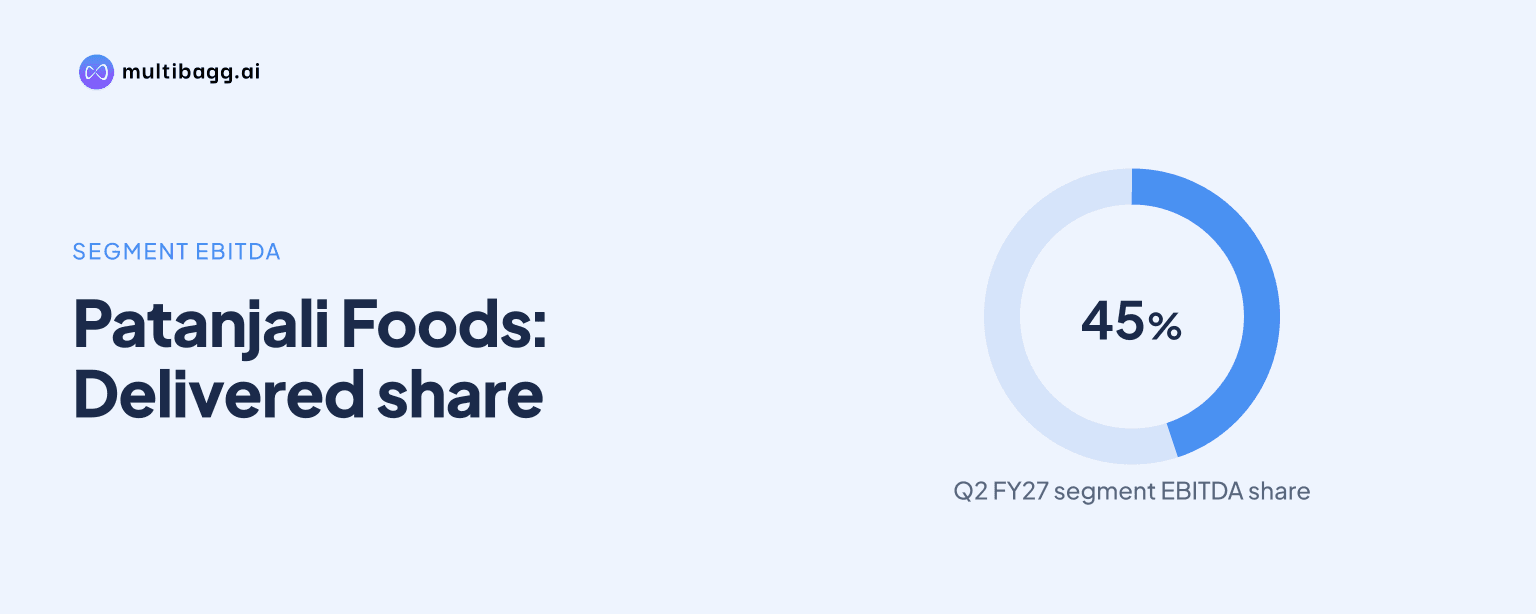
Patanjali Foods Limited’s fast-moving consumer goods (FMCG) business generated 45% of second-quarter fiscal year 2027 (Q2 FY27) segment earnings before interest, tax, depreciation and amortisation (EBITDA), excluding unallocable income, on 26% of revenue, with Rs 2,923 crore revenue, Rs 221 crore EBITDA and a 7.57% margin.
Know Patanjali Foods inside out
Results, valuation, peers and who's buying, in one view.
Why did Patanjali Foods FMCG contribute more EBITDA than revenue?
Patanjali Foods generated 45% of segment EBITDA from FMCG on 26% of revenue in Q2 FY27 because Rs 221 crore of EBITDA on Rs 2,923 crore of revenue produced a 7.57% margin. Management specified that the segment contribution percentages exclude unallocable income.
The contrast with edible oils is material. Edible oils delivered the company’s highest-ever quarterly revenue of Rs 8,532 crore, up 22% year on year, but reported a 3% EBITDA margin. FMCG’s revenue base was therefore much smaller, yet its margin was more than twice the edible-oil margin, explaining its larger share of allocated earnings.
At the company level, Patanjali Foods reported Rs 11,323 crore of revenue from operations in Q2 FY27, up 16% year on year, and operating EBITDA of Rs 426 crore at a 3.76% margin. The segment figures should not be directly added to reported operating EBITDA because management’s 45% FMCG contribution measure excludes unallocable income.
Which Patanjali Foods categories supported FMCG earnings?
Biscuits were the largest specifically quantified food growth driver, reaching a record Rs 638 crore in Q2 FY27, up 28% year on year, with an 11.91% EBITDA margin. First-half fiscal year 2027 (H1 FY27) biscuit revenue was Rs 1,198 crore, also up 28%, while its margin was 13.52%, above the overall FMCG margin of 7.01% for the half year.
Management said Doodh biscuits, described as a Rs 1,300 crore annual brand, anchored the portfolio. The company also cited consumer response to Almond & Raisins Cookies and newly introduced Atta, Fruit & Nut and Kaju Pista variants. In Q2, it entered namkeen with 10 products, including Bhujia, Aaloo Bhujia, khatta meetha and Crunchy Peanuts, in Rs 10, 200-gram and 400-gram packs.
Home and personal care (HPC) supplied Rs 714 crore of Q2 revenue, up 11% year on year, and Rs 1,343 crore in H1 FY27, up 13%. Dental care was its largest stated subcategory at Rs 378 crore in Q2 and Rs 704 crore in H1, while skincare contributed Rs 188 crore in Q2 and Rs 352 crore in the half year.
The category detail shows different growth mechanisms. Management said skincare moved from Rs 165 crore in Q1 FY27 to Rs 187 crore in Q2 almost entirely through volume growth, with limited price increases because of competition. Patanjali Foods also launched Dant Kanti Advance, Kesh Kanti Milk Protein, shampoo sachets, dishwash gel and toilet cleaner at affordable price points and in convenient formats.
Got a follow-up? Ask IRIS
How did Patanjali Foods FMCG performance change in H1 FY27?
Patanjali Foods’ FMCG revenue rose 15% year on year to Rs 5,861 crore in H1 FY27, while EBITDA reached Rs 411 crore and the margin was 7.01%. The segment represented 26% of first-half revenue and 36% of first-half EBITDA excluding unallocable income, compared with 45% of EBITDA in Q2 alone.
The increase from a 36% H1 EBITDA share to a 45% Q2 share coincided with the quarterly FMCG margin of 7.57% exceeding the 7.01% first-half margin. Biscuits contributed to the quarterly mix with Rs 638 crore of Q2 revenue and an 11.91% margin, while the 13.52% H1 margin includes the first quarter.
Not every food category expanded at the same pace. Textured soya products generated Rs 186 crore in Q2, with volume-led growth of 16% year on year, while ghee generated Rs 306 crore. Consumer staples generated Rs 839 crore in Q2 and Rs 1,949 crore in H1, a category management said was constrained by commodity costs and margin discipline.
During the earnings-call question session, management said it consciously reduced staples revenue from Rs 1,110 crore in Q1 FY27 to Rs 838 crore in Q2 rather than pursue volumes at inadequate margins. It said staples EBITDA improved from negative Rs 59 crore in Q1 to positive Rs 15.61 crore in Q2, indicating that the change was intended to improve profitability rather than maximise sales.
What pressures and plans could affect Patanjali Foods FMCG mix?
Patanjali Foods said wheat prices rose after the new crop arrival and ended September above the prior-year level, while sugar, milk procurement, soybean and crude-linked inputs also increased. Freight and logistics costs rose as well, and management expects commodity inflation to continue in the near term, managing it through sourcing, product mix and calibrated pricing.
The company did not present a universal price-led growth strategy. Management said biscuit growth was largely volume-led, with only a small price component in premium products, while skincare growth was also primarily volume-led. That approach is relevant as management described urban markets as relatively resilient but rural demand as relatively muted amid food inflation of 8.94% in October.
Management said festive demand gained momentum in October and November and expected the wedding season and winter months to support consumption. It is adapting to modern trade, e-commerce and quick commerce gaining share relative to traditional trade, while continuing to invest in general trade as the backbone of distribution.
For HPC, management said it expects to close FY27 with about 15% growth and expects the second half to be better than the first. It also said the oral-care market could grow about 10% to 12%, while noting increased competitor launches, pricing activity and product variants; Dant Kanti revenue rose from Rs 325 crore in Q1 to Rs 378 crore in Q2.
Conclusion
Patanjali Foods’ Q2 FY27 mix shows that FMCG had a larger role in earnings than its 26% sales share suggests: Rs 221 crore of EBITDA, a 7.57% margin and 45% of EBITDA excluding unallocable income. Biscuits at Rs 638 crore and HPC at Rs 714 crore underpinned the segment’s revenue base, while the company reduced staples volumes to move that business from negative Rs 59 crore EBITDA in Q1 to positive Rs 15.61 crore in Q2.
Next, investors can watch whether management’s expectation of about 15% FY27 HPC growth and a stronger second half materialises after the October-November festive pickup. The unresolved factor is commodity inflation across wheat, sugar, milk, soybean, crude-linked materials and freight, which management said it will address through pricing, sourcing and product-mix actions while seeking to preserve affordability.