










Patel Chem H1 FY27 revenue rises 25% while margins narrow
Key highlights
- Patel Chem reported H1 FY27 revenue of Rs 76.49 crore, up 25.07% year on year.
- Patel Chem’s H1 FY27 EBITDA rose 14.13% to Rs 10.14 crore, while PAT rose 2.28% to Rs 6.27 crore.
- Patel Chem said EBITDA and PAT margins moderated by 127 and 183 basis points in H1 FY27.
- Patel Chem increased Talod capacity from 720 metric tonnes to 4,500 metric tonnes through an approximately Rs 20 crore expansion.
powered by IRIS
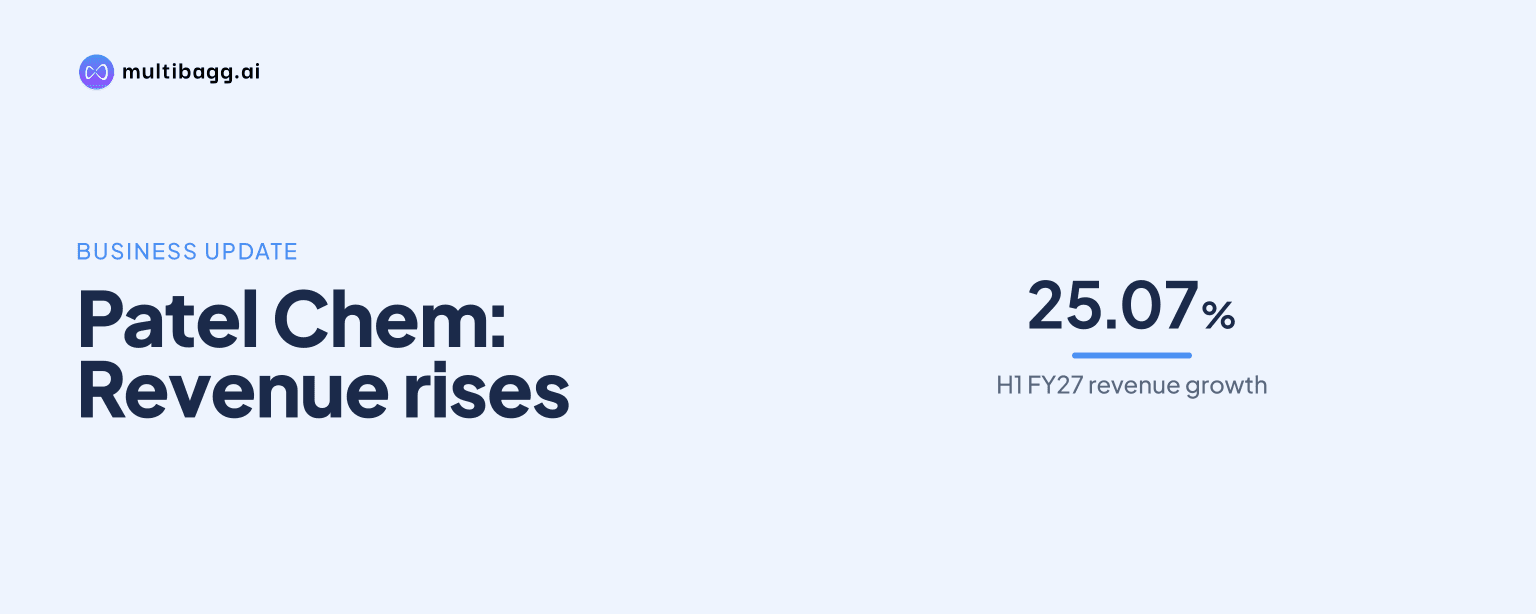
Patel Chem Specialities Limited reported H1 FY27 revenue of Rs 76.49 crore, up 25.07% year on year, but profit growth lagged sales growth: EBITDA rose 14.13% to Rs 10.14 crore and profit after tax increased 2.28% to Rs 6.27 crore, while the company said both margins moderated.
Know Patel Chem Specialities inside out
Results, valuation, peers and who's buying, in one view.
How did Patel Chem’s H1 FY27 earnings compare with H1 FY26?
Patel Chem increased revenue faster than EBITDA and profit after tax in the half year ended September 30, 2026. Revenue from operations rose from Rs 61.16 crore in H1 FY26 to Rs 76.49 crore in H1 FY27, an increase of Rs 15.33 crore. EBITDA, or earnings before interest, tax, depreciation and amortisation, increased by Rs 1.26 crore to Rs 10.14 crore, while profit after tax, or PAT, increased by Rs 0.14 crore to Rs 6.27 crore.
The comparison shows a widening gap between revenue growth and earnings growth in H1 FY27. Revenue grew 10.94 percentage points faster than EBITDA and 22.79 percentage points faster than PAT. The release does not provide a line-item breakdown of costs, finance charges, tax or product mix that would explain why the Rs 15.33 crore increase in revenue resulted in only a Rs 0.14 crore increase in PAT.
Why did Patel Chem’s margins decline despite higher sales?
Patel Chem said EBITDA margin moderated by 127 basis points and PAT margin by 183 basis points in H1 FY27, even as revenue increased 25.07%. A basis point is one-hundredth of a percentage point. The company reported the margin movements alongside EBITDA growth of 14.13% and PAT growth of 2.28%, confirming that earnings did not keep pace with the rise in revenue during the September 2026 half year.
Management did not quantify the operational or financial drivers of the margin decline in the H1 FY27 release. Managing Director Bhupesh Patel said management remained focused on improving operational efficiency and managing costs effectively, while also identifying working-capital efficiency and financial discipline as priorities. These are management plans rather than disclosed explanations for the 127-basis-point EBITDA-margin and 183-basis-point PAT-margin changes.
The difference matters because Patel Chem operates in cellulose-based excipients and speciality chemicals for pharmaceutical, food and beverage, cosmetics and industrial applications. Patel Chem serves domestic and international business-to-business customers and cites United States Drug Master File, Good Manufacturing Practice and ISO 9001:2015 certifications. However, the release gives no H1 FY27 segment revenue, export revenue, customer concentration or product-level pricing data to identify whether the margin change differed across applications or markets.
Got a follow-up? Ask IRIS
What does the Talod expansion add to Patel Chem’s operations?
Patel Chem completed its second expansion at the Talod facility, lifting annual production capacity from 720 metric tonnes to 4,500 metric tonnes. That is an increase of 3,780 metric tonnes, or more than six times the former capacity. The company said the project involved approximately Rs 20 crore of capital expenditure, financed through bank loans and internal accruals.
Trial batches have commenced at Talod, and commercial production is expected to begin shortly, according to the release dated November 6, 2026. Management described the additional capacity as intended to support growing market demand and faster delivery schedules. The statement does not state the date commercial production will start, expected utilisation levels, revenue potential, product mix, customer commitments or the timing of any margin contribution from the new capacity.
The operational expansion coincides with a rise in capital work-in-progress to Rs 21.86 crore as of September 30, 2026, from Rs 14.51 crore on March 31, 2026. That Rs 7.35 crore increase, or approximately 50.66%, indicates continuing capital deployment beyond the completed Talod expansion. Patel Chem explicitly said its financial results do not specify the commissioning timeline or additional manufacturing capacity associated with this capital work-in-progress.
How did Patel Chem’s funding and balance-sheet figures change?
Patel Chem’s shareholders’ funds increased to Rs 105.77 crore on September 30, 2026, from Rs 99.50 crore on March 31, 2026, an increase of approximately 6.30%. Cash and bank balances stood at Rs 31.04 crore at the September date, while total long-term and short-term borrowings were Rs 23.74 crore.
Borrowings increased by Rs 8.51 crore from Rs 15.23 crore at the end of FY26 to Rs 23.74 crore at September 30, 2026. The reported debt increase occurred alongside the approximate Rs 20 crore Talod expansion, which was funded by bank loans and internal accruals, and the Rs 7.35 crore rise in capital work-in-progress. The release does not separate the borrowings used for Talod from other financing or disclose interest costs.
The figures present both a larger equity base and a higher borrowing balance during H1 FY27. Shareholders’ funds rose by Rs 6.27 crore over the March 2026 balance, while borrowings rose by Rs 8.51 crore over the same comparison point. With cash and bank balances at Rs 31.04 crore, the release supplies the reported liquidity figure but does not provide operating cash flow, receivables, inventory, debt maturities or a working-capital cycle.
Conclusion
Patel Chem’s H1 FY27 result combined a 25.07% rise in revenue to Rs 76.49 crore with slower increases in EBITDA and PAT, resulting in margin moderation of 127 and 183 basis points respectively. At the same time, the company raised Talod capacity from 720 metric tonnes to 4,500 metric tonnes, increased shareholders’ funds to Rs 105.77 crore and carried Rs 23.74 crore of total borrowings at September 30, 2026.
The next disclosed operational marker is commercial production at the Talod expansion, where trial batches have already started and production is expected shortly. Investors can also watch whether the Rs 21.86 crore capital work-in-progress is commissioned, because Patel Chem has not disclosed its timeline or associated capacity, and whether management’s stated focus on costs, operational efficiency and working-capital efficiency coincides with changes in margins.