










Shri Techtex Limited H1 FY27 revenue rises 146% on pass-through
Key highlights
- Shri Techtex reported H1 FY27 revenue from operations of Rs 90.92 crore, up 146% year on year.
- H1 FY27 revenue exceeded Shri Techtex's FY26 full-year revenue of Rs 84.13 crore by Rs 6.79 crore.
- Shri Techtex's H1 FY27 net profit rose 130% to Rs 13.90 crore, while net profit margin declined to 15.3% from 16.3%.
- Materials and traded goods rose to 65.3% of H1 FY27 revenue from 52.8% in H1 FY26.
powered by IRIS
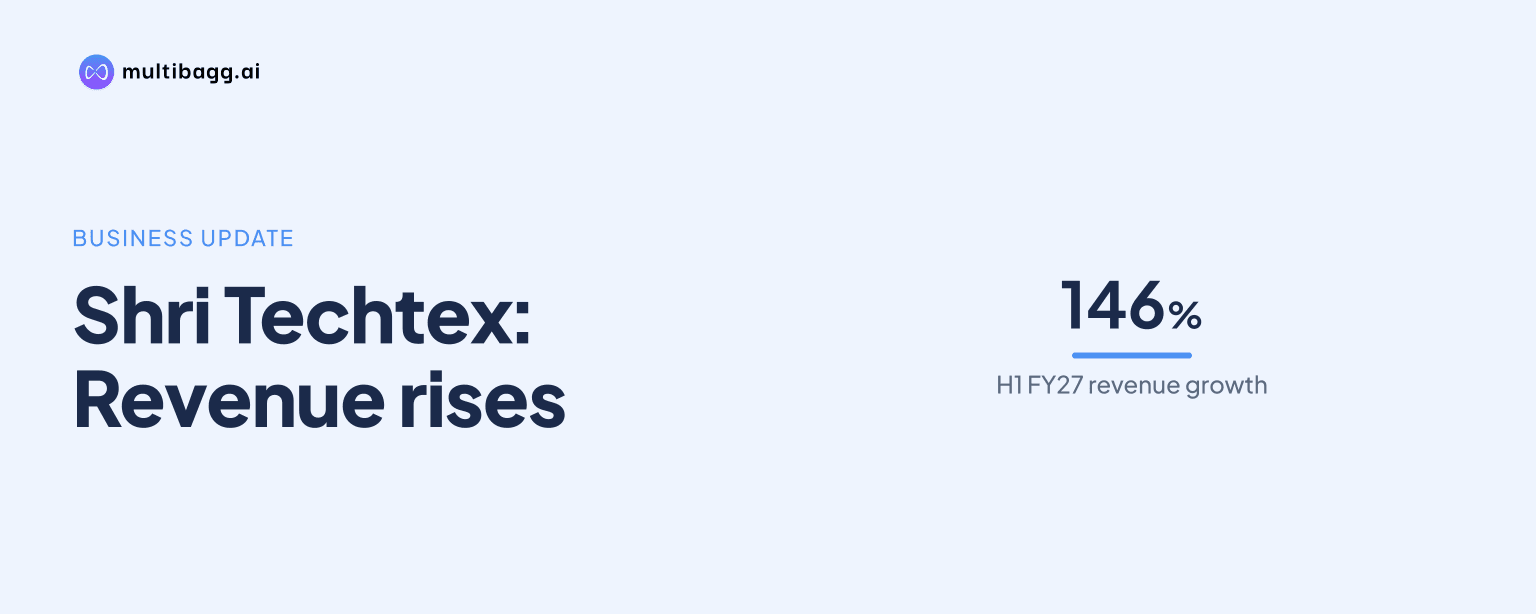
Shri Techtex Limited reported H1 FY27 revenue from operations of Rs 90.92 crore, up 146% year on year for the half ended 30 September 2026, as polymer prices rose by up to 50%, freight was passed through to selling prices and trading volumes increased. Net profit rose 130% to Rs 13.90 crore.
Know Shri Techtex inside out
Results, valuation, peers and who's buying, in one view.
What drove Shri Techtex's H1 FY27 revenue increase?
Shri Techtex's H1 FY27 sales increase was driven by higher polymer prices, freight recovery in customer prices and higher trading volumes. Revenue from operations reached Rs 90.92 crore in the half year ended 30 September 2026, compared with Rs 36.99 crore in H1 FY26 and Rs 47.14 crore in H2 FY26. That equated to growth of 146% year on year and 93% from the preceding half.
The presentation said polymer prices rose by up to 50% after the Iran conflict. It identifies polymer pricing, higher freight passed through in prices and strong trading volumes as the stated reasons for the Rs 53.93 crore year-on-year increase in revenue. H1 FY27 revenue also exceeded FY26 full-year revenue of Rs 84.13 crore by Rs 6.79 crore.
The comparison shows that H1 FY27 sales were not only above the year-earlier half but also nearly double H2 FY26 revenue. The source describes H2 FY26 as the balancing figure between FY26 audited results and H1 FY26 unaudited results, while both H1 periods are unaudited and subject to limited review.
Did Shri Techtex's profit rise with sales?
Shri Techtex's net profit rose 130% to Rs 13.90 crore in H1 FY27 from Rs 6.04 crore in H1 FY26, while it increased from Rs 13.25 crore in H2 FY26. Basic and diluted earnings per share were Rs 5.57, compared with Rs 2.42 a year earlier and Rs 5.31 in H2 FY26.
Earnings before interest, tax, depreciation and amortisation, or EBITDA, rose 105% year on year to Rs 20.29 crore from Rs 9.92 crore. Profit before tax increased 134% to Rs 19.00 crore from Rs 8.12 crore, and total tax rose 146% to Rs 5.10 crore from Rs 2.08 crore.
Shri Techtex attributed the profit increase to high trading volumes and the sale of lower-cost inventory purchased before polymer prices rose. Total income grew 130% to Rs 92.75 crore, including Rs 1.83 crore of other income, which was 45% below Rs 3.32 crore in H1 FY26.
Why did Shri Techtex's margins decline despite higher profit?
Shri Techtex's margin ratios declined because material and traded-goods costs took a larger share of revenue in H1 FY27. EBITDA margin was 22.3%, down from 26.8% in H1 FY26 and 39.8% in H2 FY26, while net profit margin was 15.3%, compared with 16.3% and 28.1%, respectively.
Materials and traded goods, net of inventory change, accounted for 65.3% of H1 FY27 revenue, up from 52.8% in H1 FY26. Gross margin consequently declined to 34.7% from 47.2%, a change the presentation links to polymer prices that were up by as much as 50% after the Iran conflict.
Other cost ratios fell as sales rose. Other expenses were 13.3% of revenue in H1 FY27 versus 26.5% in H1 FY26, employee costs were 1.1% versus 2.8%, and depreciation was 1.3% versus 3.2%. The presentation says low-cost stock sold at new prices and flat fixed costs contributed operating leverage.
Total expenses increased 129% to Rs 73.75 crore in H1 FY27 from Rs 32.19 crore in H1 FY26. The near-matched rates of total-income growth of 130% and expense growth of 129% are consistent with higher absolute profit alongside lower reported margin percentages.
Got a follow-up? Ask IRIS
How did Shri Techtex's financial costs and balance sheet change?
Shri Techtex reported finance costs of Rs 10 lakh in H1 FY27, down from Rs 61 lakh in H1 FY26. Finance costs represented 0.1% of revenue in H1 FY27, compared with 1.6% a year earlier; the source shows a negative Rs 11 lakh finance-cost figure for H2 FY26.
Depreciation was Rs 1.19 crore in H1 FY27, compared with Rs 1.20 crore in H1 FY26 and Rs 1.19 crore in H2 FY26. The company reported H1 FY27 EBITDA as profit before tax plus finance costs and depreciation, rather than presenting EBITDA as a separately audited line item.
Net worth was Rs 131.74 crore at 30 September 2026, up from Rs 117.84 crore at 31 March 2026. Shri Techtex said the 30 September figure comprised paid-up equity of Rs 24.95 crore and reserves of Rs 106.79 crore, while book value per share was Rs 52.80 against a face value of Rs 10.
What is Shri Techtex planning for H2 FY27?
Shri Techtex plans to keep passing through input-cost changes while polymer prices remain volatile, and management says revenue will ease if polymer prices normalise. The presentation provides no H2 FY27 revenue, profit or margin target, despite H1 FY27 revenue reaching Rs 90.92 crore.
Management has proposed adding manufacturing capacity, adding customers in domestic and export markets, and launching a new product. These are stated priorities rather than confirmed outcomes: the 6 November 2026 presentation does not disclose capacity size, project expenditure, commissioning date, customer target or product-launch timetable.
The reliance on pass-through is relevant because materials and traded goods accounted for 65.3% of H1 FY27 sales. Management also cautions that actual results may differ from forward-looking statements, leaving the durability of the H1 FY27 pricing and trading-volume effects unresolved.
Conclusion
Shri Techtex delivered Rs 90.92 crore of H1 FY27 revenue and Rs 13.90 crore of net profit, increases of 146% and 130%, respectively. The presentation attributes the sales result to polymer-price inflation, freight pass-through and trading volumes, while low-cost inventory supported profit. At the same time, gross margin fell 12.5 percentage points to 34.7% as material and traded-goods costs increased.
The next reporting period will show whether polymer prices remain volatile and whether pass-through continues, since management says revenue would ease if polymer prices normalise. Progress on the proposed manufacturing-capacity addition, domestic and export customer additions and a new product also warrants attention, as no investment amount, scale or timetable was disclosed as of 6 November 2026.